Budapest Post

Cum Deo pro Patria et Libertate
Budapest, Europe and world news

Nasa moon discovery: What does finding water on the moon actually mean?

Nasa moon discovery: What does finding water on the moon actually mean?

Water has been discovered on the sunlit surface of the Moon for the first time.

Researchers suggest that in some cases tiny patches of ice might exist in permanent shadows no bigger than a penny.

They explored phenomena on the moon called ‘cold traps’, which are shadowy regions of the surface that exist in a state of eternal darkness.

It is thought that many have gone without a single ray of sunlight for potentially billions of years.

But what are the implications of Nasa’s findings, and what do they mean for the future of lunar exploration?


So are there puddles of water on our celestial neighbour?
Nasa has discovered water at the moon’s southern hemisphere


In a word, no. Water molecules have been discovered in the Moon’s southern hemisphere, at the Clavius Crater.

The crater and its surrounding region radius is one of the largest craters visible from Earth.

The molecules, which are thought to be trapped in glass-like beads, are so spread apart that they do not form, ice, or liquid water.

What does the discovery mean for the future of space travel?
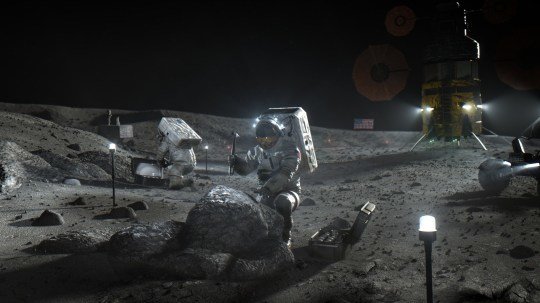
This illustration made available by NASA in April 2020 depicts Artemis astronauts on the Moon.


Water is extremely critical for deep space exploration. It can be turned into oxygen for astronauts to breathe and drink, and could be a fuel supply.

But water is heavy, and is therefore expensive to launch from the surface of the Earth.

“Anytime we don’t need to pack water for our trip, we have an opportunity to take other useful items with us.

“Being able to use water that is already at the moon would be a big help for us in exploring the Moon,” explained Jacob Bleacher, chief exploration scientist for Nasa’s human exploration and operations mission directorate.

However, it is not yet known whether the water detected on the sunlit surface of the is accessible for use as a resource.

But how did the scientists find the water?
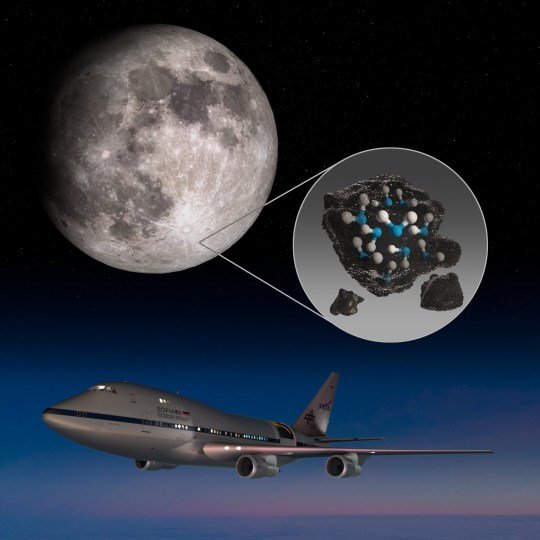
Nasa’s Stratospheric Observatory for Infrared Astronomy (SOFIA) – a modified 747 – found sunlit lunar water.


Nasa’s Stratospheric Observatory for Infrared Astronomy (Sofia) found the molecules.

Flying at altitudes of up to 45,000 feet, the modified Boeing 747SP jetliner with a 106-inch diameter telescope reaches above 99% of the water vapour in Earth’s atmosphere.

Using its Faint Object infraRed CAmera for the Sofia Telescope (Forcast), Sofia was able to pick up the specific wavelength unique to water molecules.

Is there enough water to keep the astronauts going, if they can get to it?
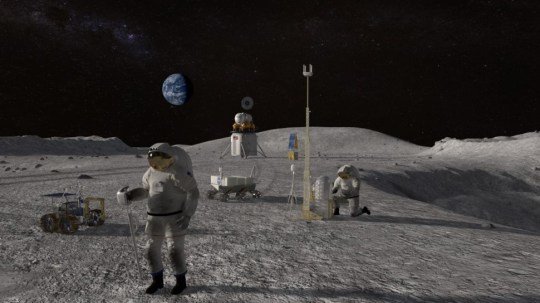
Nasa says water on the moon could be an in-situ resource for future astronauts


The data reveals water in concentrations of 100 to 412 parts per million – roughly equivalent to a 12-ounce bottle of water – trapped in a cubic metre of soil spread across the lunar surface.

The experts say it is an important discovery because now they know the water exists outside some of the dark craters that are really hard to get into and really hard to operate in.

If the water is in sunlight why doesn’t it evaporate?
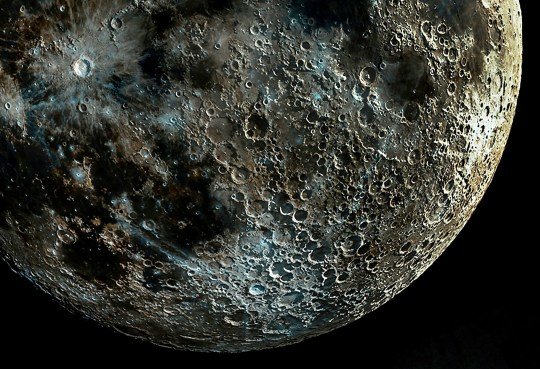
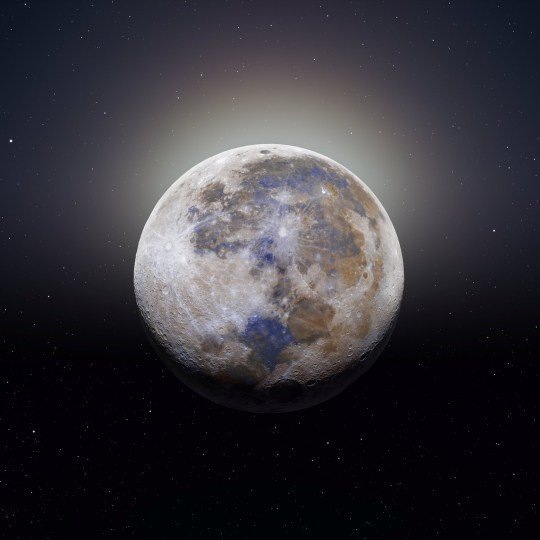
A composite picture of the moon made up from thousands of pictures taken at different moon phases to capture every detail of the craters


Daytime temperatures near the lunar equator reach 120C, while night time temperatures can be as low as minus 130C, and the Moon’s poles are even colder.

But Casey Honniball, the lead author who published the results from her graduate thesis work at the University of Hawaii at Manoa in Honolulu, explained the water is protected by the beads it is trapped in.

She said: “We believe the water is being stored inside the micro meteorite impact glasses beads, and these would shelter the water from being lost to space or migrating to the lunar pole.

“And this would mean that without a lunar atmosphere the water could stay on the surface of the Moon.

The water is locked in the glass beads, so it is able to withstand the harsh conditions of the Moon.

What happens next?
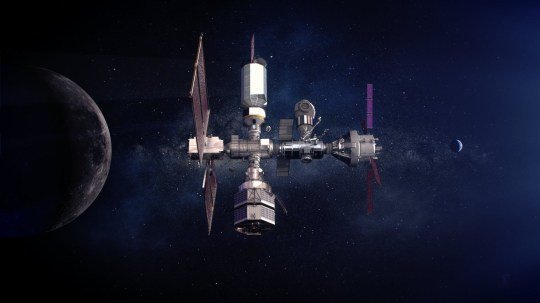

Nasa plans to put an orbiting space base called the Lunar Gateway up next to the moon


Sofia’s follow-up flights will look for water in additional sunlit locations and during different lunar phases to learn more about how the water is produced, stored, and moved across the Moon.

The data will add to the work of future moon missions, such as Nasa’s Volatiles Investigating Polar Exploration Rover (Viper), to create the first water resource maps of the Moon for future human space exploration.

AI Disclaimer: An advanced artificial intelligence (AI) system generated the content of this page on its own. This innovative technology conducts extensive research from a variety of reliable sources, performs rigorous fact-checking and verification, cleans up and balances biased or manipulated content, and presents a minimal factual summary that is just enough yet essential for you to function as an informed and educated citizen. Please keep in mind, however, that this system is an evolving technology, and as a result, the article may contain accidental inaccuracies or errors. We urge you to help us improve our site by reporting any inaccuracies you find using the "Contact Us" link at the bottom of this page. Your helpful feedback helps us improve our system and deliver more precise content. When you find an article of interest here, please look for the full and extensive coverage of this topic in traditional news sources, as they are written by professional journalists that we try to support, not replace. We appreciate your understanding and assistance.
Newsletter

Related Articles

0:00
0:00
Close
French Police Probe Suspected Weather-Data Tampering After Unusual Polymarket Bets on Paris Temperatures
CATL Unveils Revolutionary EV Battery Tech: 1000 km Range and 7-Minute Charging Ahead of Beijing Auto Show
Changi Airport: How Singapore Engineered the World’s Most Efficient Travel Experience
Power Dynamics: Apple’s Leadership Shakeup, Geopolitical Risks in the Strait of Hormuz, and Europe's Energy Strategy Amidst Global Challenges
Apple's Leadership Transition: Can New CEO John Ternus Navigate AI Challenges and Geopolitical Pressures?
Italy’s €100K Tax Gambit: Europe’s Soft Power Tax Haven
Budapest latest News Roundup
Travel on all public transport in the Australian state of Victoria will be free in May and then half price for the remainder of this year as the government ramps up help for consumers battling high fuel costs
News Roundup
Microsoft lost 2.5 millions users (French government) to Linux
Privacy Problems in Microsoft Windows OS
News roundup
Hungary's elections
Péter András Magyar and the Strategic Reset of Hungary
Hungary After the Landslide — A Strategic Reset in Europe
The CIA’s Secret Technology That Can Find You by Your Heartbeat Successfully Locates Downed Airman
Operation Europe: Trump Deploys Vance to Hungary to Save the EU
Asian Energy Security Tested as Strait of Hormuz Disruption Threatens Oil Supplies
Iran Sets Three Conditions for Ending Regional War as Diplomatic Efforts Intensify
Iran warns of $200 oil as forces target merchant ships in Gulf
Japan to Release 45 Days of Oil Reserves Amid Iran Conflict
Global Energy Agency Announces Record Release of 400 Million Barrels to Stabilize Oil Markets Amid Hormuz Disruption
U.S. and Israel Intensify Strikes on Iran as Conflict Expands to Lebanon and Gulf States
When the State Replaces the Parent: How Gender Policy Is Redefining Custody and Coercion
Larry Summers, the former U.S. Treasury Secretary, is resigning from Harvard University as fallout continues over his ties to Jeffrey Epstein.
U.S. stocks ended higher on Wednesday, with the Dow gaining about six-tenths of a percent, the S&P 500 adding eight-tenths of a percent, and the tech-heavy Nasdaq climbing roughly one-and-a-quarter percent.
Nvidia posted better than expected results for the January quarter on Wednesday and forecast current quarter revenue above market estimates.
Ukrainian government intensifies pressure on Hungary and Slovakia with oil blockade
Britain’s Channel Crisis: Paying Billions While the Boats Keep Coming
Woman Receives Gift Card for Christmas – Discovers It Is ‘Worth’ 63,000,000,000,000,000 Pounds
United Nations Calls for Global Action Against Disinformation and Hate Speech Online
Tucker Carlson warns of an inevitable clash in Western societies over mass migration
OpenAI CEO Sam Altman praises the rapid progress of Chinese tech companies.
Poland's President Karol Nawrocki ENDS support for Ukrainian citizens:
Italy's PM Giorgia Meloni highlights record employment and economic growth
Chancellor Friedrich Merz Re-elected as CDU Leader, Opposes AfD Influence
Trump Directs Government to Release UFO and Alien Information
Trump Signs Global 10% Tariffs on Imports
UK Government Considers Law to Remove Prince Andrew from Royal Line of Succession
Two teens arrested in France for alleged terror plot.
US Supreme Court Voids Trump’s Emergency Tariff Plan, Reshaping Trade Power and Fiscal Risk
Greek Prime Minister Kyriakos Mitsotakis advocates for a ban on minors using social media.
Meanwhile in Time Square, NYC One of the most famous landmarks
Jensen Huang just told the story of how Elon Musk became NVIDIA’s very first customer for their powerful AI supercomputer
Former British Prince Andrew Arrested on Suspicion of Misconduct in Public Office
Former President Yoon Suk Yeol Sentenced to Life in Prison for Abuse of Authority
Unitree Robotics founder Wang Xingxing showcases future robot deployment during Spring Festival Gala.
German Chancellor Friedrich Merz calls for real name use on social media.
Italian Police Arrest Man After Alleged Attempt to Abduct Toddler at Bergamo Supermarket, Child Hospitalised With Fractured Femur
British Tourist Arrested at Hong Kong Airport After Meltdown and Vandalism
×