Budapest Post

Cum Deo pro Patria et Libertate
Budapest, Europe and world news

Europe's cocaine busts are reaching record heights

Europe's cocaine busts are reaching record heights

German, Belgian, and Dutch police seized 23 tons of cocaine in late February, the largest haul of the drug in the EU ever.

While the seizure of 23 tons of cocaine by German, Belgian and Dutch police — the largest-ever haul of the drug in the European Union — was noteworthy, it serves as merely the latest proof of how Europe has become the epicenter of the global cocaine trade.

In mid-February, German police discovered 16 tons of cocaine hidden in containers at the port of Hamburg, while their Belgian counterparts seized 7.2 tons of the drug in Antwerp soon after. Both forces acted after a tip-off from the Netherlands, where both shipments were bound.

On February 24, Dutch authorities raided two properties in and around Rotterdam and arrested the owner of an import company. "The seized mega-shipments to the Netherlands together form an absolute record. Never before has so much cocaine been intercepted at once," Dutch police said in a statement.

The drugs in Hamburg were hidden in a container of wooden blocks, which had come from Paraguay. The ones in Antwerp were packed into over 1,700 tin cans of wall filler and had left from Panama. The Dutch authorities also announced that the company receiving these two shipments had ordered 11 containers filled with mackerel, pineapple, squid and wood from Panama, but it is not yet clear whether these also contained drugs.

"We are estimating a street sales value of between 1.5 billion euros and 3.5 billion euros (between $1.8 billion $4.2 billion) for the 16 tons [seized in Germany]," Hamburg customs official Rene Matschke told AFP.

This seizure makes up almost a quarter of the 102 tons of cocaine seized in or bound for Europe in 2020, which was already an annual record, according to UN figures cited by the BBC.

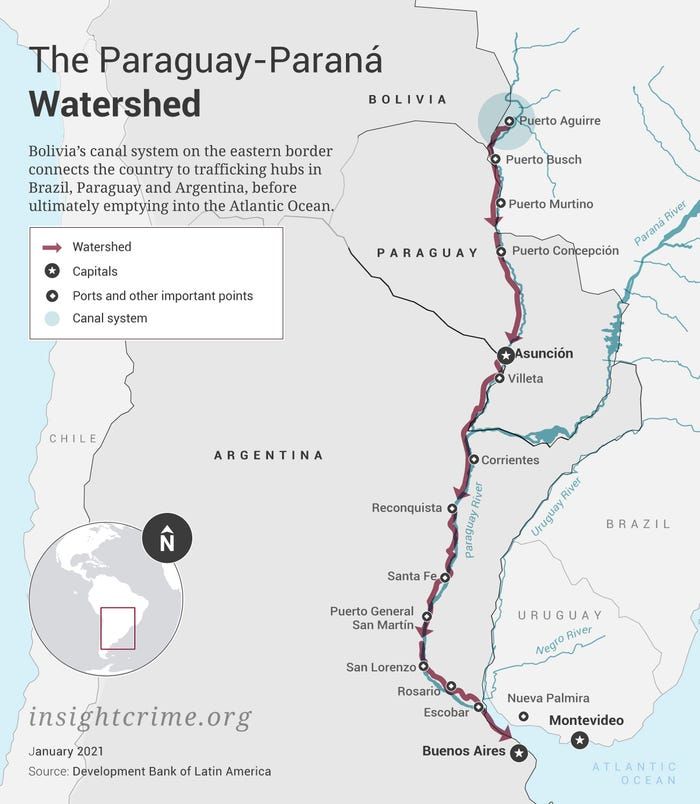
And the fact that the drugs caught in Germany had originated in Paraguay seems to confer that that country's waterways with Bolivia are now a crucial drug transportation route on the way to ports on the Atlantic, as reported by InSight Crime earlier this year.

InSight Crime analysis


While this week's haul dwarfs any previous individual operation, it comes as the latest in a rapidly escalating series of seizures.

In October 2020, 11.5 tons of cocaine were found at Antwerp in a container of scrap metal from Guyana. Other notable finds have happened regularly at Hamburg, Rotterdam and a string of smaller European ports.
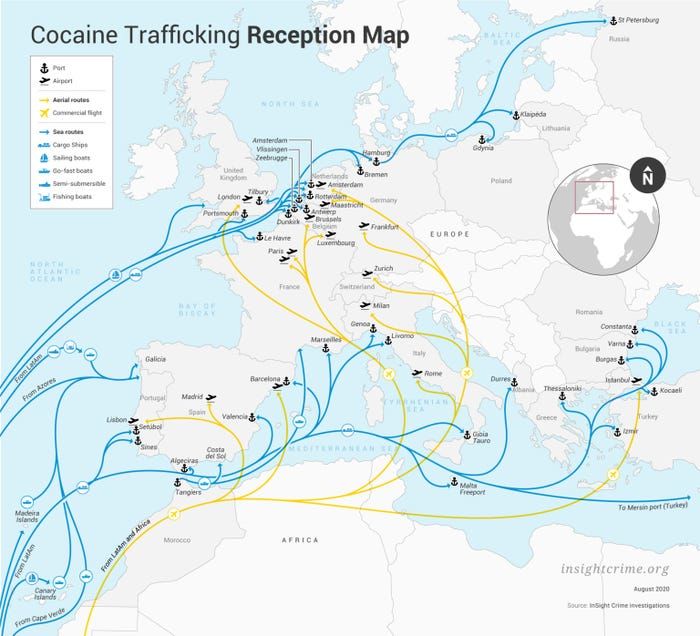

Europe is increasingly replacing the United States as the epicenter of the cocaine trade, given the sky-high prices the drug fetches there and the number of transportation options available to traffickers.

And with the increase in cocaine production in Colombia, Peru and Bolivia , as well as strong transportation links through Venezuela, Central America, Paraguay and Brazil, it may be just a matter of time before this new record is beaten.

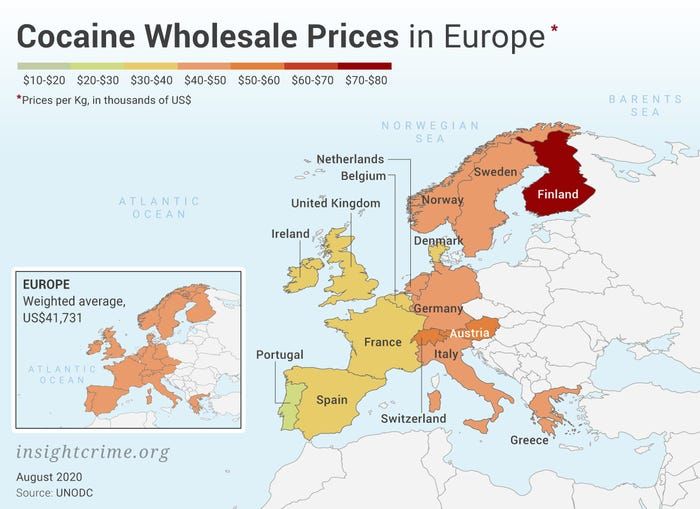
As InSight Crime revealed in its recent investigation, "Cocaine Pipeline to Europe," the switch to the European cocaine market is a no-brainer for Colombian drug traffickers, despite the distance and difficulty of access.

UNODC statistics showed that in 2017, the wholesale price for a kilogram of cocaine in Europe stood at $41,731, as opposed to $28,000 in the United States.

It is also unclear what could be done to slow down this tsunami. The ports of Hamburg, Rotterdam and Antwerp are getting savvier at halting the entry of cocaine but it is uncertain how much is getting through their nets. Smaller ports do not share that experience.

Bob van den Berghe, regional coordinator for the United Nations' Container Control Programme (CCP), gave the example of the port of Zeebrugge in Belgium that has seen a recent rise in drug shipments coming from Paramaribo in Suriname.

"In 2021, there was a seizure of around 160 kilograms at the port of Paramaribo destined for Zeebrugge. Last year, they found 730 kilograms of cocaine in the roof of a container in Paramaribo, also bound for Zeebrugge. There were other seizures in 2018 and 2019," he said.

"We don't necessarily consider Zeebrugge a risky port yet but Belgian authorities are more focused on this port," explained van den Berghe.

Similarly, while initiatives such as the UN's Container Control Programme are training port authorities in Latin America how to detect suspicious containers, new exit points are regularly being tested.

In December, the United Nations Office on Drugs and Crime (UNODC) reported that canals connecting Bolivia's eastern border to the Paraguay River in Brazil were now important for the Atlantic drug route.

"It's incredible to find those numbers in Paraguay. In October 2020, 3.5 tons of cocaine were seized in Paraguay, having come from Bolivia and on their way to Antwerp," said van den Berghe, adding that the CCP has helped to create port control units (PCUs) and training schemes in most major ports in Latin America, the Caribbean and Europe.

"It exposes the airspace between Bolivia and Paraguay, as well as the waterways and the Paraná River, as important routes to the Atlantic. The CCP would like to establish a PCU at inland ports along and near the Paraná and Paraguay rivers, such as Puerto Busch," van den Berghe told InSight Crime.

AI Disclaimer: An advanced artificial intelligence (AI) system generated the content of this page on its own. This innovative technology conducts extensive research from a variety of reliable sources, performs rigorous fact-checking and verification, cleans up and balances biased or manipulated content, and presents a minimal factual summary that is just enough yet essential for you to function as an informed and educated citizen. Please keep in mind, however, that this system is an evolving technology, and as a result, the article may contain accidental inaccuracies or errors. We urge you to help us improve our site by reporting any inaccuracies you find using the "Contact Us" link at the bottom of this page. Your helpful feedback helps us improve our system and deliver more precise content. When you find an article of interest here, please look for the full and extensive coverage of this topic in traditional news sources, as they are written by professional journalists that we try to support, not replace. We appreciate your understanding and assistance.
Newsletter

Related Articles

0:00
0:00
Close
Russia’s A7 Builds a State-Linked Payments Network Beyond Western Sanctions
AI’s Next Bottleneck Is Power, Not Just Nvidia Chips
Meta Raises AI Spending Target to as Much as $145bn Despite Pressure Over Returns
Danube Drought Exposes Nazi Wrecks and Pushes Central Europe’s Power System to the Brink
Joe Biden’s Cancer Has Spread Beyond His Bones, Hunter Biden Says
Why 2027 Could Be a Strong Year for Stocks—and Why the Forecast Is Fragile
Why Markets May Look Quiet in August After Big Tech Earnings
UK Drought Cuts Harvests and Raises Food-Security Fears
UFO: Pentagon Releases Video of Unidentified Object Tracked Over Middle East
Ukraine Tells Senate Republicans Its Drone War Offers a Blueprint for America
Weight-Loss Drug Boom Tests the Limits of Prescription Advertising Rules
Senate Scrutinises AI-Driven Personalised Pricing
Spain Seeks Mainland Transfers for 1,100 Children Stranded in Ceuta
Spain and Morocco Trade Blame After 72,000 Migrants Enter Ceuta
AI Is Remaking the US Economy, From GDP Growth to iPhone Prices
Europe’s Heat and Drought Are Now Disrupting Power, Shipping and Tourism
Europe’s Drying Rivers Trigger Power Cuts, Factory Shutdowns and Wildfire Emergencies
Record-Low Danube Forces Nuclear Cuts and Emergency Power Curbs
Danube Drought Forces Hungary’s Paks Nuclear Plant Into Full Shutdown
Ceuta Death Toll Rises as Spain and Europe Clash Over Border Response
Valued at $109 Million: F-35B Fighter Jet Crashes in Southern California
Record-Low Danube Exposes Probable Mammoth Remains in Bulgaria
US Says It Has Carried Out Heavy Strikes on Iran After Attempted Attacks on Its Forces
The AI User Nightmare: Private Claude Conversations Leaked to the Internet
Over 24 Hours in the Air: Qantas Airbus Completes Record-Breaking Test Flight
Massive Wildfires Ravage Southern Europe: Fatalities in Greece and Evacuations Across France, Spain, and Turkey
Nvidia Reportedly Takes Vast Texas Data-Centre Lease to Underwrite AI Expansion
FIFA’s Private-Investment Plan for World Cup Rights Draws European Revolt
Apple Briefly Crosses Five Trillion Dollar Valuation as Investors Retreat From AI Bets
Fresh Heatwave Threatens to Rekindle France’s Historic Wildfire Crisis
Following OpenAI's Cyberattack: 'Most Companies Still Do Not Understand What Is Coming'
OpenAI Sued After ChatGPT Allegedly Discouraged Emergency Care Before Near-Fatal Embolism
Miliband Sets Climate and International Law at Centre of UK Diplomacy
Czech Central Bank Governor Rejects Early Euro Entry and Rate-Cut Pressure
Trump Readies New Tariffs as Temporary Global Levy Nears Expiry
Vivienne Westwood Casts Cicciolina, 74, in Its New Autumn Campaign
Dejavu: Germany’s Military Expansion Reshapes Europe’s Strategic Balance With France
Morgan Stanley Builds a Wall Street Lead in AI Infrastructure Finance
High Prices Push Coffee Drinkers Toward Whole Beans and Home Brewing
Trump Draws Boos and Podium Scrutiny at Spain’s World Cup Triumph
Brilliant move: Péter Magyar Moves to Nominate Chess Grandmaster Judit Polgár as Hungary’s President
Spain Defeats Argentina in Extra Time to Win Second World Cup
Current AI Seeks to Build an Open Global AI Infrastructure Outside Big Tech Control
Germany’s Economic Malaise Reopens the Sunday Shopping Debate
Proposed U.S.-Saudi Nuclear Pact Could Permit Limited Uranium Enrichment Under International Safeguards
Netherlands Declares Water Shortage Emergency After Drought Pushes Rivers to Historic Lows
Why Kentucky Fried Chicken Became KFC—and Why the False Explanations Persist
Ukrainian Drones Strike Wildberries Warehouses Deep Inside Russia
Reported CIA Mission Helped Clear the UAE’s Path to Advanced US AI Chips
Artificial Intelligence Capital Fuels Markets While Governments and Regulators Face Mounting Strategic Tests
×