Budapest Post

Cum Deo pro Patria et Libertate
Budapest, Europe and world news

Why do migrants leave France and try to cross the English Channel?

Why do migrants leave France and try to cross the English Channel?

Efforts are under way to identify 27 people who drowned crossing the English Channel.

Their deaths have raised questions about why so many people are attempting the journey despite the dangerous conditions.

Why do migrants cross the Channel in boats?


For years, people smugglers have sent people to the UK in lorries. There have also been tragedies on these routes, including the 39 Vietnamese people found dead in a refrigerated lorry in 2019.

But security at the Port of Calais in France - where UK border controls are - has been tightened.

This means more attempts are being made to send people by boat, according to Tony Smith, former director general of UK Border Force.

He says Covid had also had a role, as fewer lorries have been travelling to the UK: "Human smugglers have changed their tactics and they've now taken to this relatively new phenomenon of putting people into small boats and bringing them across in that way."

Why do migrants leave France for the UK?


In the few studies that exist, family ties have been identified as the main reason migrants wish to travel from France to the UK.

In a survey of 402 people at the former Calais "Jungle" camp, researchers from the International Health journal found only 12% wanted to remain in France, while 82% planned to go to England.

Of those that wanted to travel to England more than half (52%), said they already had a family member there.

"They have a connection to the UK, they speak some English, they have family, they have friends and people in their networks. They want to come and stay and rebuild their lives," says Enver Solomon, chief executive of the Refugee Council.
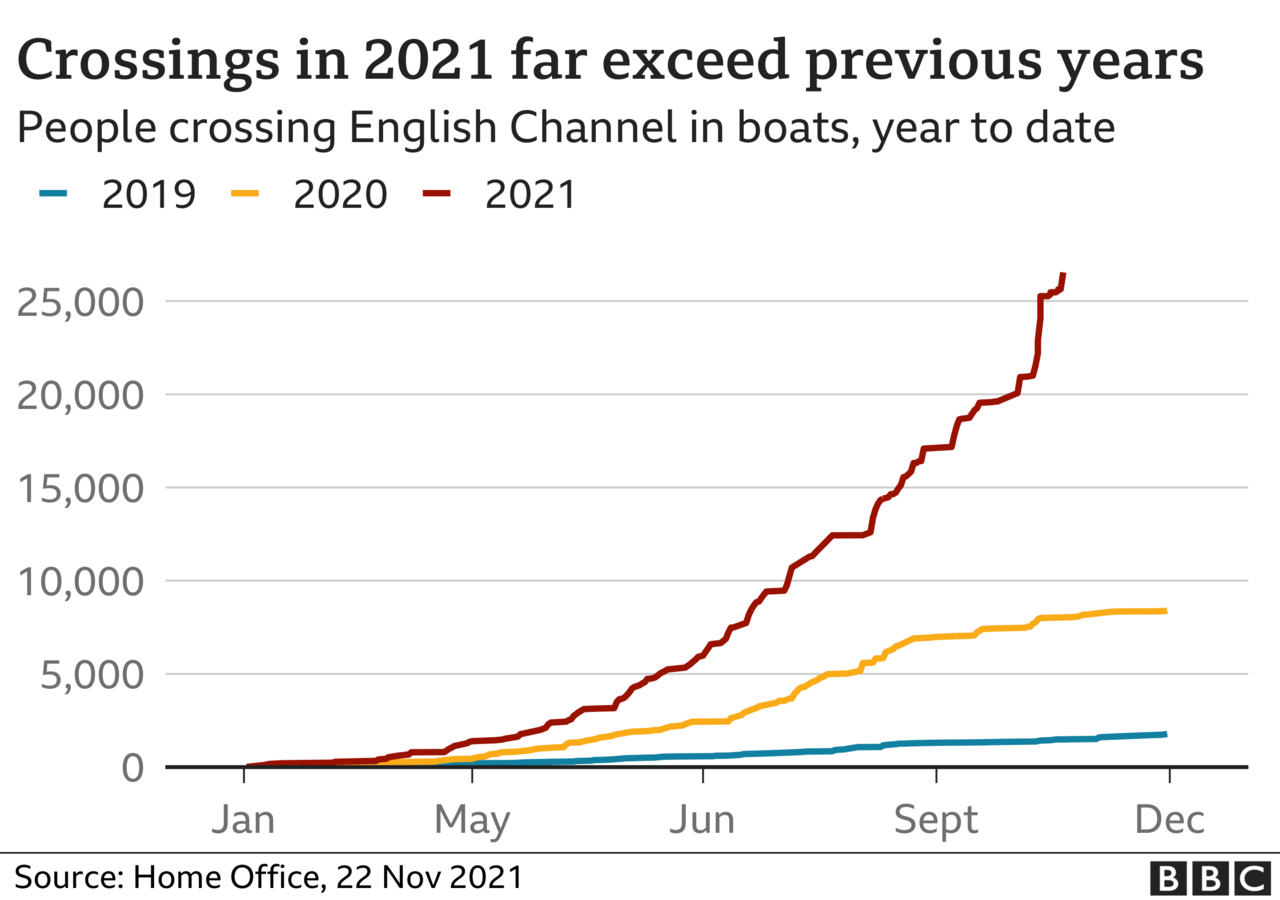

Do migrants travel for jobs and money?


While there aren't reliable surveys to support it, it's been suggested Britain's jobs market often attracts migrants - a claim supported by the French Interior Minister Gerald Darmanin.

However, Marley Morris, an immigration expert at the IPPR think tank, disagrees. He says the UK has introduced policies that make it much harder to work illegally.

"These arguments were put forward 20 years ago, when people said the UK system was too generous. The UK responded by tightening up the rules.

"While we don't have ID cards, the policies introduced make it much harder to work illegally, [and] employers are fined for employing someone for not having the right to work."

As well as language and family ties, some Calais-based migrants told the BBC they wanted to come to the UK due to historic links with their own country.

Some also expressed unhappiness at the way they are being treated in France, which can lead to more people attempting to make the crossing according to Rob McNeil, deputy director of the Migration Observatory at Oxford University.

"Imagine you are being poorly treated in the country you are in. Your presumption is that the immediate environment is unpleasant and you want to get away from that", he says.
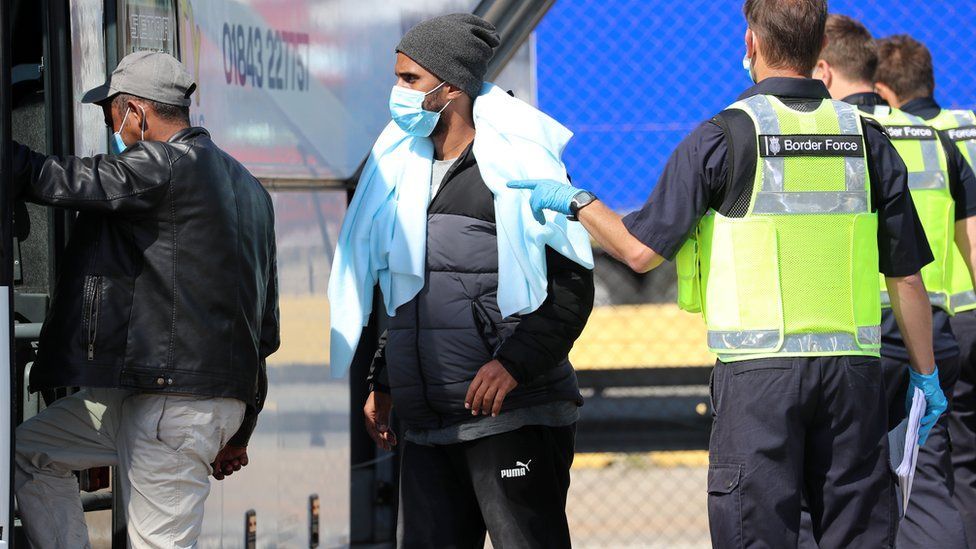
Border Force officers escort a group of men on to a waiting bus


It's unlikely that migrants choose to come to the UK because they feel they less chance of being sent back compared to other European countries adds Mr McNeil.

"One thing we know is that the data suggests that people travelling to any country have very little knowledge of the laws and practices of enforcing immigration," he says.

Despite the dangers, some say they have already taken significant risks to get as far as Calais and are willing to take further ones to get to the UK. For example, the International Health journal study also found that two-thirds of people had experienced at least one act of violence during their journey or in Calais.

How many migrants travel to the UK?
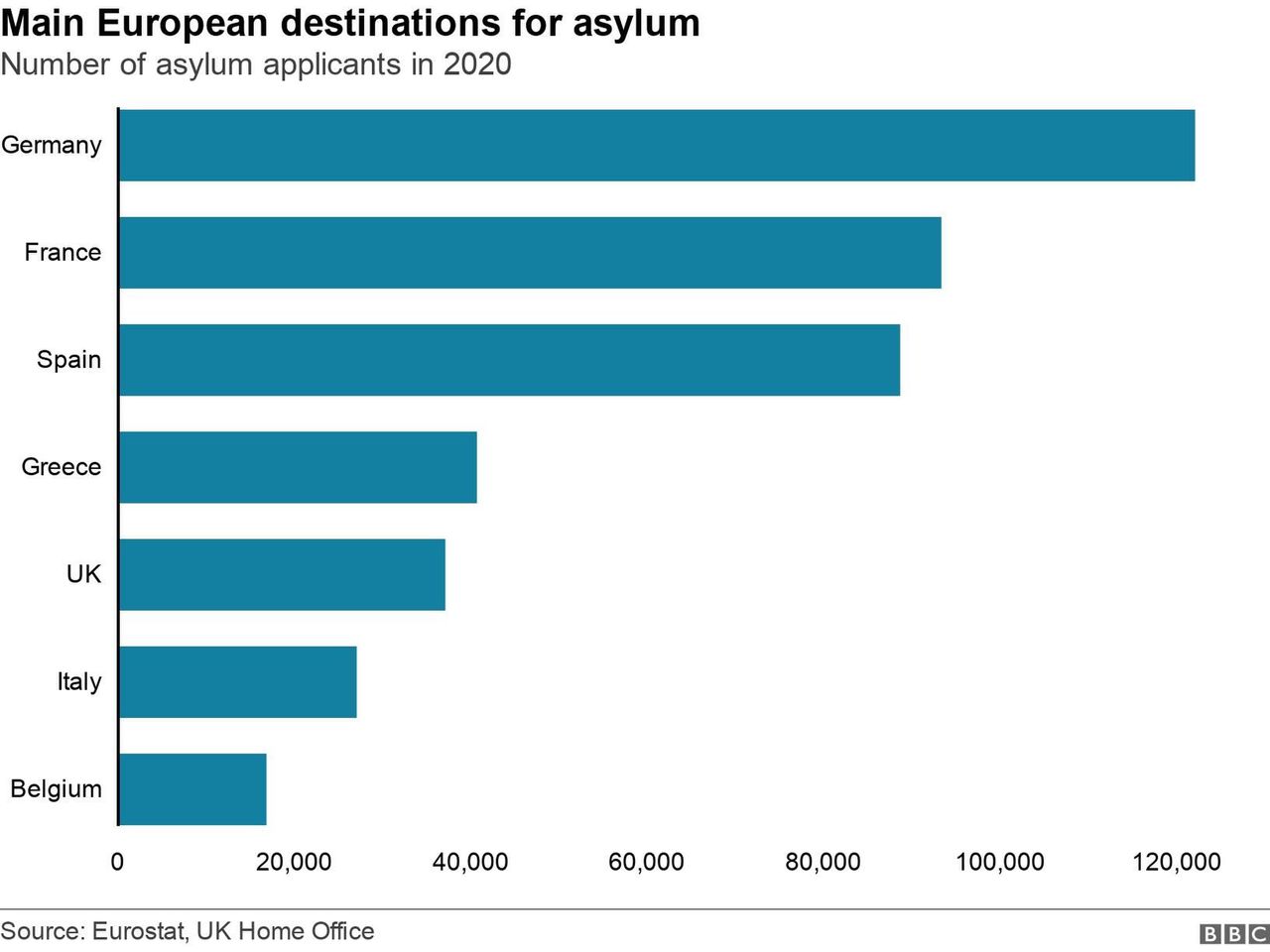
Many migrants already choose to make an asylum claim in the first country they arrive in - such as Greece, Turkey or Italy - and only a minority choose to travel on to the UK.

Last year, Germany had the highest number of asylum applicants the EU (122,015 applicants), while France had 93,475 applicants.

In the same period the UK received the 5th largest number of applicants (36,041) when compared with countries in the EU (around 7% of the total). This represents the 17th largest intake when measured per head of population, according to UN Refugee Agency.

AI Disclaimer: An advanced artificial intelligence (AI) system generated the content of this page on its own. This innovative technology conducts extensive research from a variety of reliable sources, performs rigorous fact-checking and verification, cleans up and balances biased or manipulated content, and presents a minimal factual summary that is just enough yet essential for you to function as an informed and educated citizen. Please keep in mind, however, that this system is an evolving technology, and as a result, the article may contain accidental inaccuracies or errors. We urge you to help us improve our site by reporting any inaccuracies you find using the "Contact Us" link at the bottom of this page. Your helpful feedback helps us improve our system and deliver more precise content. When you find an article of interest here, please look for the full and extensive coverage of this topic in traditional news sources, as they are written by professional journalists that we try to support, not replace. We appreciate your understanding and assistance.
Newsletter

Related Articles

0:00
0:00
Close
Trump Administration Pressures Banks to Restrict Financial Access for Undocumented Immigrants
Passenger Bound for Germany Refused to Sit Beside a Woman on a Plane — Then Slapped a Flight Attendant
Ukraine’s Leadership Rift Spills Into the Streets as Protesters Target Army Chief
Ukrainian Drone Barrage Kills Eight and Strikes Russian Logistics Network
The Ten World Cup Finals That Defined Football History
Smartphones Are Getting More Expensive, Sales Are Collapsing, and Even Apple Admits: "Prices Will Rise"
The Monaco Bombing Has Become a Test of Ukraine’s Intelligence Accountability
Leadership Change and Strategic Rivalry Redraw the Political Map
The AI Race Enters Its Infrastructure Era
Britain Nationalises British Steel to Protect Scunthorpe Production and Strategic Supply
French National Assembly Overrides Senate to Pass Historic Assisted-Dying Legislation
Spanish Prime Minister's Wife Ordered to Stand Trial as Corruption Probes Encircle Governing Party
Zelensky Faces Kyiv Protests Over Ousting of Dynamic Ukrainian Defense Minister
Thomas Tuchel Faces Fierce Backlash After Tactical Retreat Costs England World Cup Final Berth
A Quiet Bastille Day: France Grapples with World Cup Heartbreak and Leftover Fireworks
Spain in Ecstasy: "We Feel Unbeatable, We Taught the Whole World a Lesson"
Spain and UK Dismantle Gibraltar Border Following Landmark Schengen Integration Treaty
Hungary's "Puppet" President to Be Ousted, Orbán Fumes: "Democracy Is Dead"
Forget Tinder: The Surprising Platform Where People Find Love
Harvard Astrophysicist to Lead U.S. Scientific Advisory on Unidentified Aerial Phenomena
Emergency Sirens Activated Across Bahrain as Interior Ministry Issues Shelter Directives
World Cup Visitors Turn American Big-Box Stores Into Souvenir Stops
Netflix Weighs Always-On Channels, Bundles and Short-Form Video
Passenger Is Pulled Partly Outside Ryanair Jet After Window Fails Mid-Flight
The AI Invoice Shock: Layoffs Didn't Save Managers Money — They Cost Them More
Concern: Sexually Transmitted Bacterium Among Men Develops Antibiotic Resistance
Passenger Partially Pulled Out of Ryanair Jet After Cabin Window Fails Mid-Flight
Severe Heatwave Drives Dangerous Ground-Level Ozone Pollution Across Two Thirds of European Union
The Physical and Electronic Barriers Disrupting Domestic Wireless Networks
France and Morocco Open World Cup Quarter-Finals as Collina Defends Refereeing
Tech Pulse: The Future of AI and Screen Culture
Global News Briefing: Escalating Geopolitical Tensions and Corporate Shakeups
Global News Brief: Escalating Conflicts, Public Health Crises, and World Cup Drama
French Court Allows Le Pen to Run for Presidency, but with an Electronic Tag: "I Will Appeal, and I Will Run"
$1.4 Trillion: The Lawsuit That Could Crush Meta
Europe's Growing Struggle with Extreme Heat and Air Conditioning
Anthropic Reengineers Agentic Architecture to Shift Autonomous Workplace Automation to the Cloud
Logic Flaw in Windows 11 Permission Architecture Silently Consumes Hundreds of Gigabytes of Local Storage
Apple Advances Late-Stage Operating Systems with Fourth Beta Deployments
Global Crisis Alert: Escalating Middle East Tensions and UK Political Upheaval
Japanese Technology Firm Fujitsu Launches Advanced Artificial Intelligence Tool for Corporate Disclosures
South Africa Officially Launches Nationwide Campaign for Highly Contested Local Government Elections
United Kingdom Commits Additional Funding for Unexploded Ordnance Clearance in Laos
Singapore Announces Stringent New Greenhouse Gas Regulations for Commercial Cooling Systems
Cambodia and Thailand Hold High-Level Border Security Talks at United Nations Headquarters
Myanmar Military Government and China Sign Major Agreement to Upgrade Media and Cultural Cooperation
Knife Attack at Swiss Train Station Leaves Three Injured in Suspected Act of Domestic Terrorism
Transnational Extortion Gang Threatens Canadian Police With Army of One Thousand Armed Operatives
Australia Imposes Forty-Two-Day Quarantine on Cruise Ship Passengers Following Deadly Hantavirus Outbreak
International Monetary Fund Unlocks Seven Hundred Million United States Dollars for Sri Lanka Following Economic Reforms
×