
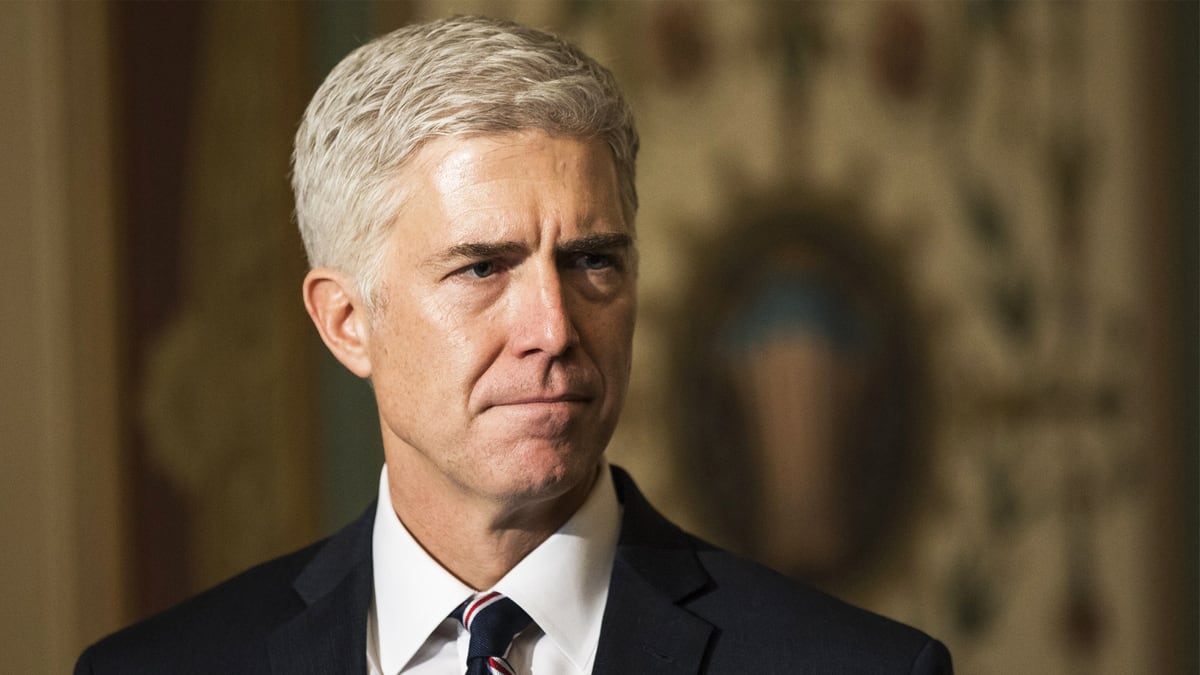

Neil Gorsuch Might Be the Supreme Court’s LGBTQ Rights Savior. But He May Not.
The most important LGBTQ equality cases since same-sex marriage may be a toss-up. And the swing vote-surprisingly, based on today’s oral arguments-may be Justice Neil Gorsuch.
At issue in today’s three cases is whether the federal anti-discrimination law, known as Title VII, protects gay and trans workers from being fired because of who they are. That law does not mention sexual orientation or gender identity. But, LGBTQ advocates argue, when someone is fired for being LGBTQ, that is covered under Title VII’s ban on discrimination “because of sex.”
After all, they argued today, if a man is fired from his job for disclosing that he is attracted to other men-as happened to Gerald Bostock, one of the plaintiffs today-that is sex discrimination: had Gerald Bostock been a woman, he wouldn’t have been fired.
Likewise, when Aimee Stephens transitioned from male to female, her employer (a funeral home) fired her. She attended the Supreme Court on Tuesday, accompanied by her attorneys and actress and advocate Laverne Cox.
Once again, Stephens' advocates argued, this is discrimination “because of sex”: had Stephens been biologically female (or, more precisely, assigned the sex of female at birth), she would not have been fired for coming to work dressed as the woman she is.
That the cases are at the Supreme Court might surprise many. The vast majority of Americans-72 percent, according to UCLA’s Williams Institute—say that transgender people should be protected from employment discrimination. The number is even higher for LGB people.
In fact, a majority of Americans think that it’s already illegal to fire someone for being gay or trans, and are surprised to hear that it isn’t.
At oral arguments today at the Supreme Court, the ideologically divided court-five conservatives, four liberals-mostly hewed to form.
First, the Court’s four liberals all seemed sympathetic to the plaintiffs. Justice Elena Kagan said that Title VII “pretty firmly” backs their claims that they’d been discriminated against “because of sex.” She said the test was “extremely simple”: Would the same thing have happened to you if you were a different sex? If not, that’s sex discrimination.
And Justice Ruth Bader Ginsberg noted that Title VII has been expanded before. Sexual harassment was also not explicitly included in the law, yet cases involving harassment are now routinely covered by it.
On the other hand, Chief Justice John Roberts expressed concern that the Court was being asked to take the role of Congress, and indeed override Congress’s express refusal to protect gay and trans workers. (The Equality Act, which would do so, passed the House earlier this year but has not been brought up for a vote in the Senate.)
This is certainly correct. Even if LGBTQ advocates’ reading of Title VII makes sense on paper, it clearly defies both Congress’ understanding of the law and its refusal to expand it.
Justice Samuel Alito was even more hostile. “You’re trying to change the meaning of what Congress understood sex to be,” Justice Alito told the plaintiffs’ attorney.
And yet, to the surprise of many, Justice Gorsuch agreed that when a person is fired because of their sexual orientation, their sex is at least a “contributing cause.” That would suggest that Gorsuch is at least sympathetic to the plaintiffs’ arguments.
How to understand this conflict?
In a sense, the Court’s conservatives are being asked to choose between two different conservative commitments: to textualism on the one hand, and to originalism on the other. Usually the two go hand in hand-but not always, and not in this case.
Textually speaking, the words “because of sex” may well apply to what happened to Bostock, Stephens, and the third plaintiff, Donald Zarda. If all that the Court is doing is reading the words on the page-“interpreting laws as written,” as conservatives like to say-then the plaintiffs might well win.
But not in terms of originalism. No one is arguing that that was the intention of Congress in 1964, when Title VII was passed. On the contrary, in 1964, stigma against gay people was universal, and the word “transgender” didn’t even exist. Justice Alito is certainly correct that, in 1964, Congress didn’t mean to include gay or trans people in the law.
Does all this mean that Justice Gorsuch will be the swing vote for LGBTQ equality?
Don’t bet on it.
First, it’s a fool’s errand to predict how a justice will vote based on the questions they ask at oral argument. Often, justices will make arguments they don’t believe, simply to test those arguments and see if they hold up. While, in this case, it’s easy to interpret Justice Alito’s hostility and Justice Kagan’s “extremely simple,” Justice Gorsuch’s equivocation could really go either way.
Second, Justice Gorsuch simply noted the textualist point: on the page, the statute favors the plaintiffs. He didn’t say that textualist point overrules Congress’s intent in 1964, or its refusal to protect gay and trans people since. And he added that ruling for plaintiffs could cause “massive social upheaval.”
Most importantly, Justice Gorsuch has just published a book, called A Republic, If You Can Keep It, touting the virtues of originalism and respect for the will of Congress. The book is practically a manifesto for the “original intent” method of interpreting laws-which would doom the plaintiffs’ cases.
So, no, it’s unlikely that Justice Gorsuch will be the new Justice Antony Kennedy. Nor are LGBTQ advocates looking to Justice Brett Kavanaugh, who was mostly silent during the oral arguments, or Justice Clarence Thomas, who was home with the flu.
Ultimately, when these cases are decided-anywhere from three to eight months from now, based on the Court's calendar-they will likely be misunderstood, which is exactly what the Right wants.
In reality, the cases are about what a law means-not what it should mean, not what some other law should mean, but what Title VII of the Civil Rights Act of 1964 says about LGBTQ people.
But social conservatives want the cases to ask a broader question: “Should it be legal to fire gay and trans people?” They want this to be a referendum on the legality and morality of homophobia. And if they win, as now seems likely, that’s exactly how they will spin it.
There’s reason to believe that strategy will backfire, however.
The Supreme Court may, of course, rule in favor of the three fired LGBTQ employees. But even if they lose these cases, the truth will become better known; and those standing in the way of the Equality Act-including Mitch McConnell-will be held accountable.
Today appears unlikely to bring justice to Aimee Stephens, Gerald Bostock, and Donald Zarda. But another day will.