Budapest Post

Cum Deo pro Patria et Libertate
Budapest, Europe and world news

War in Ukraine: Russian invasion fuels Finnish support for Nato

War in Ukraine: Russian invasion fuels Finnish support for Nato

Russia's invasion of Ukraine has sent shivers of fear through many of its neighbours - from the Baltic states to Moldova.

Finland ought theoretically to be safe, since it has historically been neutral and gave Stalin's Soviet army a hard time when he invaded the country in 1939.

There has never been much support here to join the Nato military alliance. But when the spokeswoman for the Russian foreign ministry recently warned Finland and Sweden explicitly that any move towards Nato could have military consequences, people in both countries were deeply shocked.

Since then, Russian warplanes have blatantly intruded into Swedish airspace.

If being neutral is not sufficient to guard against Russia, people here are saying that maybe joining Nato will give the two countries the protection they need.

This represents a major change of mood. In Finland, particularly, relations with Russia were thought to be pretty good.

The Ukraine invasion has changed everything.

A few days before the Russian troops moved in, Aleksi Salonen and Sampo Muhonen, a couple of geeks - their own description of themselves - were sitting in a Helsinki flat gaming. During a pause, they started talking about the growing threat from Russia, and agreed that it would be safer for Finland to apply for Nato membership.

They mentioned the idea to three friends online, and between them the five cooked up a plan to collect signatures for a petition to the Finnish parliament.

In order to launch a debate by MPs, a proposal has to have 50,000 signatures. Within 10 days they had reached 70,000.

They had touched a nerve in the Finnish population, and now the matter will be put to the government. The latest opinion polls indicate that a majority of people support the idea.

Finland is a cautious country, and its government is particularly so. When I asked Defence Minister Antti Kaikkonen for his views, he was careful not to give an answer. He acknowledged the situation was difficult, but said that joining Nato was something that required very careful consideration.

Perhaps the Finnish government wants to see what happens in Ukraine before it makes up its mind. Clearly the Russians won't invade another country when their hands are full with the fighting in Ukraine.
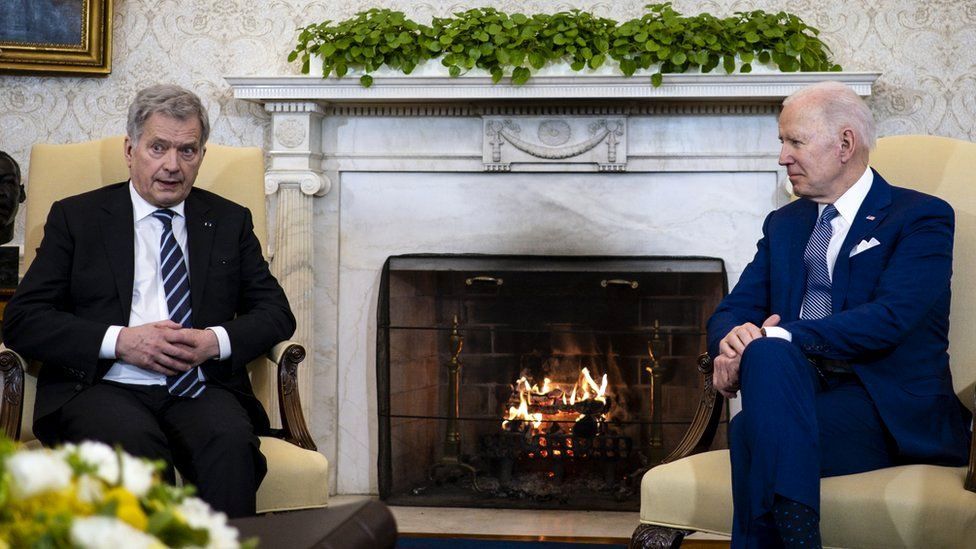
Last week, Finnish President Sauli Niinisto discussed strengthening security ties with US President Joe Biden


Viewed from Finland, there are some striking similarities between the attack on Ukraine and the invasion of Finland in 1939 - the Winter War, as it's known.

Joseph Stalin, full of self-confidence, sent his army into Finland only to find that its resistance was far greater than his generals had assured him. The Finns staged a largely guerrilla war against an army which was huge, but whose morale had been seriously damaged by the treason trials of a year or so earlier, in which the majority of the most senior figures were purged and executed.

The Winter War dragged on for months before negotiations finally began and an agreement was reached. Russia took some territory from Finland, but the Finns kept their independence - and have done so ever since.

The invasion of Ukraine has similarly been mismanaged. The logistical side was botched from the start, with too little fuel, food and water supplied to the troops - many of whom had been assured they were only carrying out an exercise.

Western analysts say even maps were in short supply, with tank drivers often having to stop to get directions. This was not by any means a Blitzkrieg, and the prerequisite for any modern war - the destruction of the enemy's communications - simply never happened.

None of this means that President Vladimir Putin won't win in the end.

He has already assured France's President Macron that he will go on until he takes the whole of Ukraine. The danger is that if he cannot do it with his conventional forces, the temptation will be strong to use his tactical nuclear weapons to force Ukraine to surrender.

Russian nuclear theory seems to regard this as an acceptable risk; Western experts are much more worried by the possibilities. There can be no certainties if that threshold is crossed.

Russia claims to have invaded Ukraine because it wanted to save the Ukrainian people from neo-fascism. What President Putin really seems to want to ensure - apart from avenging what he sees as Ukraine's treachery in breaking away from Russia - is that there is no question of Ukrainian President Volodymyr Zelensky joining Nato.

In fact, that genuinely doesn't seem to have been a possibility within the foreseeable future.

But there is a real irony in the fact that the war in Ukraine now seems to be giving Finland - and perhaps Sweden - real cause for considering whether they should join the Western military alliance.

AI Disclaimer: An advanced artificial intelligence (AI) system generated the content of this page on its own. This innovative technology conducts extensive research from a variety of reliable sources, performs rigorous fact-checking and verification, cleans up and balances biased or manipulated content, and presents a minimal factual summary that is just enough yet essential for you to function as an informed and educated citizen. Please keep in mind, however, that this system is an evolving technology, and as a result, the article may contain accidental inaccuracies or errors. We urge you to help us improve our site by reporting any inaccuracies you find using the "Contact Us" link at the bottom of this page. Your helpful feedback helps us improve our system and deliver more precise content. When you find an article of interest here, please look for the full and extensive coverage of this topic in traditional news sources, as they are written by professional journalists that we try to support, not replace. We appreciate your understanding and assistance.
Newsletter

Related Articles

0:00
0:00
Close
Miliband Sets Climate and International Law at Centre of UK Diplomacy
Czech Central Bank Governor Rejects Early Euro Entry and Rate-Cut Pressure
Trump Readies New Tariffs as Temporary Global Levy Nears Expiry
Vivienne Westwood Casts Cicciolina, 74, in Its New Autumn Campaign
Dejavu: Germany’s Military Expansion Reshapes Europe’s Strategic Balance With France
Morgan Stanley Builds a Wall Street Lead in AI Infrastructure Finance
High Prices Push Coffee Drinkers Toward Whole Beans and Home Brewing
Trump Draws Boos and Podium Scrutiny at Spain’s World Cup Triumph
Brilliant move: Péter Magyar Moves to Nominate Chess Grandmaster Judit Polgár as Hungary’s President
Spain Defeats Argentina in Extra Time to Win Second World Cup
Current AI Seeks to Build an Open Global AI Infrastructure Outside Big Tech Control
Germany’s Economic Malaise Reopens the Sunday Shopping Debate
Proposed U.S.-Saudi Nuclear Pact Could Permit Limited Uranium Enrichment Under International Safeguards
Netherlands Declares Water Shortage Emergency After Drought Pushes Rivers to Historic Lows
Why Kentucky Fried Chicken Became KFC—and Why the False Explanations Persist
Ukrainian Drones Strike Wildberries Warehouses Deep Inside Russia
Reported CIA Mission Helped Clear the UAE’s Path to Advanced US AI Chips
Artificial Intelligence Capital Fuels Markets While Governments and Regulators Face Mounting Strategic Tests
China’s Moonshot’s Kimi K3 Narrows the Gap With Anthropic Through Scale, Openness and Lower Cost
The Ledger Will Not Trust on Faith
Trump Administration Pressures Banks to Restrict Financial Access for Undocumented Immigrants
Passenger Bound for Germany Refused to Sit Beside a Woman on a Plane — Then Slapped a Flight Attendant
Ukraine’s Leadership Rift Spills Into the Streets as Protesters Target Army Chief
Ukrainian Drone Barrage Kills Eight and Strikes Russian Logistics Network
The Ten World Cup Finals That Defined Football History
Smartphones Are Getting More Expensive, Sales Are Collapsing, and Even Apple Admits: "Prices Will Rise"
The Monaco Bombing Has Become a Test of Ukraine’s Intelligence Accountability
Leadership Change and Strategic Rivalry Redraw the Political Map
The AI Race Enters Its Infrastructure Era
Britain Nationalises British Steel to Protect Scunthorpe Production and Strategic Supply
French National Assembly Overrides Senate to Pass Historic Assisted-Dying Legislation
Spanish Prime Minister's Wife Ordered to Stand Trial as Corruption Probes Encircle Governing Party
Zelensky Faces Kyiv Protests Over Ousting of Dynamic Ukrainian Defense Minister
Thomas Tuchel Faces Fierce Backlash After Tactical Retreat Costs England World Cup Final Berth
A Quiet Bastille Day: France Grapples with World Cup Heartbreak and Leftover Fireworks
Spain in Ecstasy: "We Feel Unbeatable, We Taught the Whole World a Lesson"
Spain and UK Dismantle Gibraltar Border Following Landmark Schengen Integration Treaty
Hungary's "Puppet" President to Be Ousted, Orbán Fumes: "Democracy Is Dead"
Forget Tinder: The Surprising Platform Where People Find Love
Harvard Astrophysicist to Lead U.S. Scientific Advisory on Unidentified Aerial Phenomena
Emergency Sirens Activated Across Bahrain as Interior Ministry Issues Shelter Directives
World Cup Visitors Turn American Big-Box Stores Into Souvenir Stops
Netflix Weighs Always-On Channels, Bundles and Short-Form Video
Passenger Is Pulled Partly Outside Ryanair Jet After Window Fails Mid-Flight
The AI Invoice Shock: Layoffs Didn't Save Managers Money — They Cost Them More
Concern: Sexually Transmitted Bacterium Among Men Develops Antibiotic Resistance
Passenger Partially Pulled Out of Ryanair Jet After Cabin Window Fails Mid-Flight
Severe Heatwave Drives Dangerous Ground-Level Ozone Pollution Across Two Thirds of European Union
The Physical and Electronic Barriers Disrupting Domestic Wireless Networks
France and Morocco Open World Cup Quarter-Finals as Collina Defends Refereeing
×