Budapest Post

Cum Deo pro Patria et Libertate
Budapest, Europe and world news

The UN has said nuclear war is 'back within the realm of possibility.' Here are the places in the US most likely to be hit in a nuclear attack.

The UN has said nuclear war is 'back within the realm of possibility.' Here are the places in the US most likely to be hit in a nuclear attack.

An Insider map shows the essential points Russia would have to attack to wipe out the US's nuclear forces, according to a nuclear weapons expert.

The UN secretary-general said that nuclear war is "back within the realm of possibility" following Russia's warning earlier this year it was putting its nuclear forces on alert amid its war in Ukraine, which threatens to draw NATO into direct combat with Russia. Since then, nuclear threats have continued to raise concerns a nuclear weapon could be used in a conflict for the first time in decades.

Much of the focus as of late has been on the risk of Russian President Vladimir Putin using a nuclear weapon in Ukraine in a desperate move to change his army's forturnes on the battlefield, but the Russian leader has also directed warnings at the US and NATO.

In December, Putin also suggested that Russia may abandon its "no first use" military doctrine, which says Russia would only use nuclear weapons as a last resort.

"They [the US] have it in their strategy, in the documents it is spelled out – a preventive blow," Putin said at a news conference in Kyrgyzstan. "We don't. We, on the other hand, have formulated a retaliatory strike in our strategy."

"So if we're talking about this disarming strike, then maybe think about adopting the best practices of our American partners and their ideas for ensuring their security," he added. "We're just thinking about it."

While the risk of tensions between the US and Russia escalating to open conflict and nuclear war is low, the threat exists.

In 2017, Russian state media detailed how Moscow would annihilate US cities and areas after a nuclear treaty collapsed and put the Cold War rivals back in targeting mode — a shocking threat even by the Russian regime's extreme standards. 

Hyping up a then-new hypersonic nuclear-capable missile, Russian state TV said the Pentagon, Camp David, Jim Creek Naval Radio Station in Washington, Fort Ritchie in Maryland, and McClellan Air Force Base in California, would be targets, according to Reuters.

But the latter two have been closed for over two decades, making them strange choices for targets. 

With most everything from Russia or its heavily censored media, it's best to take its claims with a grain of salt. Instead of taking Russia's word for it when it comes to nuclear targets, Insider got an expert opinion on where Moscow would likely try to strike.

Since the Cold War, the US and Russia have drawn up plans on how to best wage nuclear war against each other, and while large population centers with huge cultural impact may seem like obvious choices, strategists believe a nuclear attack will focus on countering the enemy's nuclear forces — destroying them before they can counter-attack.

According to Stephen Schwartz, the author of "Atomic Audit: The Costs and Consequences of US Nuclear Weapons Since 1940," as the Cold War progressed and improvements in nuclear weapons and intelligence-collection technologies enabled greater precision in where those weapons were aimed, the emphasis in targeting shifted from cities to nuclear stockpiles and nuclear war-related infrastructure.

This map shows the essential points Russia would have to attack to wipe out the US's nuclear forces, according to Schwartz:
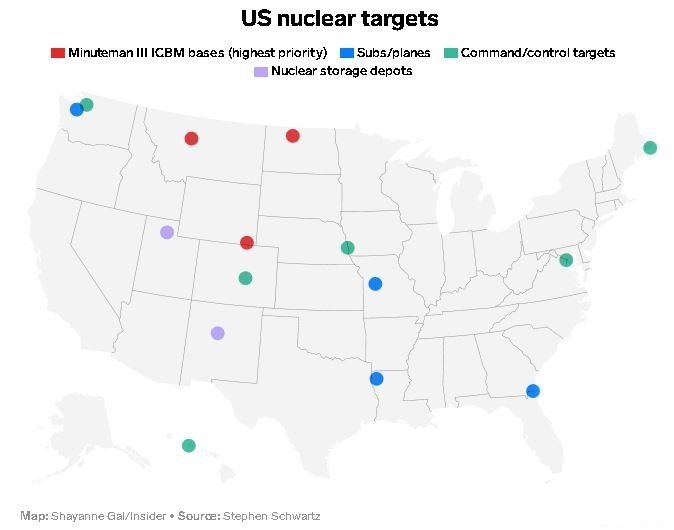


The map represents targets for an all-out attack on the US's fixed nuclear infrastructure, weapons, and command-and-control centers, but even a massive strike like this wouldn't guarantee anything.

"It's exceedingly unlikely that such an attack would be fully successful," Schwartz told Insider. "There's an enormous amount of variables in pulling off an attack like this flawlessly, and it would have to be flawless. If even a handful of weapons escape, the stuff you missed will be coming back at you."

Even if every single US intercontinental ballistic missile silo, stockpiled nuclear weapon, and nuclear-capable bomber were flattened, US nuclear submarines could — and would — retaliate.

According to Schwartz, at any given time, the US has four to five nuclear-armed submarines "on hard alert, in their patrol areas, awaiting orders for launch."

Even high-ranking officials in the US military don't know where the silent submarines are, and there's no way Russia could chase them all down before they fired back, which Schwartz said could be done in as little as 5 to 15 minutes.

But a strike on a relatively sparsely populated area could still lead to death and destruction across the US, depending on how the wind blew. That's because of fallout.
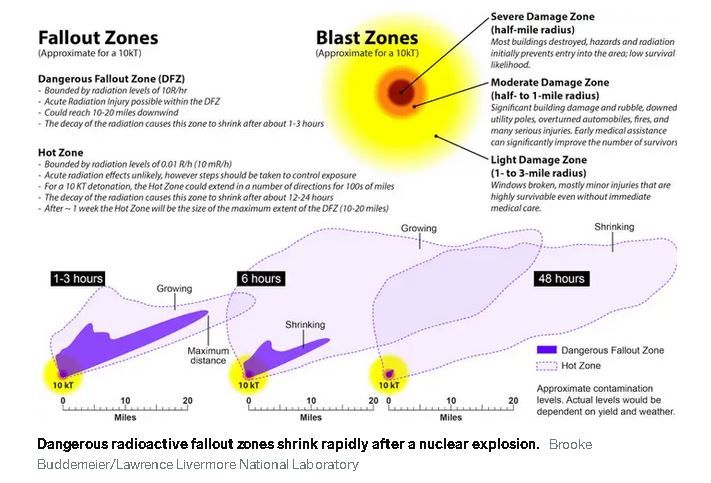

The US has strategically positioned the bulk of its nuclear forces, which double as nuclear targets, far from population centers. But if you happen to live next to an ICBM silo, fear not.

There's a "0.0% chance" that Russia could hope to survive an act of nuclear aggression against the US, according to Schwartz. So while we all live under a nuclear "sword of Damocles," Schwartz added, people in big cities like New York and Los Angeles most likely shouldn't worry about being struck by a nuclear weapon.

AI Disclaimer: An advanced artificial intelligence (AI) system generated the content of this page on its own. This innovative technology conducts extensive research from a variety of reliable sources, performs rigorous fact-checking and verification, cleans up and balances biased or manipulated content, and presents a minimal factual summary that is just enough yet essential for you to function as an informed and educated citizen. Please keep in mind, however, that this system is an evolving technology, and as a result, the article may contain accidental inaccuracies or errors. We urge you to help us improve our site by reporting any inaccuracies you find using the "Contact Us" link at the bottom of this page. Your helpful feedback helps us improve our system and deliver more precise content. When you find an article of interest here, please look for the full and extensive coverage of this topic in traditional news sources, as they are written by professional journalists that we try to support, not replace. We appreciate your understanding and assistance.
Newsletter

Related Articles

0:00
0:00
Close
Ukraine's Ousted Defence Minister Calls for Wartime Presidential Election
Thieves Steal Antonello da Messina Renaissance Masterpieces From Sicilian Museum
Google Launches Pixel 11 With Gemini AI at the Center of Its Hardware Strategy
Russia’s A7 Builds a State-Linked Payments Network Beyond Western Sanctions
AI’s Next Bottleneck Is Power, Not Just Nvidia Chips
Meta Raises AI Spending Target to as Much as $145bn Despite Pressure Over Returns
Danube Drought Exposes Nazi Wrecks and Pushes Central Europe’s Power System to the Brink
Joe Biden’s Cancer Has Spread Beyond His Bones, Hunter Biden Says
Why 2027 Could Be a Strong Year for Stocks—and Why the Forecast Is Fragile
Why Markets May Look Quiet in August After Big Tech Earnings
UK Drought Cuts Harvests and Raises Food-Security Fears
UFO: Pentagon Releases Video of Unidentified Object Tracked Over Middle East
Ukraine Tells Senate Republicans Its Drone War Offers a Blueprint for America
Weight-Loss Drug Boom Tests the Limits of Prescription Advertising Rules
Senate Scrutinises AI-Driven Personalised Pricing
Spain Seeks Mainland Transfers for 1,100 Children Stranded in Ceuta
Spain and Morocco Trade Blame After 72,000 Migrants Enter Ceuta
AI Is Remaking the US Economy, From GDP Growth to iPhone Prices
Europe’s Heat and Drought Are Now Disrupting Power, Shipping and Tourism
Europe’s Drying Rivers Trigger Power Cuts, Factory Shutdowns and Wildfire Emergencies
Record-Low Danube Forces Nuclear Cuts and Emergency Power Curbs
Danube Drought Forces Hungary’s Paks Nuclear Plant Into Full Shutdown
Ceuta Death Toll Rises as Spain and Europe Clash Over Border Response
Valued at $109 Million: F-35B Fighter Jet Crashes in Southern California
Record-Low Danube Exposes Probable Mammoth Remains in Bulgaria
US Says It Has Carried Out Heavy Strikes on Iran After Attempted Attacks on Its Forces
The AI User Nightmare: Private Claude Conversations Leaked to the Internet
Over 24 Hours in the Air: Qantas Airbus Completes Record-Breaking Test Flight
Massive Wildfires Ravage Southern Europe: Fatalities in Greece and Evacuations Across France, Spain, and Turkey
Nvidia Reportedly Takes Vast Texas Data-Centre Lease to Underwrite AI Expansion
FIFA’s Private-Investment Plan for World Cup Rights Draws European Revolt
Apple Briefly Crosses Five Trillion Dollar Valuation as Investors Retreat From AI Bets
Fresh Heatwave Threatens to Rekindle France’s Historic Wildfire Crisis
Following OpenAI's Cyberattack: 'Most Companies Still Do Not Understand What Is Coming'
OpenAI Sued After ChatGPT Allegedly Discouraged Emergency Care Before Near-Fatal Embolism
Miliband Sets Climate and International Law at Centre of UK Diplomacy
Czech Central Bank Governor Rejects Early Euro Entry and Rate-Cut Pressure
Trump Readies New Tariffs as Temporary Global Levy Nears Expiry
Vivienne Westwood Casts Cicciolina, 74, in Its New Autumn Campaign
Dejavu: Germany’s Military Expansion Reshapes Europe’s Strategic Balance With France
Morgan Stanley Builds a Wall Street Lead in AI Infrastructure Finance
High Prices Push Coffee Drinkers Toward Whole Beans and Home Brewing
Trump Draws Boos and Podium Scrutiny at Spain’s World Cup Triumph
Brilliant move: Péter Magyar Moves to Nominate Chess Grandmaster Judit Polgár as Hungary’s President
Spain Defeats Argentina in Extra Time to Win Second World Cup
Current AI Seeks to Build an Open Global AI Infrastructure Outside Big Tech Control
Germany’s Economic Malaise Reopens the Sunday Shopping Debate
Proposed U.S.-Saudi Nuclear Pact Could Permit Limited Uranium Enrichment Under International Safeguards
Netherlands Declares Water Shortage Emergency After Drought Pushes Rivers to Historic Lows
Why Kentucky Fried Chicken Became KFC—and Why the False Explanations Persist
×