Record-Low Danube Forces Nuclear Cuts and Emergency Power Curbs
Hungary faces the first complete shutdown of its sole nuclear plant as Romania uses explosives to protect its remaining reactor and industries across the region reduce electricity use.
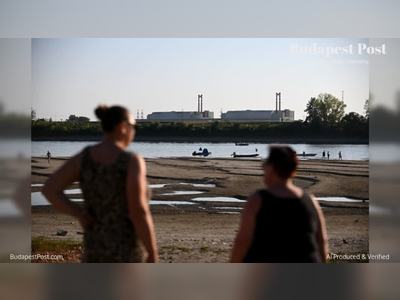
Persistent drought and successive heat waves have driven the Danube to record lows, turning a prolonged weather emergency into an escalating test of Central and Eastern Europe’s electricity system.
Nuclear reactors that depend on the river for cooling have reduced output or stopped, hydropower generation has collapsed in Serbia, factories are suspending production and governments are asking households to curb demand as temperatures climb above 38 degrees Celsius.
In Budapest, the Danube gauge fell to approximately 10 centimetres on Monday, breaking the previous record low of 33 centimetres set in 2018. The measurement is a reading relative to the gauge’s reference level, not the river’s total physical depth, but it reflects the extraordinary contraction of its navigable channel.
Sandbanks, rocks and sections of riverbed have emerged along the river’s course, while shipping, tourism and agricultural transport have been disrupted.
The immediate energy threat is most acute in Hungary.
The four-reactor Paks nuclear power station, the country’s only nuclear plant, normally produces about 2,000 megawatts and supplies nearly half of Hungary’s electricity generation, equivalent to roughly one-third of national consumption.
By Monday, successive reactor shutdowns had reduced its output to only 240 megawatts, or about 12 per cent of normal capacity.
Engineers kept the final turbine operating longer than initially expected, temporarily postponing a complete shutdown.
Prime Minister Péter Magyar said the station could probably continue producing limited power through Monday or Tuesday, but a full suspension remained likely on Tuesday or Wednesday if the river receded further.
It would be the first complete shutdown of Paks caused by insufficient cooling water in the plant’s 44 years of operation and could last for weeks if river conditions do not recover.
Hungary is compensating with electricity imports, renewable generation and emergency conservation.
Large industrial consumers have been asked to reduce demand, while households are being urged to save electricity during the evening peak between 5 p.m. and 10 p.m. Electric freight trains have been barred from operating during those hours, and the government has acquired authority to impose mandatory restrictions on major commercial users if voluntary measures prove insufficient.
The conservation campaign reduced national demand by about 700 megawatts on Sunday.
Pharmaceutical producer Richter subsequently pledged to cut its consumption by more than half for three weeks and make power from its solar facilities available to the grid.
Romania has resorted to direct intervention in the river.
Naval forces used approximately 180 kilograms of explosives on Monday to remove a large rock outcrop near the Bala branch of the Danube.
The controlled blast was intended to clear the way for a temporary dam that will direct more water into the main channel serving the Cernavodă nuclear power station.
The plant normally provides about one-fifth of Romania’s electricity.
Unit 1 has been shut down in a safe condition because of the exceptionally low river level.
Operators initially prepared to stop Unit 2 as well, but an overnight technical assessment found that cooling conditions and operating margins still permitted it to remain connected safely.
The station is consequently producing about half its normal output, with the remaining reactor under continuous review.
The Danube’s flow entering Romania has fallen to about 1,500 cubic metres per second, less than one-third of the July average.
The government placed the energy sector under a nationwide state of alert for August, while officials warned that Romania’s limited cross-border interconnections constrain how much replacement electricity can be imported.
The temporary river works are scheduled for completion on Wednesday.
Dacia and Ford agreed to suspend Romanian vehicle production until August 19, reducing combined electricity demand by approximately 200 megawatts.
Other large companies have been asked to shift or curtail operations during the evening peak, when air-conditioning demand is highest and solar generation fades.
Serbia is confronting the same hydrological shock from a different direction.
Output at the Djerdap 1 hydroelectric station, the country’s largest, has fallen to about 20 per cent of capacity.
Low water has also affected cooling at the Kostolac coal-fired power complex.
Prime Minister Đuro Macut convened an emergency meeting and asked residents to minimise their use of air conditioners and other power-intensive appliances.
Cargo vessels remain operational on parts of the Serbian Danube, but some are carrying only half their normal loads because of the reduced navigable depth.
The wider heat emergency is straining services far beyond the river.
More than 400 firefighters and 21 aircraft were deployed against a large wildfire northwest of Athens after flames destroyed homes, pine forest and agricultural land.
Two crew members were killed when firefighting helicopters collided in mid-air.
In the Netherlands, a fire burned through roughly 21 hectares of the De Rosmolen nature area in Limburg, prompting the evacuation of a campsite accommodating about 300 people, disrupting rail services and bringing military helicopters into the response.
Italy’s Piedmont region has declared an emergency over water shortages and wildfires.
Vienna registered 40.1 degrees Celsius on Monday, provisionally setting a new record for the Austrian capital.
In Britain, provisional measurements show that England and Wales experienced their driest July since national records began in 1836. England received only 6.5 millimetres of rain, or 10 per cent of its long-term July average, while Wales recorded 9.3 millimetres, or 9 per cent of average.
All of Wales and around half of England are officially experiencing drought conditions.
The crisis is unfolding against a measurable long-term warming trend.
Europe is the world’s fastest-warming continent, heating at roughly twice the global average since the 1980s.
Recent climate data indicate that European temperatures have risen by about 0.53 degrees Celsius per decade since the mid-1990s, compared with approximately 0.26 degrees globally.
That background does not by itself determine the cause of every individual fire or drought, but hotter conditions intensify evaporation, dry vegetation and increase simultaneous demand for water and electricity.
With no substantial rainfall expected in the Danube basin in the immediate forecast, the confirmed next step is completion of Romania’s temporary diversion on Wednesday, while Hungary, Romania and Serbia continue conservation measures and daily safety reviews of their power stations.
Nuclear reactors that depend on the river for cooling have reduced output or stopped, hydropower generation has collapsed in Serbia, factories are suspending production and governments are asking households to curb demand as temperatures climb above 38 degrees Celsius.
In Budapest, the Danube gauge fell to approximately 10 centimetres on Monday, breaking the previous record low of 33 centimetres set in 2018. The measurement is a reading relative to the gauge’s reference level, not the river’s total physical depth, but it reflects the extraordinary contraction of its navigable channel.
Sandbanks, rocks and sections of riverbed have emerged along the river’s course, while shipping, tourism and agricultural transport have been disrupted.
The immediate energy threat is most acute in Hungary.
The four-reactor Paks nuclear power station, the country’s only nuclear plant, normally produces about 2,000 megawatts and supplies nearly half of Hungary’s electricity generation, equivalent to roughly one-third of national consumption.
By Monday, successive reactor shutdowns had reduced its output to only 240 megawatts, or about 12 per cent of normal capacity.
Engineers kept the final turbine operating longer than initially expected, temporarily postponing a complete shutdown.
Prime Minister Péter Magyar said the station could probably continue producing limited power through Monday or Tuesday, but a full suspension remained likely on Tuesday or Wednesday if the river receded further.
It would be the first complete shutdown of Paks caused by insufficient cooling water in the plant’s 44 years of operation and could last for weeks if river conditions do not recover.
Hungary is compensating with electricity imports, renewable generation and emergency conservation.
Large industrial consumers have been asked to reduce demand, while households are being urged to save electricity during the evening peak between 5 p.m. and 10 p.m. Electric freight trains have been barred from operating during those hours, and the government has acquired authority to impose mandatory restrictions on major commercial users if voluntary measures prove insufficient.
The conservation campaign reduced national demand by about 700 megawatts on Sunday.
Pharmaceutical producer Richter subsequently pledged to cut its consumption by more than half for three weeks and make power from its solar facilities available to the grid.
Romania has resorted to direct intervention in the river.
Naval forces used approximately 180 kilograms of explosives on Monday to remove a large rock outcrop near the Bala branch of the Danube.
The controlled blast was intended to clear the way for a temporary dam that will direct more water into the main channel serving the Cernavodă nuclear power station.
The plant normally provides about one-fifth of Romania’s electricity.
Unit 1 has been shut down in a safe condition because of the exceptionally low river level.
Operators initially prepared to stop Unit 2 as well, but an overnight technical assessment found that cooling conditions and operating margins still permitted it to remain connected safely.
The station is consequently producing about half its normal output, with the remaining reactor under continuous review.
The Danube’s flow entering Romania has fallen to about 1,500 cubic metres per second, less than one-third of the July average.
The government placed the energy sector under a nationwide state of alert for August, while officials warned that Romania’s limited cross-border interconnections constrain how much replacement electricity can be imported.
The temporary river works are scheduled for completion on Wednesday.
Dacia and Ford agreed to suspend Romanian vehicle production until August 19, reducing combined electricity demand by approximately 200 megawatts.
Other large companies have been asked to shift or curtail operations during the evening peak, when air-conditioning demand is highest and solar generation fades.
Serbia is confronting the same hydrological shock from a different direction.
Output at the Djerdap 1 hydroelectric station, the country’s largest, has fallen to about 20 per cent of capacity.
Low water has also affected cooling at the Kostolac coal-fired power complex.
Prime Minister Đuro Macut convened an emergency meeting and asked residents to minimise their use of air conditioners and other power-intensive appliances.
Cargo vessels remain operational on parts of the Serbian Danube, but some are carrying only half their normal loads because of the reduced navigable depth.
The wider heat emergency is straining services far beyond the river.
More than 400 firefighters and 21 aircraft were deployed against a large wildfire northwest of Athens after flames destroyed homes, pine forest and agricultural land.
Two crew members were killed when firefighting helicopters collided in mid-air.
In the Netherlands, a fire burned through roughly 21 hectares of the De Rosmolen nature area in Limburg, prompting the evacuation of a campsite accommodating about 300 people, disrupting rail services and bringing military helicopters into the response.
Italy’s Piedmont region has declared an emergency over water shortages and wildfires.
Vienna registered 40.1 degrees Celsius on Monday, provisionally setting a new record for the Austrian capital.
In Britain, provisional measurements show that England and Wales experienced their driest July since national records began in 1836. England received only 6.5 millimetres of rain, or 10 per cent of its long-term July average, while Wales recorded 9.3 millimetres, or 9 per cent of average.
All of Wales and around half of England are officially experiencing drought conditions.
The crisis is unfolding against a measurable long-term warming trend.
Europe is the world’s fastest-warming continent, heating at roughly twice the global average since the 1980s.
Recent climate data indicate that European temperatures have risen by about 0.53 degrees Celsius per decade since the mid-1990s, compared with approximately 0.26 degrees globally.
That background does not by itself determine the cause of every individual fire or drought, but hotter conditions intensify evaporation, dry vegetation and increase simultaneous demand for water and electricity.
With no substantial rainfall expected in the Danube basin in the immediate forecast, the confirmed next step is completion of Romania’s temporary diversion on Wednesday, while Hungary, Romania and Serbia continue conservation measures and daily safety reviews of their power stations.
AI Disclaimer: An advanced artificial intelligence (AI) system generated the content of this page on its own. This innovative technology conducts extensive research from a variety of reliable sources, performs rigorous fact-checking and verification, cleans up and balances biased or manipulated content, and presents a minimal factual summary that is just enough yet essential for you to function as an informed and educated citizen. Please keep in mind, however, that this system is an evolving technology, and as a result, the article may contain accidental inaccuracies or errors. We urge you to help us improve our site by reporting any inaccuracies you find using the "Contact Us" link at the bottom of this page. Your helpful feedback helps us improve our system and deliver more precise content. When you find an article of interest here, please look for the full and extensive coverage of this topic in traditional news sources, as they are written by professional journalists that we try to support, not replace. We appreciate your understanding and assistance.