Why Kentucky Fried Chicken Became KFC—and Why the False Explanations Persist
The 1991 rebrand was a calculated effort to modernize the chain, broaden its menu identity and soften the increasingly unfashionable association with fried food—not a response to state licensing demands or genetically altered chickens. :contentReference[oaicite:0]{index=0}
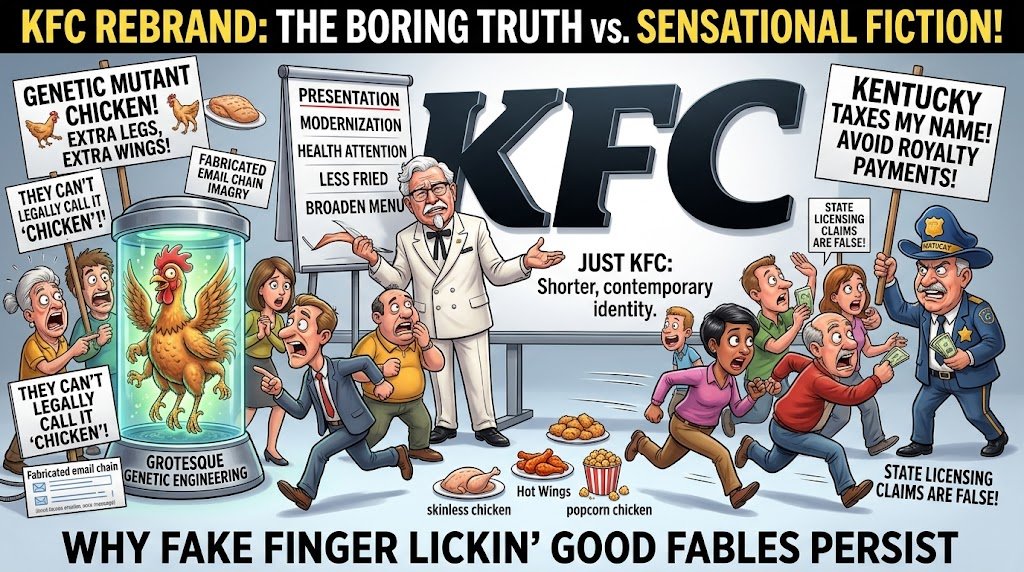
KFC adopted its abbreviated name in 1991 because the company wanted a shorter, more contemporary identity that placed less emphasis on the word "fried" and allowed the brand to represent a menu extending beyond traditional bone-in chicken.
The change was a conventional commercial repositioning, not the consequence of a legal dispute with Kentucky or any inability to describe its products as chicken.
The rebrand arrived as American diners were becoming more attentive to fat, calories and the health implications of fried food.
KFC was also confronting stronger competition from grilled-chicken products and other poultry formats.
Kyle Craig, then president of the chain's United States business, said the company wanted a more contemporary image and acknowledged that "fried" no longer conveyed one.
The initials were already familiar.
Consumer research conducted before the change found that most customers readily associated KFC with Kentucky Fried Chicken, allowing the company to compress its signage and advertising without sacrificing recognition.
The shorter name also suited an increasingly international business because three letters were easier to reproduce, remember and identify across languages and markets.
The company was simultaneously trying to diversify what customers associated with the brand.
Its menu was expanding beyond the original bucket meal, and the early 1990s brought products including Hot Wings, popcorn chicken, sandwiches and skinless chicken intended to appeal to more health-conscious diners.
Some experiments failed commercially, but they reinforced the logic of adopting a name that did not define the entire business by one cooking method.
That straightforward explanation has competed for decades with a more colorful story: that Kentucky began charging businesses to use the state's name, forcing the restaurant chain to abbreviate its identity to avoid royalty payments.
No credible evidence supports that claim.
The company continued to acknowledge the full Kentucky Fried Chicken name, and the supposed licensing conflict does not appear in the documented account of the 1991 branding decision.
An even more durable legend alleged that KFC used grotesquely engineered birds with extra legs or wings and therefore could no longer legally call its food chicken.
The claim is false.
Variations spread through email chains, websites and social-media posts, often accompanied by fabricated images or invented descriptions of laboratory-grown animals.
The rumor eventually produced legal consequences in China, where KFC pursued companies accused of circulating stories about chickens with multiple wings and legs.
Courts held technology businesses responsible for spreading false claims that damaged the chain's reputation.
The litigation addressed defamatory online content; it did not uncover evidence supporting the mutant-chicken story.
Such myths survive because major rebrands create an information gap that folklore quickly fills.
A familiar corporate name disappears, the official explanation receives less attention than the change itself, and a mundane marketing decision becomes attached to narratives involving government fees, secret ingredients or industrial manipulation.
Repetition then gives the story an appearance of credibility even when no underlying evidence exists.
The original company grew from Harland Sanders' roadside food business in Corbin, Kentucky.
Sanders served travelers before turning his pressure-fried chicken recipe into a franchise system, and the full Kentucky Fried Chicken name became inseparable from his white-suited public persona.
The 1991 abbreviation altered the corporate presentation but preserved the Colonel's image, the bucket and the original recipe as the brand's central identifiers.
The distinction also became less absolute over time.
KFC remained the formal global identity, but the company has periodically revived the words Kentucky Fried Chicken in packaging, restaurant designs and individual markets.
That flexibility demonstrates that the initials were never imposed by a prohibition on the old name; they were adopted because management considered them more useful.
KFC now operates tens of thousands of restaurants across roughly one hundred and fifty countries, and its branding continues to evolve around the same problem confronted in 1991: preserving the familiarity of Colonel Sanders while adapting the chain to changing tastes, media formats and international audiences.
The enduring record supports a prosaic conclusion—the company shortened its name to modernize a globally recognized brand, and the more sensational explanations remain unsupported myths.
The change was a conventional commercial repositioning, not the consequence of a legal dispute with Kentucky or any inability to describe its products as chicken.
The rebrand arrived as American diners were becoming more attentive to fat, calories and the health implications of fried food.
KFC was also confronting stronger competition from grilled-chicken products and other poultry formats.
Kyle Craig, then president of the chain's United States business, said the company wanted a more contemporary image and acknowledged that "fried" no longer conveyed one.
The initials were already familiar.
Consumer research conducted before the change found that most customers readily associated KFC with Kentucky Fried Chicken, allowing the company to compress its signage and advertising without sacrificing recognition.
The shorter name also suited an increasingly international business because three letters were easier to reproduce, remember and identify across languages and markets.
The company was simultaneously trying to diversify what customers associated with the brand.
Its menu was expanding beyond the original bucket meal, and the early 1990s brought products including Hot Wings, popcorn chicken, sandwiches and skinless chicken intended to appeal to more health-conscious diners.
Some experiments failed commercially, but they reinforced the logic of adopting a name that did not define the entire business by one cooking method.
That straightforward explanation has competed for decades with a more colorful story: that Kentucky began charging businesses to use the state's name, forcing the restaurant chain to abbreviate its identity to avoid royalty payments.
No credible evidence supports that claim.
The company continued to acknowledge the full Kentucky Fried Chicken name, and the supposed licensing conflict does not appear in the documented account of the 1991 branding decision.
An even more durable legend alleged that KFC used grotesquely engineered birds with extra legs or wings and therefore could no longer legally call its food chicken.
The claim is false.
Variations spread through email chains, websites and social-media posts, often accompanied by fabricated images or invented descriptions of laboratory-grown animals.
The rumor eventually produced legal consequences in China, where KFC pursued companies accused of circulating stories about chickens with multiple wings and legs.
Courts held technology businesses responsible for spreading false claims that damaged the chain's reputation.
The litigation addressed defamatory online content; it did not uncover evidence supporting the mutant-chicken story.
Such myths survive because major rebrands create an information gap that folklore quickly fills.
A familiar corporate name disappears, the official explanation receives less attention than the change itself, and a mundane marketing decision becomes attached to narratives involving government fees, secret ingredients or industrial manipulation.
Repetition then gives the story an appearance of credibility even when no underlying evidence exists.
The original company grew from Harland Sanders' roadside food business in Corbin, Kentucky.
Sanders served travelers before turning his pressure-fried chicken recipe into a franchise system, and the full Kentucky Fried Chicken name became inseparable from his white-suited public persona.
The 1991 abbreviation altered the corporate presentation but preserved the Colonel's image, the bucket and the original recipe as the brand's central identifiers.
The distinction also became less absolute over time.
KFC remained the formal global identity, but the company has periodically revived the words Kentucky Fried Chicken in packaging, restaurant designs and individual markets.
That flexibility demonstrates that the initials were never imposed by a prohibition on the old name; they were adopted because management considered them more useful.
KFC now operates tens of thousands of restaurants across roughly one hundred and fifty countries, and its branding continues to evolve around the same problem confronted in 1991: preserving the familiarity of Colonel Sanders while adapting the chain to changing tastes, media formats and international audiences.
The enduring record supports a prosaic conclusion—the company shortened its name to modernize a globally recognized brand, and the more sensational explanations remain unsupported myths.
AI Disclaimer: An advanced artificial intelligence (AI) system generated the content of this page on its own. This innovative technology conducts extensive research from a variety of reliable sources, performs rigorous fact-checking and verification, cleans up and balances biased or manipulated content, and presents a minimal factual summary that is just enough yet essential for you to function as an informed and educated citizen. Please keep in mind, however, that this system is an evolving technology, and as a result, the article may contain accidental inaccuracies or errors. We urge you to help us improve our site by reporting any inaccuracies you find using the "Contact Us" link at the bottom of this page. Your helpful feedback helps us improve our system and deliver more precise content. When you find an article of interest here, please look for the full and extensive coverage of this topic in traditional news sources, as they are written by professional journalists that we try to support, not replace. We appreciate your understanding and assistance.