‘I want to show France who we are’: the slum influencer with his sights on parliament
Influence is not a word readily associated with St Jacques, the Gypsy quarter of the city of Perpignan. Yet, on a recent chilly night shortly before 8pm, the ineffable hand of influence is behind an outbreak of street theatre on the plane tree-lined oblong of Place Cassanyes. People are arriving in droves. By 7.50pm, there must be more than 200, mostly young men, in rowdy clusters. Smoking, yelling, stretching, one group doing can-can legs: it’s like Fast & Furious without the automobiles.
One man in a red Adidas tracksuit is trying to line everyone up across the square’s breadth. A beacon in a sea of dark casual-wear, the influencer known as NasDas – St Jacques born and bred – is responsible for this circus. The previous night, NasDas posted to his 1.2 million followers a picture of one of his posse holding up a crinkled €500 bill, followed by footage of a previous Place Cassanyes footrace. Tonight is a rerun, only with a bigger prize. But this time the turnout is far bigger, too. Streaming live on Snapchat, he’s antsy: “On my mother’s life, I didn’t expect this kind of crowd – from Avignon, from Marseille, from everywhere.”
NasDas – real name Nasser Sari – has achieved the feat of becoming France’s No 1 Snapchat influencer from one of the country’s poorest neighbourhoods. Perpignan is the last French Mediterranean city 20 miles (32km) north of the Spanish border; rising up a hill at the back of its town centre is St Jacques, a tightly packed, roughneck enclave on a medieval street grid where 60% of households live in poverty. Three-quarters of a population numbering somewhere 3,000 and 7,000 are Catalan Gypsies; the remainder, coexisting sometimes tensely with their neighbours, are Arab – including the 25-year-old NasDas, whose parents emigrated from Algeria.
When outsiders go to St Jacques, they often see only the omnipresent rubbish. But NasDas saw life, beauty and humour in his daily surroundings. A few years ago, he began shooting the street shenanigans and characters around him: “I didn’t want to be No 1, or even to be a Snapchatter or an influencer. I’d just get my phone out at the cafe: ‘Who’s going to pay? You? You never pay!’ And I realised that people liked watching my daily life.”
He began adding semi-dramatised skits, like one spoofing banlieue arrivisme, in which his posse abscond to Barcelona with his credit card and hit the luxury boutiques – while he receives a stream of obscene receipts on his smartphone back home. By mid-2020, his sly observations and charm had won him tens of thousands of followers. Caught in a smartphone window, NasDas has a genial, almost Fozzie Bear-ish charisma riffing with his catchphrase: “La chiennété!” (which translates as something like “Doglife”).
Strangely, among France’s many influencers, hardly any are chronicling its quartiers populaires (working-class neighbourhoods) like this. “You go on Snapchat, and it’s people in thongs, next to luxury buildings and nice cars – all the same things,” says NasDas’s manager, a 32-year-old who appears in the videos anonymously as the “masked man”.
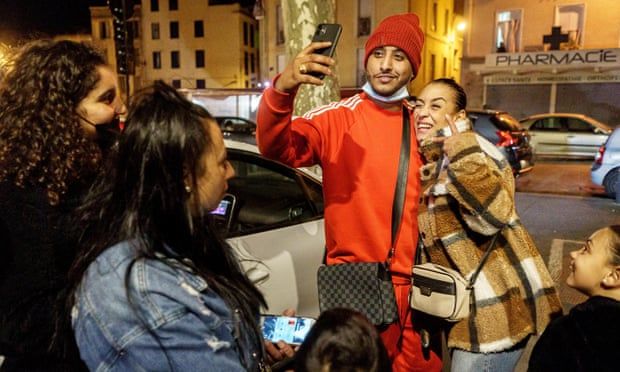 People taking photos or selfies with the influencer Nasser Sari, better known as Nas Das, in his hometown of Perpignan.
There are rappers, dancers, humorists and makeup artists from those places – but few instances of people simply documenting daily life. Nordine Idri, a 17-year-old from Marseille who recounted his former life as a drug-network lookout on YouTube, is another isolated example. Cinema about the cités (estates) – from La Haine to Intouchables to Girlhood – has tended to be steered by outsiders (2019’s Les Misérables was a rare high-profile example told by the residents themselves). But it seems surprising that social media, where all the technology needed fits into your pocket, hasn’t produced more chroniclers of the quartiers. Maybe the impulse in those impoverished places is more towards the aspirational kind of influencing.
NasDas likes flashing the cash, too. But the extraordinary thing is that he seems to give most of it away – he forks out banknotes on his feed almost every day. By summer this year, he was Snapchat’s top influencer in France (or so he claims – Snapchat won’t confirm with exact figures) and had successfully monetised his operation with commercial contracts and product placements: for dentists, online CV apps, iced tea, luxury cars, all sorts. He estimates that he gives away about 80% of what he earns – most of it privately, he says. Developing St Jacques is his main priority; with handouts, through education (he encourages truant kids to go to school and organises street clean-ups for his Snap feed) and by promoting local businesses.
The day before the race, this social-media Robin Hood sits sipping a café noisette at a table on Place Cassanyes. He is six feet tall, easygoing in the flesh compared with his antic Snapchat persona, but authoritative too. He says people coming from all over France for selfies with him proves that he has changed St Jacques’ image. As we talk, two brothers from Grenoble step up for a moment with their hero. But NasDas acknowledges that his neighbourhood won’t change overnight: “There’s a reality you shouldn’t hide. The level of violence is still quite high, unfortunately. In my eyes it’s too high, because I can’t stand violence.” In August a 23-year-old man was shot and killed outside a takeaway only metres away.
On NasDas’s finger is a gold lion signet ring. Maybe it stands for his mother, whom he describes as a “lion”. She is where he gets his sense of social responsibility from; she raised him and his four siblings solo after his father died when he was 10. They lived two floors above the abandoned police station on the corner of Place Cassanyes that became St Jacques’ key drug-dealing point. Some of his peers were earning €300 a day when he was 16, but she battled to keep him out of the trade. Now, with his newfound fame, he’s taking St Jacques under his wing.
At Perpignan’s funfair, the dusk sky has faded to dark ochre as the Day-Glo lights of the rides obscure the stars. Team NasDas is trying to do a “low-profile” trip, so he can chaperone his young niece and nephew. At least, as low-profile as you can be when you and your right-hand man, Samos, are dressed in matching white tracksuits. At the entrance, people are already peeking and whispering: “Il y a NasDas” (his niece is helpfully wearing a “NasDas la Chiennété” T-shirt). Soon they’re sidling up for a non-stop stream of photos. Next to the waltzers, we get bogged down by fans and well-wishers for nearly 20 minutes. “He’s so funny,” gush a couple of twentysomething local women. “He doesn’t give a damn.”
During hundreds of interactions, NasDas is staunchly friendly – but there is a weary lag in his eyes. He admits he has struggled with his breakneck rise to fame, and the constant requests for money and help: “There was a point I thought I was going mad. I just wanted to go and drink a coffee like everyone else, and I couldn’t.” When he began having anxiety attacks, his managers took him out to the countryside to get things in perspective. A couple of sessions with a therapist later, he got back on the horse.
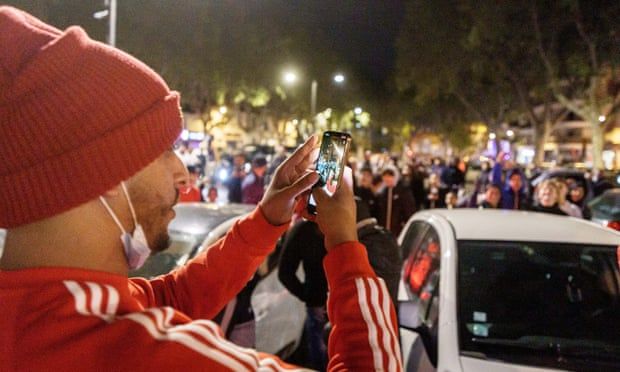 Nas Das takes a moment of respite to write a story on Snapchat, his favourite social network, in Perpignan.
Milling around him at the funfair is most of Team NasDas: Samos, the rail-thin, broken-toothed pal who often serves as his stooge in the videos; Tounsi, a burly, gruff twentysomething who is the only one NasDas was close to prior to fame; 4BDV, an urchin-like 17-year-old who looks 12 and whom NasDas took into his house after he showed up in St Jacques after crossing the Mediterranean from Algeria by boat (the influencer is applying to be his legal guardian); only Billy DZ – ill, apparently – isn’t present.
Now there is an entire infrastructure supporting the team: a total of 40 people – including two Paris influencer agencies – looking after technical support, event bookings, commercial opportunities and strategy. And NasDas is sizing up the world beyond social media; he will soon appear on TV talkshows, Netflix has contacted him about a possible documentary, and he plans to perform a one-man show at Paris’s 3,000-seater Olympia venue next year.
Even those things could be just the beginning. NasDas likes to use his feed to flex his social conscience, beyond handouts for the residents. He has often criticised Perpignan town hall’s management of St Jacques; dysfunctional and corrupt under previous administrations, but now with an extra vindictive edge under Louis Aliot, the only far-right Rassemblement National mayor of a major French city. The influencer recently turned his smartphone on the case of an eight-year-old taken into police custody (along with 4BDV) after being spotted on CCTV with a plastic pellet gun. Parking charges imposed in September on Place Cassanyes – which many residents can’t afford are another of NasDas’s targets. Whether it’s judicial or economic, he sees the intended effect in straightforward terms: “It’s repression.”
Now that NasDas has become a public figure, the town hall has begun taking notice of him, he says. “I think they’re even more offended because I’m not asking for their help. It disturbs them: a young Maghrebin who doesn’t ask for help and succeeds in sorting out the neighbourhood.” (The town hall did not respond to requests for comment.)
 Louis Aliot, the far-right mayor of Perpignan,
welcomes Marine Le Pen, the Rassemblement Nationale party leader, to
his town hall last July.
Louis Aliot, the far-right mayor of Perpignan,
welcomes Marine Le Pen, the Rassemblement Nationale party leader, to
his town hall last July.
But he could have the perfect reply. He plans to stand for the national assembly in June elections to attempt to become one of four MPs for Pyrenées-Orientales, the département of which Perpignan is capital. “I want to shatter the cliches,” he says. “I’m young, of colour, someone who dares. I want to annoy people a bit. To show France who we are.” Pyrenées-Orientales has about 350,000 registered voters; if only a portion of NasDas’s followers vote for him, he could be Snapchatting from parliament this time next year.
The pressures on NasDas aren’t just from the outside. St Jacques has a long history of unhealthy dependency on community figureheads with privileged access to power. Going back to the 1970s, there have been claims that patriarchs among some Gypsy families in St Jacques traded the community vote for political favours. Cash sums and white goods were allegedly distributed after elections; latterly jobs and influence over the long-mooted renovation of this tumbledown district.
Now NasDas, through the power conferred by social media, is the one with influence – in every sense. There can be no doubting his deep solicitude for St Jacques, but you wonder whether he can withstand the pressures he will probably face from inside his neighbourhood.
Just before the race, as we’re talking, he is collared by a community “big brother”, who harangues him in Arabic. Ten minutes later, he turns up again, demanding that NasDas speak to someone on the phone. What was that about? Apparently, the man is one of several intermediaries, including the man on the phone and someone else in prison, who are facilitating a product placement on Snapchat for a business in Paris. He was trying to get NasDas to lower his fee to €5,000, so he can take a larger, €3,000 cut of the original price.
The influencer insists it is just an isolated case; that he experiences virtually no open jealousy, and 99.99% of St Jacques is behind him. But you suspect that this coveting of the money and publicity NasDas is generating will increase as his star rises. In any case, he is irate: “It’s the people from here who you drag you down. People in prison who drag you down.”
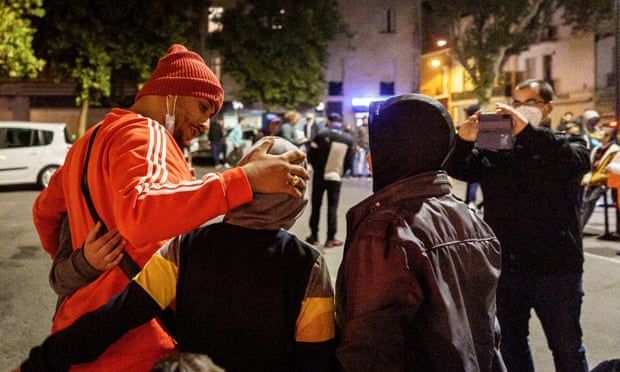 Nas Das with some of his fans.
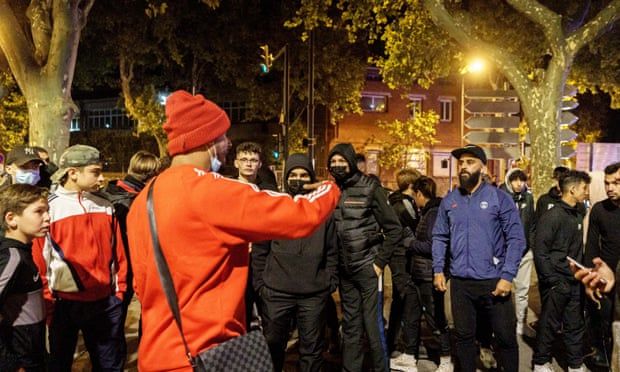 Nas Das has to spread the bad news: the race is called off because the police have been notified.
Half an hour later, on the racetrack of Place Cassanyes, another kind of people management is required. At 8.05pm, the square is heaving. “Disperse!” insists NasDas – and the throng loiters on all four sides, trying to look as inconspicuous as 300 people gathered for the same reason can.
Five minutes later, NasDas has called off the race. Three policeman on bikes are mingling among them; Tounsi reckons it’s a warning shot across the bows. With Aliot watching, there can’t be any slip-ups. The disappointed crowd starts filing away.
Grinning incredulously – as if wondering how all this has happened – NasDas retreats to a cafe to stream his reactions. He’s going nowhere: “I was in St Jacques before social media, I’m here during social media, and I’ll be here afterwards too.”