Budapest Post

Cum Deo pro Patria et Libertate
Budapest, Europe and world news

'I’ll buy five items and only keep one of them'

'I’ll buy five items and only keep one of them'

Online shopping has risen strongly during the pandemic, but this has also meant a big increase in the number of items being sent back because they don't fit, or aren't as expected. A number of tech firms are helping retailers deal with these higher returns levels.

While other people do dry January, Susie Ramroop normally practises "dry spending" at the start of the year, and makes sure she doesn't make any unnecessary purchases.

But during the UK's third lockdown, the leadership coach says that boredom has prompted her to relax that rule.

"I'll surf the John Lewis website like other people surf the news," she says.

"This week I took five big packages back to Royal Mail, then I came home and there were more parcels. I took back dresses, a skirt, four tops and a pair of shoes. If I'm not paying for postage I might as well."

Stuck between two dress sizes, and an avid clothes shopper, Susie knows she "creates a returns problem" every time she orders. And she is far from unusual.
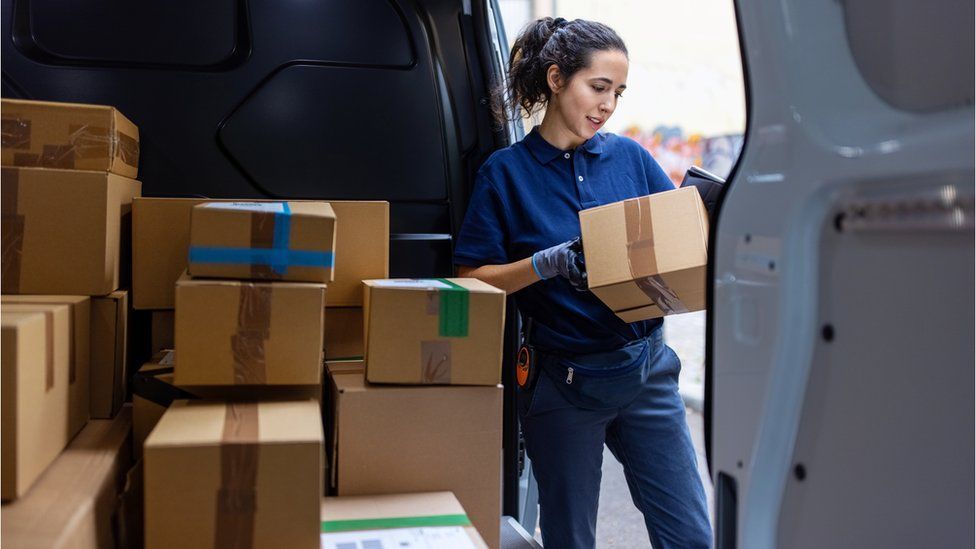
The pandemic has boosted online shopping volumes

Thanks to the lockdown, UK online sales rose by more than a third in 2020, the highest growth since 2007, according to online retail body IMRG.

One problem with this for retailers is that customers are far more likely to return items when they buy them online. This is especially the case for items of clothing, which obviously cannot be tried on first.

A quarter of all fashion goods bought online in 2019 were sent back, according to one report. For in-store purchases that figure is less than 10%.

And online return rates have soared further during the pandemic, according to market research group Mintel. It found that 38% of all UK online shoppers said that the Covid-19 outbreak "had made them more confident in returning online purchases".

"The legacy from Covid is higher return rates," says Nick Carroll, Mintel's associate director of retail research.

He says that younger shoppers were already happy to "buy, try, return", but during the pandemic this has also become learned behaviour for older customers. Mintel's study also found that almost half (49%) of UK online shoppers had sent something back in the past year, rising to 60% for those aged 16-34.

This trend has caused headaches for online retailers, who often pay to cover the cost of delivery and return, and have to find a way to get the item back into their supply chain.

Shoppers can hold on to goods for weeks, or even months, before sending them back, by which time the resale value may have plummeted, meaning goods sometimes end up in landfill.

Teacher Naomi Hodge had to buy maternity clothes online during the pandemic, but found the sizes "completely impossible to guess".

"I'm not normally the kind of person who would buy multiple sizes and then send lots back," she says. "But I was getting very uncomfortable in the clothes I had, and needed something that fitted.

Naomi Hodge struggled to buy clothes online while pregnant
"I feel bad about the environmental impact and all the extra journeys delivery drivers have been making, I don't like messing retailers around either."

To solve problems like these, a number of tech firms are trying to make the returns process as slick and environmentally friendly as possible.

Rebound Returns, which manages about 40 million returns transactions a year, saw its global volumes shoot up by 63% during the pandemic.

The UK firm looks after the online returns process for clothing retailers like Asos, Boden and Gymshark, and asks customers to fill in their details online every time they request a return.

Rebound Returns - who shoppers will not be aware of, as it operates within the retailers' websites - flags up when a return is coming, meaning that the retailer can process the refund quickly and get the stock turned around.

The firms can also use this data to compare what their customers buy with what they send back, meaning they can target shoppers with correctly sized items.

"Brands are asking us how to target the right product to the right person, and improve the returns experience," says Rebound Returns chief executive Graham Best. "Consumers want choice, but they don't want every choice in the world. They want intelligent choice and that creates loyalty."

Rebound Returns also adds up the carbon footprint of its supply chain and passes that on to the retailer, so they can give customers the chance to make "sustainable choices" at the checkout, such as a slower delivery time, or the chance to make a charity donation.

This idea holds strong appeal for Steph Naylor, a data privacy manager from Woking, Surrey.

Steph Naylor says she tries not to choose next-day delivery for items

"A couple of years ago I used to do so much online shopping, to the point where I got two or three parcels every other day. Now I'll actively try not to choose next-day delivery. I'm not going anywhere, and I don't mind if it takes longer to reach me.

"It would be great to see on the checkout page when you make that choice between next day or longer delivery what the carbon footprint is of those options, " she says.

"If you could see the environmental impact, people would make more responsible choices. It would definitely make a big difference to me."

Swedish start-up Returnado, which manages the returns on behalf of clothing brands such as Musto and Helly Hansen, has taken a slightly different approach to boosting sustainability.

Haider Abdo, founder of Returnado, was struck by how much easier it was to buy items than to return them

Customers are asked to upload a photo of the item they are returning so brands can assess the product's condition, and work out whether it should be returned, partially refunded, repaired, or if it can be disposed of locally.

Shoppers are also offered alternative items based on what they've bought previously, which leads to about 30% of returns being turned into exchanges, the company says.

Haider Abdo founded Returnado after spotting the mismatch between the ease of buying things online, and the difficulty of returning them.

"This doesn't just have an impact on the number of unreturned goods being sat on by consumers, but also their sentiment towards the brand and the likelihood of items ending up in landfill," he says.

AI Disclaimer: An advanced artificial intelligence (AI) system generated the content of this page on its own. This innovative technology conducts extensive research from a variety of reliable sources, performs rigorous fact-checking and verification, cleans up and balances biased or manipulated content, and presents a minimal factual summary that is just enough yet essential for you to function as an informed and educated citizen. Please keep in mind, however, that this system is an evolving technology, and as a result, the article may contain accidental inaccuracies or errors. We urge you to help us improve our site by reporting any inaccuracies you find using the "Contact Us" link at the bottom of this page. Your helpful feedback helps us improve our system and deliver more precise content. When you find an article of interest here, please look for the full and extensive coverage of this topic in traditional news sources, as they are written by professional journalists that we try to support, not replace. We appreciate your understanding and assistance.
Newsletter

Related Articles

0:00
0:00
Close
United Nations Calls for Global Action Against Disinformation and Hate Speech Online
Tucker Carlson warns of an inevitable clash in Western societies over mass migration
OpenAI CEO Sam Altman praises the rapid progress of Chinese tech companies.
Poland's President Karol Nawrocki ENDS support for Ukrainian citizens:
Italy's PM Giorgia Meloni highlights record employment and economic growth
Chancellor Friedrich Merz Re-elected as CDU Leader, Opposes AfD Influence
Trump Directs Government to Release UFO and Alien Information
Trump Signs Global 10% Tariffs on Imports
UK Government Considers Law to Remove Prince Andrew from Royal Line of Succession
Two teens arrested in France for alleged terror plot.
US Supreme Court Voids Trump’s Emergency Tariff Plan, Reshaping Trade Power and Fiscal Risk
Greek Prime Minister Kyriakos Mitsotakis advocates for a ban on minors using social media.
Meanwhile in Time Square, NYC One of the most famous landmarks
Jensen Huang just told the story of how Elon Musk became NVIDIA’s very first customer for their powerful AI supercomputer
Former British Prince Andrew Arrested on Suspicion of Misconduct in Public Office
Former President Yoon Suk Yeol Sentenced to Life in Prison for Abuse of Authority
Unitree Robotics founder Wang Xingxing showcases future robot deployment during Spring Festival Gala.
German Chancellor Friedrich Merz calls for real name use on social media.
Italian Police Arrest Man After Alleged Attempt to Abduct Toddler at Bergamo Supermarket, Child Hospitalised With Fractured Femur
British Tourist Arrested at Hong Kong Airport After Meltdown and Vandalism
European Commission Plans Purchase Incentives Limited to Vehicles Manufactured Largely in the EU
French District of Pas-de-Calais Introduces Immediate License Suspension for Drivers Using Mobile Phones
Volkswagen Targets €60 Billion in Cost Reductions as Sales Decline and Global Pressures Intensify
Eighty-Year-Old Lottery Winner Sentenced to 16.5 Years for Drug Trafficking
Rubio Calls for Sweeping U.N. Reform, Saying It Has Failed to End Wars in Gaza and Ukraine
10,000 Condoms Distributed at Winter Olympics 2026 Athlete Village Depleted Within 72 Hours
Poland's President Advocates for Evaluating Independent Nuclear Weapons Development
Mayor of Serdobsk in Russia’s Penza Region Resigns After Housing Certificates Granted to Migrant Family Trigger Public Outcry
China’s EV Makers Face Mandatory Return to Physical Buttons and Door Handles in Driver-Distraction Safety Overhaul
UK Green Party Considering Proposal to Legalize Heroin for an Inclusive Society
OpenAI and DeepCent Superintelligence Race: Artificial General Intelligence and AI Agents as a National Security Arms Race
We will protect them from the digital Wild West.’ Another country will ban social media for under-16s
Heineken announces cut of 6,000 jobs due to declining beer demand
Apple iPhone Lockdown Mode blocks FBI data access in journalist device seizure
Belgium: Man Charged with Rape After Faking Payment to Sex Worker
KPMG Urges Auditor to Relay AI Cost Savings
Canada Opens First Consulate in Greenland Amid Rising Geopolitical Tensions
China unveils plans for a 'Death Star' capable of launching missile strikes from space
Investigation Launched at Winter Olympics Over Ski Jumpers Injecting Hyaluronic Acid
U.S. State Department Issues Urgent Travel Warning for Citizens to Leave Iran Immediately
Wall Street Erases All Gains of 2026; Bitcoin Plummets 14% to $63,000
Eighty-one-year-old man in the United States fatally shoots Uber driver after scam threat
Political Censorship: French Prosecutors Raid Musk’s X Offices in Paris
AI Invented “Hot Springs” — Tourists Arrived and Were Shocked
France Begins Phasing Out Zoom and Microsoft Teams to Advance Digital Sovereignty
Tech Market Shifts and AI Investment Surge Drive Global Innovation and Layoffs
Global Shifts in War, Trade, Energy and Security Mark Major International Developments
Markets Jolt as AI Spending, US Policy Shifts, and Global Security Moves Drive New Volatility
Tesla Ends Model S and X Production and Sends $2 Billion to xAI as 2025 Revenue Declines
Starmer Signals UK Push for a More ‘Sophisticated’ Relationship With China in Talks With Xi
×