Budapest Post

Cum Deo pro Patria et Libertate
Budapest, Europe and world news

E-bike sales boom despite high prices and confusing rules

E-bike sales boom despite high prices and confusing rules

On a warm and uncomfortably humid afternoon in Washington DC's sprawling Rock Creek Park, 53-year old Dutchman and former World Bank executive Gregory Maassen is swiftly biking up an exceptionally sharp incline - barely breaking a sweat as he pedals.

"The hills are pretty steep here," he says. "Despite the fact that I like to bicycle - as most Dutch people do - it was not practical. That's how I got into e-biking. I got one in 2019 and the rest is history."

Mr Maassen, the founder of a 250-person strong E-bike Lovers club in the US capital, is one of hundreds of thousands who have turned to electric bicycles for fun or to get around their cities and towns.

Put simply, an e-bike is any bicycle that uses an integrated electric motor to assist in propulsion. While some come equipped with a throttle and can be used like a moped, they can all be pedalled - a distinction that legally separates them from electric motorcycles.

In the US, the industry, rather than the government, broadly puts e-bikes into one of three categories.

Class 1 e-bikes are equipped with a motor that provides assistance only when pedalling, with the assistance stopping when the bike reaches 20mph (32km/h) while Class 2 e-bikes come equipped with a throttle that can be used to propel the e-bike to that same speed.

Class 3 bikes come equipped with a motor that provides assistance only when the rider is pedalling, stopping when the e-bike reaches 28mph (45km/h).
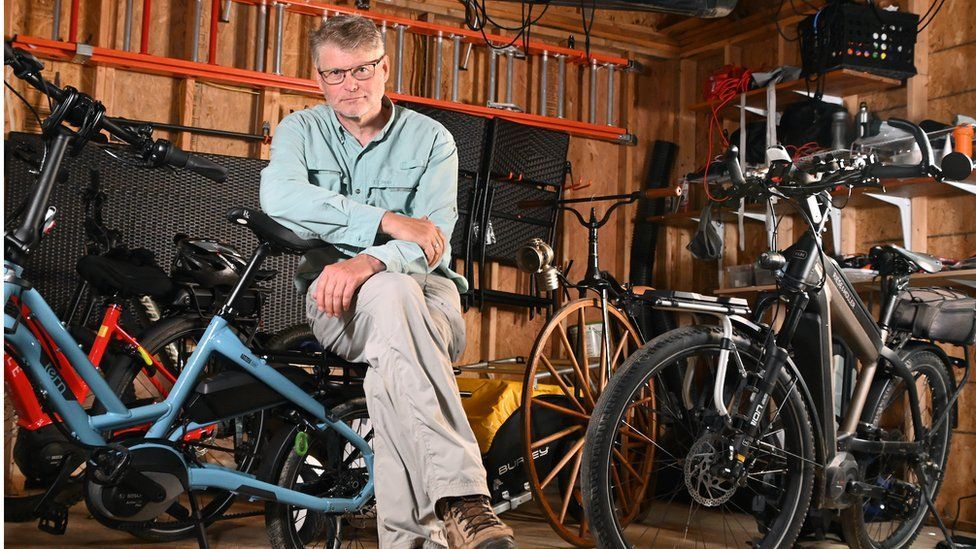
E-bike riders often don't know what type of bike they own says Gregory Maassen

According to Mr Maassen, however, the classification system remains confusing, with riders themselves often not knowing exactly what kind of bike they are using.

"It's difficult to understand what they are, because they all look the same," he explains. "It's very often just a matter of software that makes a difference.

"Then you have conversion kits. People build their own e-bikes, and there's no classification at all, or people buy stuff on the internet, with who knows what kind of specifications," Mr Maassen adds. "That's very difficult to enforce."

Industry experts say the sector is riven by varied rules and regulations across local jurisdictions or internationally, with governments, manufacturers and industry groups offering a dizzying array of ways to compare and contrast e-bikes.

In the US, for example, the National Park Service ignores the industry classification system and instead deems that e-bikes of any class can operate on park grounds alongside bicycles, provided their engines do not provide more than 750 watts of power.

In the EU and UK e-bikes must not deliver any power without the user having to pedal and must never deliver more than 250W of continuous power. Power delivery has to cut out at 15.5mph (25km/h), but the rider can go faster unassisted.

Confusion over e-bikes could end in legal wrangles, says Richard Alvin

"It's frustrating, to say the least," says Richard Alvin, a London-based former adviser to the UK government and group managing director at EV Powered, a firm that analyses and reviews electric vehicles.

"The whole principle behind e-bikes is to make it easier for cyclists to travel further distances in an environmentally friendly way. Often, they invest a lot of money in the purchase and could potentially be unable to use it to its full potential due to differing interpretations of the laws."

Claudia Wasko, the California-based vice president and general manager of Bosch eBike Systems Americas, says that confusing rules - along with media and marketing materials that wrongly identify vehicles as e-bikes - could have even more serious consequences.

"Using them on facilities designed and designated for the use of bicycles and e-bikes may result in user conflicts, may be illegal if being ridden in areas designated for bicycles, or if equipped as a bicycle, may jeopardise efforts to promote uniform laws and gain wider acceptance."

Yet the confusing regulations have done little to dampen growing public enthusiasm for the technology.

In the US alone, e-bike sales rose 116% from $8.3m in February 2019 to $18m (£12m) a year later - just before the impact of Covid - according market research firm NPD and the advocacy group People For Bikes. By February this year, sales had reached $39m.

Demand for e-bikes outstripped supplies during the pandemic, says Terika Haynes

Terika Haynes, the chief executive and founder of DT Scooters, a Florida-based online retailer specialising in electric scooters and e-bikes, says suppliers were often unable to keep up with demand during the pandemic due to factory closures and supply chain disruptions.

"We're still dealing with it. It was unfortunate, it was our time to shine with everybody wanting to get out, exercise, and wanting to buy an e-bike. But the supply just wasn't there."

However, once these issues subside Ms Haynes believes e-bike adoption will continue to grow, partly as a result of increased usage as an alternative form of urban mobility, or by companies using them as easier alternatives to bicycle tours in cities across the globe.

As an example, she notes that DT Scooters was able to bulk purchase a number of e-bikes - at "a really good wholesale price" - that were originally intended to be used by a ride-sharing company in Europe before the pandemic.

In the shorter-term, the relatively high price of e-bikes may be prohibitive for casual riders. They often cost between $1,500-4,000 (£1,000-2,800), with some higher-end machines costing up to $10,000, depending on which accessories are included.

"Prices are going up, and that's across all categories of both analogue bikes and electric bikes," says Ryan Birkicht of Pacific Cycle, which sells e-bikes under the Schwinn brand.

"The supply chain is still stressed and [manufacturers] are getting charged more for circuit boards or different electric components. I would imagine that for several years we are going to continue seeing the costs of electric bikes go up."

In the long term, he says prices will fall as more e-bikes are produced, and more potential e-bike riders are exposed to the technology.

"Electric bikes are something exciting. When you throw your leg over an e-bike, that's when it kind of clicks. It provides a lot of opportunities to do things maybe you wouldn't be able to on an analogue bike. I'd just encourage everyone to give it a shot."

AI Disclaimer: An advanced artificial intelligence (AI) system generated the content of this page on its own. This innovative technology conducts extensive research from a variety of reliable sources, performs rigorous fact-checking and verification, cleans up and balances biased or manipulated content, and presents a minimal factual summary that is just enough yet essential for you to function as an informed and educated citizen. Please keep in mind, however, that this system is an evolving technology, and as a result, the article may contain accidental inaccuracies or errors. We urge you to help us improve our site by reporting any inaccuracies you find using the "Contact Us" link at the bottom of this page. Your helpful feedback helps us improve our system and deliver more precise content. When you find an article of interest here, please look for the full and extensive coverage of this topic in traditional news sources, as they are written by professional journalists that we try to support, not replace. We appreciate your understanding and assistance.
Newsletter

Related Articles

0:00
0:00
Close
Japanese Technology Firm Fujitsu Launches Advanced Artificial Intelligence Tool for Corporate Disclosures
South Africa Officially Launches Nationwide Campaign for Highly Contested Local Government Elections
United Kingdom Commits Additional Funding for Unexploded Ordnance Clearance in Laos
Singapore Announces Stringent New Greenhouse Gas Regulations for Commercial Cooling Systems
Cambodia and Thailand Hold High-Level Border Security Talks at United Nations Headquarters
Myanmar Military Government and China Sign Major Agreement to Upgrade Media and Cultural Cooperation
Knife Attack at Swiss Train Station Leaves Three Injured in Suspected Act of Domestic Terrorism
Transnational Extortion Gang Threatens Canadian Police With Army of One Thousand Armed Operatives
Australia Imposes Forty-Two-Day Quarantine on Cruise Ship Passengers Following Deadly Hantavirus Outbreak
International Monetary Fund Unlocks Seven Hundred Million United States Dollars for Sri Lanka Following Economic Reforms
Australia Launches Record One Point Four Billion Dollar Lawsuit Against Chemical Giant 3M Over Contamination
China and Canada Foreign Ministers Meet in Ottawa in Effort to Stabilize Strained Diplomatic Ties
Indonesia Demands Urgent United Nations Security Council Reform Amid Escalating Global Conflicts
Extreme Weather Patterns Trigger Severe Drought in Madagascar and Destructive Flooding in East Africa
Indian State of Karnataka Faces Political Upheaval as Chief Minister Siddaramaiah Abruptly Resigns
Philippines and Japan Reaffirm Defense Ties as Crucial for Indo-Pacific Regional Stability
Norway Joins French Nuclear Deterrence Initiative in Major Shift for European Security Architecture
Global Critical Mineral Alliances Expand as Western Nations Move to Counter Chinese Supply Dominance
United States Imposes Fifty Percent Tariffs on Mexican Steel and Aluminum Ahead of Trade Pact Review
European Union and China Head Toward Major Trade Conflict Over Clean Technology Exports
United States Economic Growth Severely Downgraded to One Point Six Percent as Stagflation Fears Mount
World Health Organization Warns Central African Ebola Epidemic is Outpacing Containment Efforts
United States Treasury Department Conditions Sanctions Relief on Reopening of the Strait of Hormuz
Iranian Air Defenses Intercept and Destroy United States Military Drone Over Bushehr Province
Iranian Armed Forces Launch Ballistic Missiles Toward Unspecified Targets Prompting Regional Condemnation
United Nations Secretary-General Warns Global Order Facing Highest Level of Conflict Since 1945
Israel Issues Sweeping Evacuation Orders in Southern Lebanon Amid Intensified Hezbollah Conflict
Russia Announces Systemic Military Strikes Targeting Ukrainian Defense and Energy Infrastructure
United States and Iranian Negotiators Reach Draft Agreement to Extend Ceasefire and Resume Nuclear Talks
United Nations Security Council Deeply Divided Over United States Capture of Venezuelan President
US and Iran Exchange Direct Military Strikes Amid Fragile Gulf Ceasefire
World Health Organization Warns of Catastrophic Ebola Outbreak in DR Congo
Russia Threatens New Wave of Strikes on Ukrainian Infrastructure and Embassies
Scientists Warn Atlantic Ocean Currents Could Collapse Faster Than Projected
Anthropic Reaches $900 Billion Valuation in Historic AI Funding Round
Washington Imposes Crippling Sanctions on Iranian Maritime Authority
Japan and the Philippines Initiate Strategic Intelligence-Sharing Pact
Microsoft Deploys Autonomous Computer-Using AI Agents to Global Markets
Anthropic Secures $45 Billion Compute Infrastructure Agreement With SpaceX
U.S. Director of National Intelligence Resigns Amid Administration Shakeup
Micron Technology Crosses Trillion-Dollar Valuation Amid Unprecedented Hardware Demand
Canada and Germany Finalize Historic Long-Term LNG Export Agreement
China Expands International Travel Restrictions on Domestic AI Researchers
Japan Approves Sweeping Overhaul of National Intelligence Apparatus
Global Airlines Scramble Logistics as Middle East Airspace Remains Fractured
Japan's Naphtha Imports Plunge 47 Percent Amid Strait of Hormuz Closure
Global Crude Prices Retreat Below $96 as Gulf Tensions Momentarily Ease
Generative AI Outperforms Human Baselines in Landmark Global Creativity Study
NASA Partners With Private Aerospace to Unveil Permanent Lunar Base Architecture
South Korean Equity Markets Surge on Next-Generation Memory Chip Frenzy
×