Budapest Post

Cum Deo pro Patria et Libertate
Budapest, Europe and world news

Coronavirus’ global death toll may hit 5 million by March

Coronavirus’ global death toll may hit 5 million by March

In worst case, the number of Covid-19 infections in the United States could rise to 32 million, study says.

A team of Chinese experts has warned that the global impact of the coronavirus pandemic could be worse this year than it was in 2020.

By the beginning of March, the death toll from Covid-19 could rise to 5 million – from just under 2 million on Thursday – according to figures calculated by a team from China’s Centre for Disease Control and Prevention (CDC), People’s Liberation Army and public health research institutes.

The researchers, led by professor Xu Jianguo from the CDC, said in a study published on January 8 in the peer-reviewed journal Disease Surveillance that the Chinese government and the public should brace for more external shocks.

“The development of the pandemic is hard to foresee, but a numerical estimate by modelling can provide some useful information,” Xu said.


While China has largely brought Covid-19 under control, many countries are still dealing with widespread outbreaks partly driven by mutated strains. Some of the mutations are believed to have emerged in communities where herd immunity had already been established.

More than 92 million cases have been reported around the world, but that number could rise to 170 million in early March, with the United States likely to be the worst hit, according to Xu’s estimate.

In the worst case, the number of US cases could hit 32 million, or about 20 per cent of the world total. India, Brazil and Russia would be the next worst hit, with 15.5, 15 and 6 million cases respectively.

The researchers did not provide an estimate of the possible death toll in the four worst-hit countries and did not immediately respond to a request for comment.

Even in the best scenario – with governments implementing effective measures, people obeying rules such as social distancing and wearing masks, and massive vaccination programmes taking effect – the study said a further 300,000 people would die from Covid-19 by early March.

To achieve the best scenario the US would have to keep its cases at about 26 million, or no more than 3 million new infections in the intervening weeks, the study said. The US reported more than 1.7 million cases last week alone.


A researcher at the Institut Pasteur of Shanghai who is investigating the coronavirus but was not involved in the study, said that if 5 million people died by March, it could lead to the collapse of the global health care system.

“People die en masse when they cannot get even the most basic care in hospitals,” said the person, who asked not to be named.

The current global fatality rate of Covid-19 is 2.1 per cent, according to figures from Johns Hopkins University in the US. A rise in the death toll to 5 million would represent a death rate of 3 per cent, which was about the level in Wuhan when hospitals were overwhelmed by the then new disease.

Benjamin Neuman, a professor of biology and GHRC chief virologist at Texas A&M University, said there were many uncertainties in trying to predict the course of the pandemic, including fatigue, politics, traditions, attitudes towards science and the spread of false information.

“In the best case, with common sense, suitable precautions, and the current crop of effective vaccines, the total would not ever have to reach 3 million deaths,” he said.

“The worst case scenario could be much worse than 7 million … the future of Covid-19 is very much in our hands.”

Xu led one of the first expert teams sent by the Chinese government to investigate the outbreak in Wuhan. Other collaborators in the study were all lead scientists in China’s top military and civilian research institutes on infectious diseases. The study was commissioned by the Chinese Academy of Engineering, a major advisory body to China’s leaders.
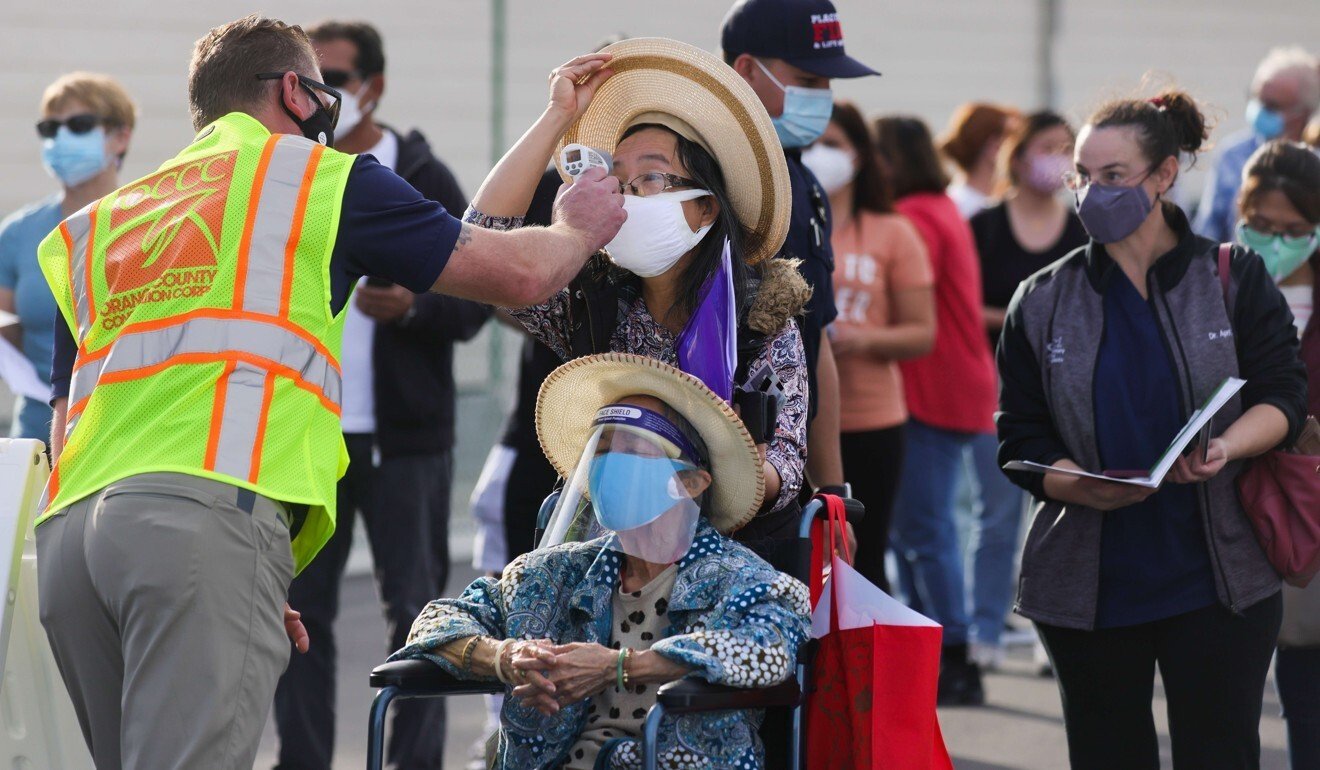

Several countries have launched mass vaccination programmes, but the Chinese team have urged Beijing to hold fire.


China’s best weapon against the pandemic is containment, but an increasing amount of scientific evidence suggests SARS-CoV-2 virus is evolving, like flu, according to Xu and his colleagues.

If the virus managed to adapt to the human body as well as the influenza virus it could hide in the population and reappear every season, they said.

And many people carrying the virus would show no symptoms and live life as normal. How long China’s strategy of containment remained effective was highly uncertain, they said.

Although some countries, including the US and Britain, have launched mass vaccination programmes, the researchers urged Beijing to wait.

They argued that as the virus mutates, antibodies generated by vaccines could be used by mutated strains as a decoy to cheat the human immune system and get into host cells more easily, making the illness even worse.

“In areas with few or no cases, there is no need to launch large scale vaccinations,” they said, adding that China should watch closely the side effects of various vaccine products overseas before inoculating its entire population.

The researchers also said the Chinese government and military should establish a nationwide testing and contact tracing network using big data and artificial intelligence. National testing facilities would need to test up to 1 million individuals a day in order to cut off the transmission chain of an outbreak, they said.

China would also need to establish large scale facilities to disinfect cargoes from overseas, while all animals, including pets, would have to be monitored constantly to prevent them becoming hosts of the virus.

The emergence of new infectious diseases “may become a new normal”, they said.

AI Disclaimer: An advanced artificial intelligence (AI) system generated the content of this page on its own. This innovative technology conducts extensive research from a variety of reliable sources, performs rigorous fact-checking and verification, cleans up and balances biased or manipulated content, and presents a minimal factual summary that is just enough yet essential for you to function as an informed and educated citizen. Please keep in mind, however, that this system is an evolving technology, and as a result, the article may contain accidental inaccuracies or errors. We urge you to help us improve our site by reporting any inaccuracies you find using the "Contact Us" link at the bottom of this page. Your helpful feedback helps us improve our system and deliver more precise content. When you find an article of interest here, please look for the full and extensive coverage of this topic in traditional news sources, as they are written by professional journalists that we try to support, not replace. We appreciate your understanding and assistance.
Newsletter

Related Articles

0:00
0:00
Close
Japanese Technology Firm Fujitsu Launches Advanced Artificial Intelligence Tool for Corporate Disclosures
South Africa Officially Launches Nationwide Campaign for Highly Contested Local Government Elections
United Kingdom Commits Additional Funding for Unexploded Ordnance Clearance in Laos
Singapore Announces Stringent New Greenhouse Gas Regulations for Commercial Cooling Systems
Cambodia and Thailand Hold High-Level Border Security Talks at United Nations Headquarters
Myanmar Military Government and China Sign Major Agreement to Upgrade Media and Cultural Cooperation
Knife Attack at Swiss Train Station Leaves Three Injured in Suspected Act of Domestic Terrorism
Transnational Extortion Gang Threatens Canadian Police With Army of One Thousand Armed Operatives
Australia Imposes Forty-Two-Day Quarantine on Cruise Ship Passengers Following Deadly Hantavirus Outbreak
International Monetary Fund Unlocks Seven Hundred Million United States Dollars for Sri Lanka Following Economic Reforms
Australia Launches Record One Point Four Billion Dollar Lawsuit Against Chemical Giant 3M Over Contamination
China and Canada Foreign Ministers Meet in Ottawa in Effort to Stabilize Strained Diplomatic Ties
Indonesia Demands Urgent United Nations Security Council Reform Amid Escalating Global Conflicts
Extreme Weather Patterns Trigger Severe Drought in Madagascar and Destructive Flooding in East Africa
Indian State of Karnataka Faces Political Upheaval as Chief Minister Siddaramaiah Abruptly Resigns
Philippines and Japan Reaffirm Defense Ties as Crucial for Indo-Pacific Regional Stability
Norway Joins French Nuclear Deterrence Initiative in Major Shift for European Security Architecture
Global Critical Mineral Alliances Expand as Western Nations Move to Counter Chinese Supply Dominance
United States Imposes Fifty Percent Tariffs on Mexican Steel and Aluminum Ahead of Trade Pact Review
European Union and China Head Toward Major Trade Conflict Over Clean Technology Exports
United States Economic Growth Severely Downgraded to One Point Six Percent as Stagflation Fears Mount
World Health Organization Warns Central African Ebola Epidemic is Outpacing Containment Efforts
United States Treasury Department Conditions Sanctions Relief on Reopening of the Strait of Hormuz
Iranian Air Defenses Intercept and Destroy United States Military Drone Over Bushehr Province
Iranian Armed Forces Launch Ballistic Missiles Toward Unspecified Targets Prompting Regional Condemnation
United Nations Secretary-General Warns Global Order Facing Highest Level of Conflict Since 1945
Israel Issues Sweeping Evacuation Orders in Southern Lebanon Amid Intensified Hezbollah Conflict
Russia Announces Systemic Military Strikes Targeting Ukrainian Defense and Energy Infrastructure
United States and Iranian Negotiators Reach Draft Agreement to Extend Ceasefire and Resume Nuclear Talks
United Nations Security Council Deeply Divided Over United States Capture of Venezuelan President
US and Iran Exchange Direct Military Strikes Amid Fragile Gulf Ceasefire
World Health Organization Warns of Catastrophic Ebola Outbreak in DR Congo
Russia Threatens New Wave of Strikes on Ukrainian Infrastructure and Embassies
Scientists Warn Atlantic Ocean Currents Could Collapse Faster Than Projected
Anthropic Reaches $900 Billion Valuation in Historic AI Funding Round
Washington Imposes Crippling Sanctions on Iranian Maritime Authority
Japan and the Philippines Initiate Strategic Intelligence-Sharing Pact
Microsoft Deploys Autonomous Computer-Using AI Agents to Global Markets
Anthropic Secures $45 Billion Compute Infrastructure Agreement With SpaceX
U.S. Director of National Intelligence Resigns Amid Administration Shakeup
Micron Technology Crosses Trillion-Dollar Valuation Amid Unprecedented Hardware Demand
Canada and Germany Finalize Historic Long-Term LNG Export Agreement
China Expands International Travel Restrictions on Domestic AI Researchers
Japan Approves Sweeping Overhaul of National Intelligence Apparatus
Global Airlines Scramble Logistics as Middle East Airspace Remains Fractured
Japan's Naphtha Imports Plunge 47 Percent Amid Strait of Hormuz Closure
Global Crude Prices Retreat Below $96 as Gulf Tensions Momentarily Ease
Generative AI Outperforms Human Baselines in Landmark Global Creativity Study
NASA Partners With Private Aerospace to Unveil Permanent Lunar Base Architecture
South Korean Equity Markets Surge on Next-Generation Memory Chip Frenzy
×