

Coronavirus and travel: Everything you need to know
The US Centers for Disease Control and Prevention is still urging Americans -- even those who have been vaccinated -- not to travel, although a recent uptick in the number of passengers screened at US airport checkpoints indicates that people are traveling again in greater numbers.
In the locked down United Kingdom, it is currently illegal to travel abroad to vacation.
So in many cases, we may be getting ahead of ourselves. But there is no doubt that interest in traveling and making future plans is picking up -- raising lots of questions about how to safely navigate the new travel landscape.
Each country has its own tangle of rules and restrictions, so almost any trip will require deep pre-travel research.
Here's what you need to consider as the pandemic eases:
Even if I can travel, should I?
Restrictions vary widely across the world, and for many people it is possible to travel domestically and internationally. Yet many public health officials would advise against it. As noted, the CDC recommends against travel right now.
"We are very worried about transmissible variants. A lot of them have come through our travel corridors, so we're being extra cautious right now with travel," CDC director Dr. Rochelle Walensky told CNN's Anderson Cooper on March 11.
Walensky noted that every time travel escalates, a surge in coronavirus cases follows, citing Independence Day, Labor Day and the winter holiday season.
That said, the agency does provide detailed considerations for those who feel they must travel, as well as a tiered assessment of the least and most risky types of travel and traveler behaviors.
Canada advises against all nonessential travel outside Canada until further notice.
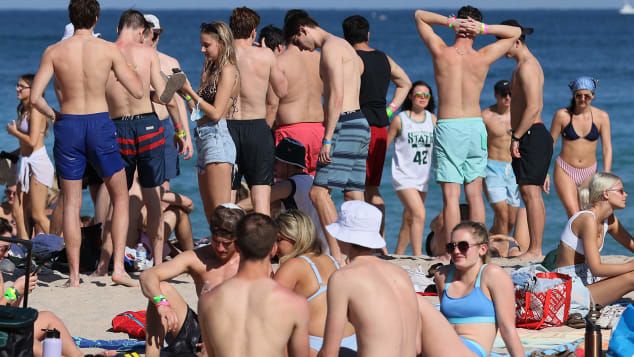 City officials in Fort Lauderdale, Florida, are anticipating a large spring break crowd this month.
Can I travel within my own country?
As with most things pandemic-related, it depends on where you live. Leisure travel is completely out of bounds for the moment in the UK, although destinations are already bracing for a huge influx of domestic travelers when the lockdown eases later this spring.
In Canada, there are no federal travel requirements for Canadians traveling between provinces and territories, although there are provincial or territorial rules and restrictions in many cases and nonessential travel is discouraged.
In the US, some states have restrictions and mandates that apply to travelers, while others offer unrestricted access to visitors. See a compilation of those evolving policies here.
In Germany, overnight stays in hotels for tourism purposes are prohibited.
No matter where you are, it's important to check regional and national websites and resources for guidance and restrictions on travel.
Do I need a negative Covid-19 test to travel internationally?
In a great many cases, yes, you will need a negative Covid-19 test before you travel to another country.
But again, it depends on your destination. Check local government and tourism sites for Covid-related requirements. CNN Travel's Unlocking the World guides offer up to date information on many popular destinations
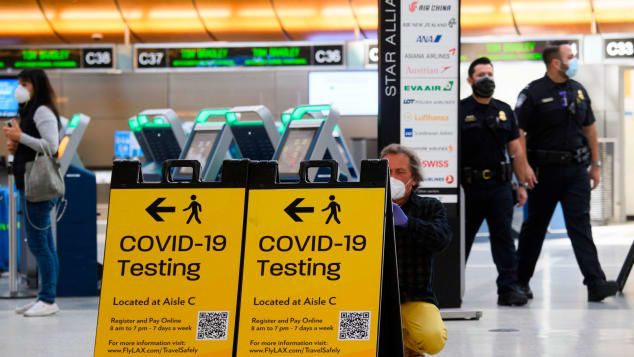 A traveler takes a photo of a Covid-19 testing sign at Los Angeles International Airport (LAX) in February 2021.
The time frame for getting a test before departure varies by destination and there can be requirements around the type of test or the testing provider, as is the case for Hawaii.
Not every destination requires a test. For example, Mexico has one of the world's most relaxed travel policies. The country currently does not require testing or quarantine for international arrivals.
But in Europe, many destinations have barred nonessential travel such as tourism from non-European Union countries and tests are required for entry.
Do I need a negative Covid-19 test to get into the United States?
All air passengers two years of age and older entering the United States must have a negative Covid-19 test result taken within three days of your flight to the US or documentation indicating you have recovered from Covid-19.
The requirement includes US citizens and legal permanent residents returning to the United States.
Nonessential travel is restricted across US land borders with Canada and Mexico.
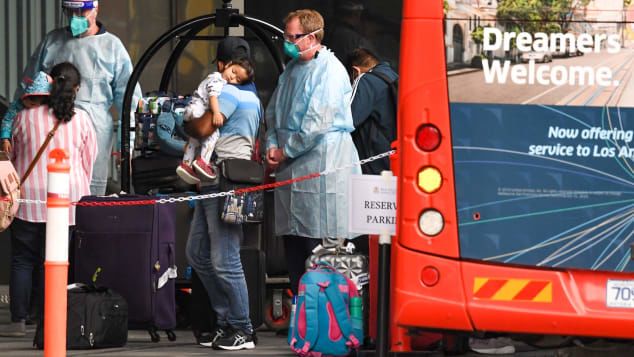 Travelers arrive at a hotel in Melbourne, Australia, to quarantine in December 2020.
Will I have to quarantine?
Some countries require all travelers to quarantine and have narrow restrictions on the acceptable reasons for entering at all. Others have no quarantine requirements (Mexico, for one) or are much less restrictive.
Travelers entering Canada, including those who have tested negative or recovered from Covid-19 or have been vaccinated, must quarantine or face fines or more severe penalties. International leisure and tourism arrivals are barred from entry.
Many popular tourism destinations in the Caribbean and elsewhere have adopted testing rules that allow international arrivals to bypass quarantine requirements with negative results.
The US CDC recommends getting tested and quarantining after travel, but it is not mandatory.
It's important to check on specific requirements for your destination and for returning home.
Do I have to be vaccinated for international travel?
It's complicated. Some countries are starting to open borders to vaccinated travelers who would otherwise be barred from entry. Travelers from non-Schengen countries, including the US and the UK, will soon be allowed to visit Iceland with proof of vaccination or having recovered from Covid.
Some countries are allowing vaccinated travelers to bypass entry requirements they would otherwise need to comply with such as negative Covid-19 tests and quarantines. For example, travelers to Belize can bypass pre-departure Covid tests.
So while being vaccinated may not be a requirement to travel, proof of vaccination could significantly smooth the journey.
But being vaccinated is far from a carte blanche. Some countries are only welcoming vaccinated travelers from specific areas, such as the European Economic Area. And many haven't yet made a decision on vaccinated visitors.
So even if you're vaccinated, you'll need to make sure your destination is welcoming inoculated travelers from your location.
 International air travelers are likely to share health information in the future via new apps.
How do I share my test results and vaccination status with travel providers?
The confusing tangle of Covid regulations continues.
In the US, incoming travelers must present a "verifiable test result" to their airline. It "must be in the form of written documentation (paper or electronic copy) of a laboratory test result," according to the CDC.
When possible, take both electronic and paper copies wherever you travel.
The process for sharing test results and vaccination status varies by destination and in some cases they are only valid in specific languages.
There are a number of digital applications -- commonly referred to as "vaccine passports" or "vaccination certificates" -- in development that aim to streamline health information so that it's securely shareable across borders.
Numerous international airlines have plans to trial the International Air Transport Association's Travel Pass. Clear's Health Pass and Common Pass are also health information apps.
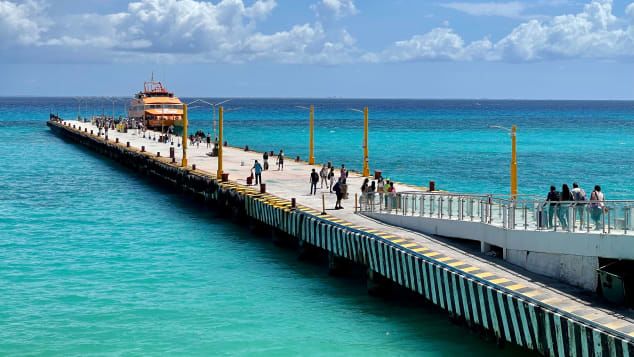 Tourists line up to board a boat in
Playa del Carmen, Mexico on March 3, 2021. Mexico has some of the
world's loosest travel rules.
Tourists line up to board a boat in
Playa del Carmen, Mexico on March 3, 2021. Mexico has some of the
world's loosest travel rules.
I'm planning to travel. What can I do to decrease my risk of contracting or spreading the virus?
The mitigation strategies you use at home apply on the road. Vigilant hand hygiene, social distancing and mask use are key, as is avoiding crowded indoor spaces.
Air travel is considered riskier by the CDC than car travel because of the unavoidable contact with other people in airports and aboard flights, although documented cases of on board transmission are few.
The advanced air filtration used on commercial airliners -- plus mask mandates on planes -- helps to lower the risk in flight.
Limiting stops and contact with others on road trips, social distancing and opting for contactless check-in at hotels are all important ways to reduce risk. As are focusing on outdoor activities and avoiding close contact with people outside of your bubble.
Hopefully, in the months to come, our worlds will expand well beyond our bubbles -- with careful country-by-country calculations.