Budapest Post

Cum Deo pro Patria et Libertate
Budapest, Europe and world news

Analysis: Zuckerberg tries to hit hard at the whistleblower, but nothing lands

Analysis: Zuckerberg tries to hit hard at the whistleblower, but nothing lands

Hours after Facebook whistleblower Frances Haugen testified before Congress about how the social network poses a danger to children and democracy, Mark Zuckerberg took to the platform he built and posted a 1,300-word screed trying to undermine her.

His main argument was that Haugen was taking Facebook's research on its impact on children -- among the tens of thousands of pages of internal documents and research she took before she left the company -- out of context. In essence, he argued she cannot be trusted to properly portray the company's findings, claiming she painted a "false picture of the company."

But although Facebook employs many talented and diligent researchers, its top executive who cannot be trusted when it comes to sharing the work of those researchers with the public.

In August, Facebook (FB) released a report about the most-viewed posts on its platform in the United States. Guy Rosen, Facebook's vice president of integrity (yes, that's a real job title at Facebook) said at the time the company had become "by far the most transparent platform on the internet."

The report covered Facebook data for the second quarter of this year, and Facebook suggested it painted a rather rosy picture. "Many of the most-viewed pages focused on sharing content about pets, cooking, family," Facebook said.

There was a catch. The research report focused on the second quarter of 2021 -- but what about the first quarter? Had Facebook not gathered data and compiled a report for the first three months of 2021?

It had, but Facebook executives chose not to share it with the public "because of concerns that it would look bad for the company," The New York Times reported. The shelved report showed that the most-viewed link on Facebook in the first quarter of this year was a news article that said a doctor died after receiving the coronavirus vaccine, the Times reported.

That a news article with clear potential to be reshared in a way that undermines the safety of vaccination would be one of the most popular pieces of content on Facebook amid a pandemic didn't fit with the image the company's executives are trying to project: that anti-vaccine sentiment isn't running rampant on the platform and the company isn't contributing to America's vaccine hesitancy problem.

When the research eventually leaked to the Times, Facebook came clean, "We're guilty of cleaning up our house a bit before we invited company," said Andy Stone, a Facebook spokesperson.

The next month, the company was criticized after New York University researchers who were studying misinformation on Facebook said they were booted from the platform. (The company said their decision to deplatform the researchers was related to a separate study on political ads that involved using a browser extension that allowed users to anonymously share the ads they saw on Facebook with the researchers.)

Facebook does regularly publish reports on its enforcement of its rules and how much content it catches that is against them, such as hate speech. Earlier this year the company announced it had brought on EY to audit the research beyond those reports.

Bringing in an auditor could be a welcome move, but when it comes to the company's handling of its engagement reports earlier this year, the very blatant cherry-picking of what research to make public and what to hide raises the question: what else does Facebook know that it's not telling us? And who is really creating a "false picture" of the company and its impact on society?
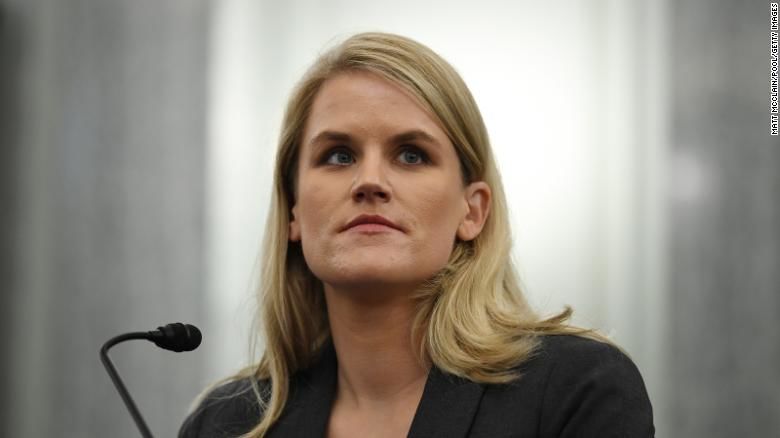
Facebook whistleblower, Frances Haugen appears before the Senate Commerce, Science, and Transportation Subcommittee.


A low-level employee


Facebook's other attempt to undermine the whistleblower was to portray Haugen as a low-level employee who doesn't know what she is talking about. But that strategy appears to be backfiring, too.

Samidh Chakrabarti was head of "civic engagement" at Facebook. Chakrabarti had regularly been put forward by the company to speak publicly about the good work Facebook was doing, even being part of the press tour of the Facebook "war room" for the 2018 US Midterm elections. (The war room was later widely mocked as a publicity stunt.)

After her testimony Tuesday, Facebook described Haugen as "a former product manager at Facebook who worked for the company for less than two years, had no direct reports, never attended a decision-point meeting with C-level executives."

That prompted Chakrabati to respond on Twitter, "Well I was there for over 6 years, had numerous direct reports, and led many decision meetings with C-level execs, and I find the perspectives shared on the need for algorithmic regulation, research transparency, and independent oversight to be entirely valid for debate."

Unfortunately for Facebook, Haugen is on to something.

AI Disclaimer: An advanced artificial intelligence (AI) system generated the content of this page on its own. This innovative technology conducts extensive research from a variety of reliable sources, performs rigorous fact-checking and verification, cleans up and balances biased or manipulated content, and presents a minimal factual summary that is just enough yet essential for you to function as an informed and educated citizen. Please keep in mind, however, that this system is an evolving technology, and as a result, the article may contain accidental inaccuracies or errors. We urge you to help us improve our site by reporting any inaccuracies you find using the "Contact Us" link at the bottom of this page. Your helpful feedback helps us improve our system and deliver more precise content. When you find an article of interest here, please look for the full and extensive coverage of this topic in traditional news sources, as they are written by professional journalists that we try to support, not replace. We appreciate your understanding and assistance.
Newsletter

Related Articles

0:00
0:00
Close
The AI User Nightmare: Private Claude Conversations Leaked to the Internet
Over 24 Hours in the Air: Qantas Airbus Completes Record-Breaking Test Flight
Massive Wildfires Ravage Southern Europe: Fatalities in Greece and Evacuations Across France, Spain, and Turkey
Nvidia Reportedly Takes Vast Texas Data-Centre Lease to Underwrite AI Expansion
FIFA’s Private-Investment Plan for World Cup Rights Draws European Revolt
Apple Briefly Crosses Five Trillion Dollar Valuation as Investors Retreat From AI Bets
Fresh Heatwave Threatens to Rekindle France’s Historic Wildfire Crisis
Following OpenAI's Cyberattack: 'Most Companies Still Do Not Understand What Is Coming'
OpenAI Sued After ChatGPT Allegedly Discouraged Emergency Care Before Near-Fatal Embolism
Miliband Sets Climate and International Law at Centre of UK Diplomacy
Czech Central Bank Governor Rejects Early Euro Entry and Rate-Cut Pressure
Trump Readies New Tariffs as Temporary Global Levy Nears Expiry
Vivienne Westwood Casts Cicciolina, 74, in Its New Autumn Campaign
Dejavu: Germany’s Military Expansion Reshapes Europe’s Strategic Balance With France
Morgan Stanley Builds a Wall Street Lead in AI Infrastructure Finance
High Prices Push Coffee Drinkers Toward Whole Beans and Home Brewing
Trump Draws Boos and Podium Scrutiny at Spain’s World Cup Triumph
Brilliant move: Péter Magyar Moves to Nominate Chess Grandmaster Judit Polgár as Hungary’s President
Spain Defeats Argentina in Extra Time to Win Second World Cup
Current AI Seeks to Build an Open Global AI Infrastructure Outside Big Tech Control
Germany’s Economic Malaise Reopens the Sunday Shopping Debate
Proposed U.S.-Saudi Nuclear Pact Could Permit Limited Uranium Enrichment Under International Safeguards
Netherlands Declares Water Shortage Emergency After Drought Pushes Rivers to Historic Lows
Why Kentucky Fried Chicken Became KFC—and Why the False Explanations Persist
Ukrainian Drones Strike Wildberries Warehouses Deep Inside Russia
Reported CIA Mission Helped Clear the UAE’s Path to Advanced US AI Chips
Artificial Intelligence Capital Fuels Markets While Governments and Regulators Face Mounting Strategic Tests
China’s Moonshot’s Kimi K3 Narrows the Gap With Anthropic Through Scale, Openness and Lower Cost
The Ledger Will Not Trust on Faith
Trump Administration Pressures Banks to Restrict Financial Access for Undocumented Immigrants
Passenger Bound for Germany Refused to Sit Beside a Woman on a Plane — Then Slapped a Flight Attendant
Ukraine’s Leadership Rift Spills Into the Streets as Protesters Target Army Chief
Ukrainian Drone Barrage Kills Eight and Strikes Russian Logistics Network
The Ten World Cup Finals That Defined Football History
Smartphones Are Getting More Expensive, Sales Are Collapsing, and Even Apple Admits: "Prices Will Rise"
The Monaco Bombing Has Become a Test of Ukraine’s Intelligence Accountability
Leadership Change and Strategic Rivalry Redraw the Political Map
The AI Race Enters Its Infrastructure Era
Britain Nationalises British Steel to Protect Scunthorpe Production and Strategic Supply
French National Assembly Overrides Senate to Pass Historic Assisted-Dying Legislation
Spanish Prime Minister's Wife Ordered to Stand Trial as Corruption Probes Encircle Governing Party
Zelensky Faces Kyiv Protests Over Ousting of Dynamic Ukrainian Defense Minister
Thomas Tuchel Faces Fierce Backlash After Tactical Retreat Costs England World Cup Final Berth
A Quiet Bastille Day: France Grapples with World Cup Heartbreak and Leftover Fireworks
Spain in Ecstasy: "We Feel Unbeatable, We Taught the Whole World a Lesson"
Spain and UK Dismantle Gibraltar Border Following Landmark Schengen Integration Treaty
Hungary's "Puppet" President to Be Ousted, Orbán Fumes: "Democracy Is Dead"
Forget Tinder: The Surprising Platform Where People Find Love
Harvard Astrophysicist to Lead U.S. Scientific Advisory on Unidentified Aerial Phenomena
Emergency Sirens Activated Across Bahrain as Interior Ministry Issues Shelter Directives
×