

Analysis: Boris Johnson is picking a Brexit fight at a very risky moment
To the outside observer, then, it might seem odd that Johnson now also appears to be picking a Brexit-related fight with his old foe, the European Union.
 Sinn Fein's Vice President Michelle O'Neill, center, celebrates with
party colleagues after being elected in Mid Ulster at the Medow Bank
election count centre in Magherafelt , Northern Ireland, Friday, May, 6,
2022.
Sinn Fein's Vice President Michelle O'Neill, center, celebrates with
party colleagues after being elected in Mid Ulster at the Medow Bank
election count centre in Magherafelt , Northern Ireland, Friday, May, 6,
2022.
Yet the British government has spent much of this week talking up the prospect of overriding a key part of the Brexit deal that Johnson himself negotiated and signed with the bloc back in 2019.
The issue in question is the Northern Ireland Protocol, a safeguard that was put in place to ensure that the border between the Republic of Ireland (part of the EU) and Northern Ireland (part of the United Kingdom) remains open -- thereby mitigating the risk of sectarian violence returning to the island of Ireland.
The UK government argues that the protocol is not working for a variety of reasons, but most recently because the Unionists in Northern Ireland are not willing to form a power-sharing government with the Republican Sinn Fein party. Sinn Fein won the legislative elections in Northern Ireland for the first time in history last week. The main Unionist party, the Democratic Unionist Party (DUP), says however that until the protocol is fixed to their satisfaction, they will continue to hold out.
Yet officials in Brussels believe that this is just the latest excuse London is using to disregard the protocol, having previously claimed it is damaging the internal market of the UK. To date, the British government has yet to fully implement the protocol, much to the EU's disdain.
Exactly what the British government plans to do in the immediate future remains unclear. There are instruments within the protocol, most notably something called Article 16, which can unilaterally suspend parts of the treaty and trigger a consultation between the EU and UK, if one side believes it is not working properly.
Worse still, in the eyes of Brussels at least, the UK has hinted that it might write into domestic law policies that would override the protocol.
Regardless of the arguments over who is right and wrong, there are serious questions to be asked as to how sensible it is for the UK to start a fight with the EU at the moment.
EU officials have made it clear to CNN that if the UK really does throw the baby out with the bathwater, it is ready to retaliate in a variety of ways. British media have talked up the prospect of a "trade war," which the EU denies is its intention. However, as one European diplomat put it, "if the UK does rubbish the protocol in a way that we see is harmful both to our single market and Northern Ireland, then all bets are off."
Catherine Barnard, professor in European law at Trinity College, Cambridge, explained that if the UK "triggers Article 16 lawfully because of trade disruption, then the EU can use rebalancing measures." However, the greater fear in Brussels is the UK writing domestic legislation that simply upends the protocol.
 Britain's Prime Minister Boris Johnson gestures as he speaks to members
of the media during a visit the Blackpool Transport Depot in north-west
England on February 3, 2022.
Britain's Prime Minister Boris Johnson gestures as he speaks to members
of the media during a visit the Blackpool Transport Depot in north-west
England on February 3, 2022.
"In that instance, the EU could bring enforcement procedures or even go so far as terminating parts of the trade deal that the UK and EU agreed in 2019. And that means tariffs," she added.
Given the UK's reliance on imports from and exports to the EU, this would obviously have a negative impact on the UK economy. And it's this which is baffling people in Brussels and London: Why would Johnson want to do this when the UK is already entering a cost of living crisis?
"Brexit was a deliberate political decision to create trade barriers between the UK and EU. And to some extent, we have already seen the cost of goods, including foods, go up for British citizens," said Jonathan Portes, professor of economics at King's College London. "Obviously further trade barriers would exacerbate that, which would go against the Brexiteer claim that leaving the EU would lead to cheaper goods coming into the UK via new trade deals."
Hypothetically, signing new trade deals could do exactly that. However, trade agreements are notoriously difficult to negotiate and require major infrastructure changes in order to reap the benefits. And time is not something the British people currently struggling to put food on the table have much of right now.
So why is the British government doing this? Members of Johnson's Conservative party have a range of views as to why picking this fight now is not a terrible idea.
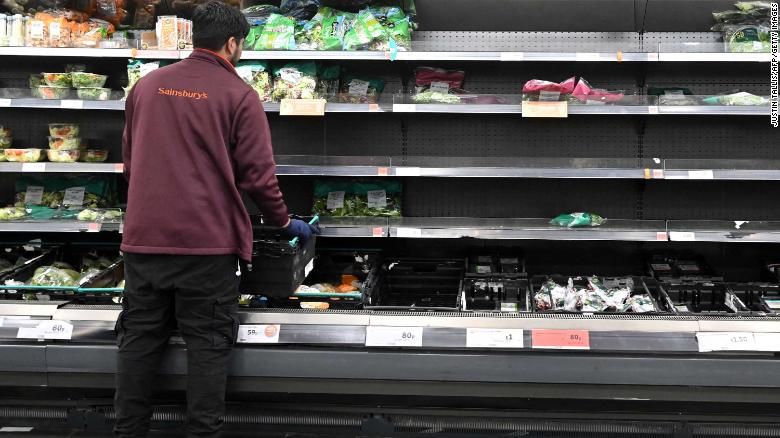 A worker restocks empty shelves of lettuce and salad leaves inside a Sainsbury's supermarket in London on September 7, 2021.
Many of them believe that the protocol really was an unfair deal that is undermining the integrity of the UK. They believe that the risk of British products entering the EU single market that don't meet its standards -- the bloc's main reason for creating a customs border -- is sufficiently small in the context of everything else happening in the world that the EU will ultimately suck it up.
And as one senior Conservative figure told CNN: "It has the added benefit of making Johnson look like he's standing up to the EU. If he is perceived to win this fight, it will definitely appeal to his base of support."
But this calculation also comes with some risk. Another Conservative adviser said that the Prime Minister is "playing with fire opening up the question of Brexit again, considering he told the public in 2019 that it was done and dusted."
Diplomats and officials in Brussels are not so sure that, should Johnson pull the trigger in such a dramatic way, the EU would feel like playing nice. One senior official told CNN that "given we have recently had to take a hardline with some of our own member states, like Hungary over rule of law, I don't see how going soft on the UK will wash."
Johnson's approval ratings have been tanking in recent months and how he handles the UK's cost of living crisis is potentially one of the few things that could win him back support. So, in this context, doing something that could exacerbate the crisis has the potential to backfire badly.
"Voters tend to punish the government when economic times are bad. If the government doesn't get to grips with the cost of living crisis soon, they risk incurring the wrath of the electorate when they next go to the polls," said Will Jennings, professor of politics at Southampton University.
And Brexit is still very much a live issue in the UK, one which voters often use as a stronger indicator of where their political allegiances lie than party politics.
 British Prime Minister Boris Johnson (L) is welcomed by Ukraine's
President Volodymyr Zelensky at the Presidential Palace, in Kyiv on
February 1, 2022.
British Prime Minister Boris Johnson (L) is welcomed by Ukraine's
President Volodymyr Zelensky at the Presidential Palace, in Kyiv on
February 1, 2022.
"The Conservatives benefited in 2019 because they were able to paint Labour as frustrating the will of the people," Jennings added. "They are no longer in the same position. Voters want to enjoy the Brexit dividend -- and technocratic wrangling over international treaties isn't as easy to sell to them."
All of this baffles officials and diplomats in Brussels.
"Does Boris really want supermarket shelves to be emptier than they are now? It was clear in the recent local election [that] the reason people didn't vote Conservative was cost of living [concerns]," said a senior European diplomat. "So why would you compound that and make it worse if you are the Conservative Party?"
Yet Johnson has made a career out of taking risks. Many of those have paid off, not least the biggest gamble of his political life in backing Brexit, a move that would ultimately put him in 10 Downing Street.
But he is also a Prime Minister who has governed through unprecedented crisis after unprecedented crisis. And it is entirely possible that the gambits that worked when he was outside the tent, seeking power, no longer work when he is the man at the helm of a country on its knees.
It might be the case that his instinct of kicking Brussels digs him out of a hole and bolsters his support. Or it could be viewed as simply the latest act of political desperation by a man trying to distract from a government light on policy and trying to regain a grip in the only way he knows how: by bashing his enemies.