Budapest Post

Cum Deo pro Patria et Libertate
Budapest, Europe and world news

Strait of Hormuz Reopens Briefly Amid Fragile Middle East Ceasefire as Global Tensions Persist

Strait of Hormuz Reopens Briefly Amid Fragile Middle East Ceasefire as Global Tensions Persist

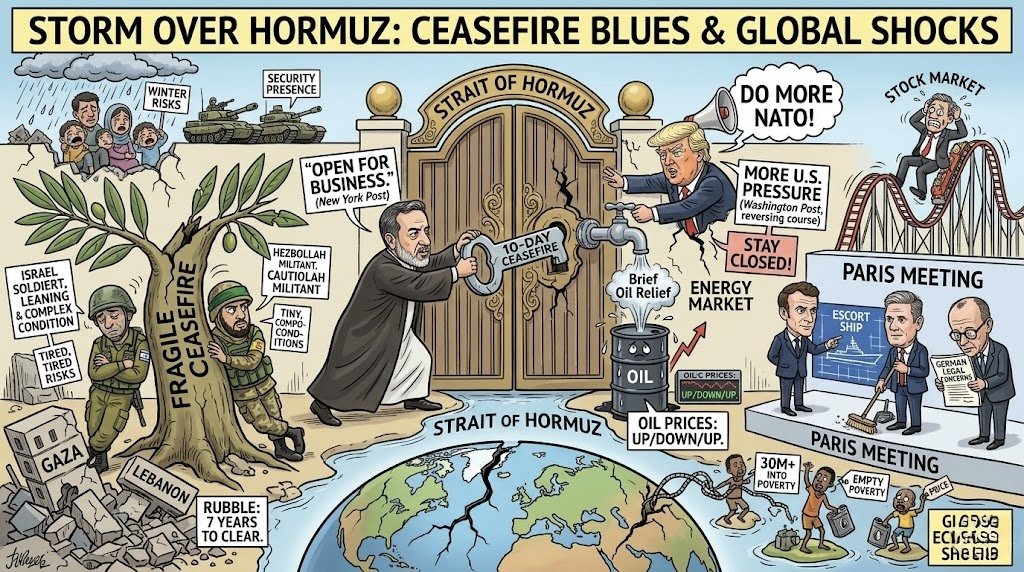
A fragile ceasefire in the Middle East has triggered a temporary reopening of the strategically vital Strait of Hormuz, offering brief relief to global energy markets — but the situation remains highly volatile, with military tensions, humanitarian crises, and geopolitical uncertainty continuing to escalate.

Temporary Opening of a Critical Global Oil Route

Iran’s Foreign Minister Abbas Araqchi announced that the Strait of Hormuz would remain “completely open for business” during the duration of a newly brokered 10-day ceasefire between Israel and Lebanon. 

The strait — one of the world’s most important maritime chokepoints, carrying roughly a fifth of global oil shipments — had been severely disrupted during weeks of escalating conflict involving Iran, Israel, and the United States. 

Iran stated that commercial vessels could transit via coordinated maritime routes, while international actors began preparing plans to restore secure navigation.

However, optimism proved short-lived. Within days, Iran reversed course and reimposed restrictions on the strait, citing continued U.S. naval pressure and unresolved tensions. 


NATO Allies Prepare Defensive Maritime Mission

As instability around the Strait intensified, a coalition of mainly European and NATO-aligned countries convened in Paris to develop a plan to secure maritime traffic.

The initiative — led by French President Emmanuel Macron and joined by UK Prime Minister Keir Starmer and German Chancellor Friedrich Merz — is expected to include:

  • Military escort vessels
  • Mine-clearing operations
  • Advanced radar and surveillance systems

European leaders emphasized that the mission would be strictly defensive, aimed at ensuring safe passage rather than escalating military involvement.

Germany signaled that its participation would depend on:

  • A sustained ceasefire
  • A multilateral legal framework
  • Potential United Nations authorization

The effort follows pressure from U.S. President Donald Trump, who reportedly urged NATO allies to take a more active role in securing global shipping routes.


Ceasefire Between Israel and Lebanon Offers Limited Relief

The maritime developments are closely tied to a U.S.-brokered 10-day ceasefire between Israel and Lebanon, which came into effect on April 16, 2026. 

The agreement aims to pause hostilities and create space for negotiations after weeks of intense fighting between Israeli forces and Hezbollah.

  • Israel has agreed to halt offensive operations
  • Lebanese authorities are expected to restrain armed groups
  • Hezbollah is not a formal signatory but has signaled conditional compliance

Despite the agreement, tensions remain high:

  • Israel insists it will maintain a security presence in southern Lebanon
  • It reserves the right to carry out preemptive strikes
  • Reports of violations and continued clashes have already emerged

President Trump expressed confidence that all parties — including Hezbollah — would respect the ceasefire, though analysts remain skeptical.


Global Markets React — Then Recoil

The initial announcement of the Strait’s reopening led to:

  • A sharp drop in oil prices
  • Positive movement in global stock markets

But renewed instability quickly reversed market optimism.

Attacks on vessels, military warnings, and conflicting statements from Tehran and Washington have reinforced the perception that the situation remains unpredictable and fragile. 


Humanitarian Crisis Deepens Across the Region

While diplomatic efforts focus on ceasefires and trade routes, the humanitarian toll continues to mount:

Lebanon

  • More than 2,000 deaths reported since the escalation
  • Over 1 million people displaced

Gaza

  • Approximately 90% of the population displaced
  • Around 320,000 buildings damaged or destroyed
  • Severe risks from:
    • Structural collapse
    • Flooding and exposure
    • Unexploded ordnance
    • Toxic debris including asbestos

The United Nations estimates that:

  • Clearing rubble alone could take up to 7 years
  • Full reconstruction may take decades and cost over $40 billion

Winter conditions have further worsened living conditions, with flooding and cold exposure posing life-threatening risks.


Global Economic Fallout Expands

The conflict’s impact is no longer regional.

The United Nations Development Programme warns that ongoing escalation could push more than 30 million people into poverty worldwide, particularly affecting:

  • Sub-Saharan Africa
  • Small island developing states
  • Energy-import-dependent economies

Disruptions to fuel supply chains and rising costs are already being felt globally, reinforcing the broader economic consequences of the crisis.


A Conflict With No Clear Endgame

Despite diplomatic activity, several key issues remain unresolved:

  • The role and disarmament of Hezbollah
  • Israel’s military presence in Lebanon
  • U.S.–Iran tensions and naval confrontations
  • Control and security of the Strait of Hormuz

The ceasefire is widely viewed as temporary and fragile, rather than a definitive step toward peace.


Sum Up

The brief reopening of the Strait of Hormuz offered a glimpse of stabilization in a region under extreme strain — but the rapid reversal underscores a deeper reality:

The Middle East remains on edge, where ceasefires are tentative, alliances are shifting, and the global consequences are immediate.

Even if hostilities pause, the structural damage — humanitarian, economic, and geopolitical — will shape the region and the world for years to come.

AI Disclaimer: An advanced artificial intelligence (AI) system generated the content of this page on its own. This innovative technology conducts extensive research from a variety of reliable sources, performs rigorous fact-checking and verification, cleans up and balances biased or manipulated content, and presents a minimal factual summary that is just enough yet essential for you to function as an informed and educated citizen. Please keep in mind, however, that this system is an evolving technology, and as a result, the article may contain accidental inaccuracies or errors. We urge you to help us improve our site by reporting any inaccuracies you find using the "Contact Us" link at the bottom of this page. Your helpful feedback helps us improve our system and deliver more precise content. When you find an article of interest here, please look for the full and extensive coverage of this topic in traditional news sources, as they are written by professional journalists that we try to support, not replace. We appreciate your understanding and assistance.
Newsletter

Related Articles

0:00
0:00
Close
Japanese Technology Firm Fujitsu Launches Advanced Artificial Intelligence Tool for Corporate Disclosures
South Africa Officially Launches Nationwide Campaign for Highly Contested Local Government Elections
United Kingdom Commits Additional Funding for Unexploded Ordnance Clearance in Laos
Singapore Announces Stringent New Greenhouse Gas Regulations for Commercial Cooling Systems
Cambodia and Thailand Hold High-Level Border Security Talks at United Nations Headquarters
Myanmar Military Government and China Sign Major Agreement to Upgrade Media and Cultural Cooperation
Knife Attack at Swiss Train Station Leaves Three Injured in Suspected Act of Domestic Terrorism
Transnational Extortion Gang Threatens Canadian Police With Army of One Thousand Armed Operatives
Australia Imposes Forty-Two-Day Quarantine on Cruise Ship Passengers Following Deadly Hantavirus Outbreak
International Monetary Fund Unlocks Seven Hundred Million United States Dollars for Sri Lanka Following Economic Reforms
Australia Launches Record One Point Four Billion Dollar Lawsuit Against Chemical Giant 3M Over Contamination
China and Canada Foreign Ministers Meet in Ottawa in Effort to Stabilize Strained Diplomatic Ties
Indonesia Demands Urgent United Nations Security Council Reform Amid Escalating Global Conflicts
Extreme Weather Patterns Trigger Severe Drought in Madagascar and Destructive Flooding in East Africa
Indian State of Karnataka Faces Political Upheaval as Chief Minister Siddaramaiah Abruptly Resigns
Philippines and Japan Reaffirm Defense Ties as Crucial for Indo-Pacific Regional Stability
Norway Joins French Nuclear Deterrence Initiative in Major Shift for European Security Architecture
Global Critical Mineral Alliances Expand as Western Nations Move to Counter Chinese Supply Dominance
United States Imposes Fifty Percent Tariffs on Mexican Steel and Aluminum Ahead of Trade Pact Review
European Union and China Head Toward Major Trade Conflict Over Clean Technology Exports
United States Economic Growth Severely Downgraded to One Point Six Percent as Stagflation Fears Mount
World Health Organization Warns Central African Ebola Epidemic is Outpacing Containment Efforts
United States Treasury Department Conditions Sanctions Relief on Reopening of the Strait of Hormuz
Iranian Air Defenses Intercept and Destroy United States Military Drone Over Bushehr Province
Iranian Armed Forces Launch Ballistic Missiles Toward Unspecified Targets Prompting Regional Condemnation
United Nations Secretary-General Warns Global Order Facing Highest Level of Conflict Since 1945
Israel Issues Sweeping Evacuation Orders in Southern Lebanon Amid Intensified Hezbollah Conflict
Russia Announces Systemic Military Strikes Targeting Ukrainian Defense and Energy Infrastructure
United States and Iranian Negotiators Reach Draft Agreement to Extend Ceasefire and Resume Nuclear Talks
United Nations Security Council Deeply Divided Over United States Capture of Venezuelan President
US and Iran Exchange Direct Military Strikes Amid Fragile Gulf Ceasefire
World Health Organization Warns of Catastrophic Ebola Outbreak in DR Congo
Russia Threatens New Wave of Strikes on Ukrainian Infrastructure and Embassies
Scientists Warn Atlantic Ocean Currents Could Collapse Faster Than Projected
Anthropic Reaches $900 Billion Valuation in Historic AI Funding Round
Washington Imposes Crippling Sanctions on Iranian Maritime Authority
Japan and the Philippines Initiate Strategic Intelligence-Sharing Pact
Microsoft Deploys Autonomous Computer-Using AI Agents to Global Markets
Anthropic Secures $45 Billion Compute Infrastructure Agreement With SpaceX
U.S. Director of National Intelligence Resigns Amid Administration Shakeup
Micron Technology Crosses Trillion-Dollar Valuation Amid Unprecedented Hardware Demand
Canada and Germany Finalize Historic Long-Term LNG Export Agreement
China Expands International Travel Restrictions on Domestic AI Researchers
Japan Approves Sweeping Overhaul of National Intelligence Apparatus
Global Airlines Scramble Logistics as Middle East Airspace Remains Fractured
Japan's Naphtha Imports Plunge 47 Percent Amid Strait of Hormuz Closure
Global Crude Prices Retreat Below $96 as Gulf Tensions Momentarily Ease
Generative AI Outperforms Human Baselines in Landmark Global Creativity Study
NASA Partners With Private Aerospace to Unveil Permanent Lunar Base Architecture
South Korean Equity Markets Surge on Next-Generation Memory Chip Frenzy
×