Budapest Post

Cum Deo pro Patria et Libertate
Budapest, Europe and world news

With 10 days to go, time and history are not on Donald Trump's side

With 10 days to go, time and history are not on Donald Trump's side

Covid has tanked the gains he made in the economy and any new stimulus could be too late

It all looked so simple for Donald Trump as he took the stage at the World Economic Forum in Davos in January this year. At the start of an election year, the annual gathering of the global business elite was an opportunity to launch his campaign.

It was one Trump eagerly seized. The next 30 minutes was one long boast, detailing how a US economy that had allegedly been on its knees under Barack Obama had been transformed under his stewardship.


“Today I’m proud to declare that the United States is in the midst of an economic boom the likes of which the world has never seen before,” Trump told a packed hall. “We’ve regained our stride, we discovered our spirit and reawakened the powerful machinery of American enterprise. America is thriving, America is flourishing and, yes, America is winning again like never before.”
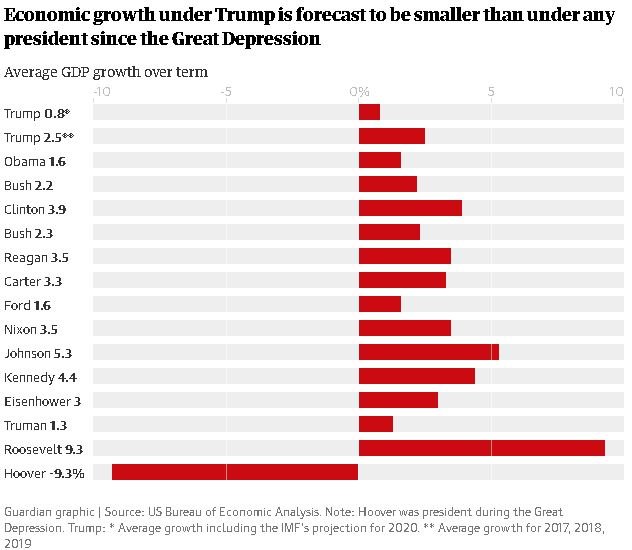


Trump knew his history. Most incumbent presidents since the second world war had seen off their challengers, and the ones that hadn’t – Gerald Ford in 1976, Jimmy Carter in 1980 and George Bush Sr in 1992 – were not helped by an underperforming economy. So, with the stock market at a record high and unemployment at its lowest since the Apollo space missions of the late 1960s, the president thought the path to victory would be smooth.


Trump had been briefed about Covid-19 and the first US case was reported on the day of his Davos speech. But he did not think for a moment that his re-election campaign would be fought against the backdrop of a global pandemic and for some time appeared to be in denial about the importance of the virus, claiming it would soon go away.

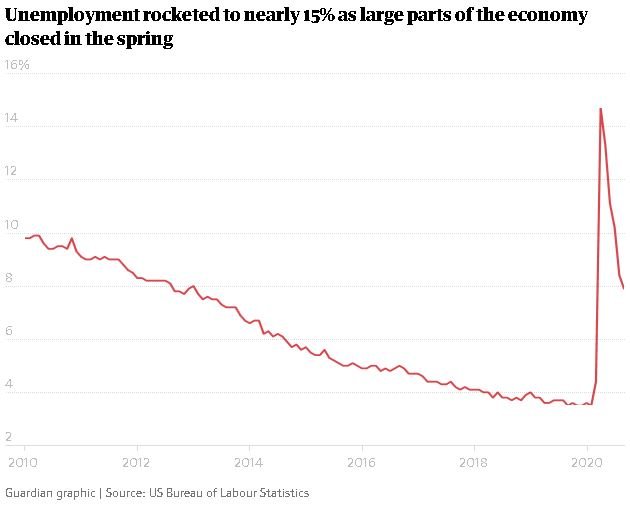
That proved to be wishful thinking. Before Thursday’s head-to-head debate with Joe Biden, the pandemic had led to more than 200,000 deaths in the US and infection rates are still rising. Unemployment rocketed to 15% as large parts of the economy closed in the spring. Far from presiding over an economic boom, the International Monetary Fund estimates that the world’s biggest economy will contract by more than 4% this year. Put into context, the last time the economy shrank by more than 4% in a presidential election year was in 1932, the depths of the Great Depression, when Herbert Hoover was in the White House. Hoover did not get a second term.

Mohamed El-Erian, the former chief executive of the US investment firm Pimco and now president of Queens’ College, Cambridge University, says that back in January Trump looked like he would avoid Hoover’s fate but now faces an uphill struggle to defeat his Democratic challenger, Biden.

“Going into Covid-19, Trump would have won on two themes: the greatest economy in the history of the US and the greatest stock market in the history of the US,” El-Erian says. “Unemployment had fallen in every section of the population, the US had outperformed other advanced countries, there had been a series of records broken on Wall Street.”

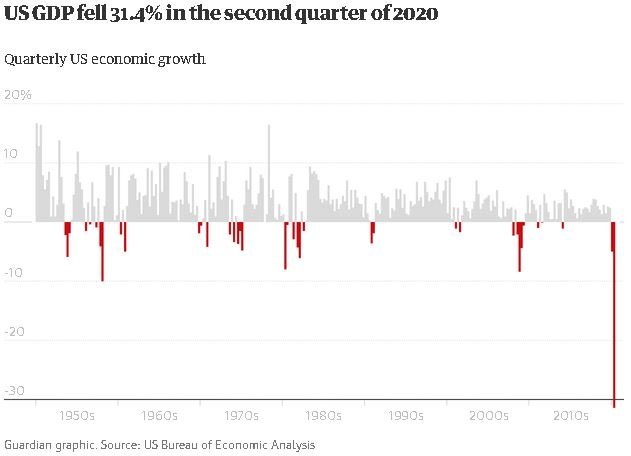
Although the economy recovered after contracting by almost 10% in the second quarter, the official unemployment rate remains at 7.9% – double its pre-crisis level. What’s more, the stubbornly high level of new jobless claims suggests the recovery has started to run out of steam as Americans self-isolate in the face of new outbreaks of the virus.


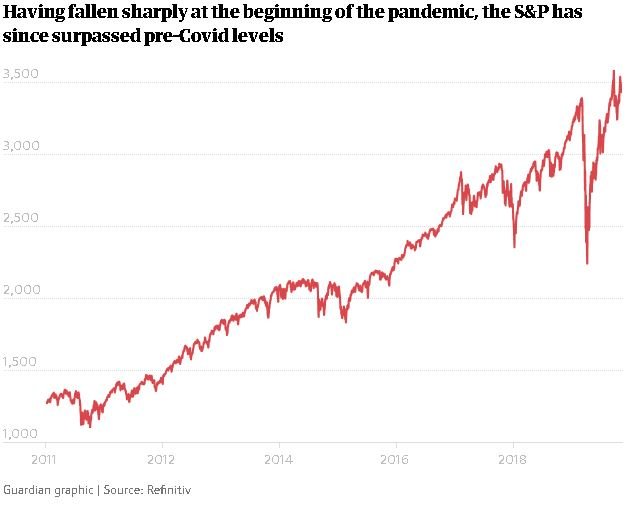
Wall Street has bounced back sharply after its sell-off in February and March but El-Erian says this is not entirely good news for Trump. “As the weeks go by the disconnect of financial markets from the economy is slowly becoming a political issue. It is the rich who are doing better.”

Unable to make the claim that he is presiding over the strongest US economy of all time, for the past few weeks Trump has been trying another tack: that he is the candidate best placed to secure recovery. The president is eager to get a fresh stimulus bill through Congress before election day.

David Blanchflower, an economics professor at Dartmouth College in New Hampshire and a former member of the Bank of England’s monetary policy committee, says the US is suffering from unemployment and underemployment, and that the official jobless figures do not truly reflect the state of the labour market. “The real unemployment rate went from 4% to 20% in six weeks,” he says.

For months, Trump has been trying to get a fresh stimulus package through Congress but Blanchflower says he has allowed the Democrats to spin out the talks for too long. “Even if a deal is agreed, voters are not going to feel the impact before the election,” he says.

With less than two weeks to go, time and history are not on the president’s side. Nor is the pandemic. As El-Erian says, this election is not only about who is best at running the economy but also who will be the best at tackling Covid-19 and who can keep Americans safe.

AI Disclaimer: An advanced artificial intelligence (AI) system generated the content of this page on its own. This innovative technology conducts extensive research from a variety of reliable sources, performs rigorous fact-checking and verification, cleans up and balances biased or manipulated content, and presents a minimal factual summary that is just enough yet essential for you to function as an informed and educated citizen. Please keep in mind, however, that this system is an evolving technology, and as a result, the article may contain accidental inaccuracies or errors. We urge you to help us improve our site by reporting any inaccuracies you find using the "Contact Us" link at the bottom of this page. Your helpful feedback helps us improve our system and deliver more precise content. When you find an article of interest here, please look for the full and extensive coverage of this topic in traditional news sources, as they are written by professional journalists that we try to support, not replace. We appreciate your understanding and assistance.
Newsletter

Related Articles

0:00
0:00
Close
Spain and Morocco Trade Blame After 72,000 Migrants Enter Ceuta
AI Is Remaking the US Economy, From GDP Growth to iPhone Prices
Europe’s Heat and Drought Are Now Disrupting Power, Shipping and Tourism
Europe’s Drying Rivers Trigger Power Cuts, Factory Shutdowns and Wildfire Emergencies
Record-Low Danube Forces Nuclear Cuts and Emergency Power Curbs
Danube Drought Forces Hungary’s Paks Nuclear Plant Into Full Shutdown
Ceuta Death Toll Rises as Spain and Europe Clash Over Border Response
Valued at $109 Million: F-35B Fighter Jet Crashes in Southern California
Record-Low Danube Exposes Probable Mammoth Remains in Bulgaria
US Says It Has Carried Out Heavy Strikes on Iran After Attempted Attacks on Its Forces
The AI User Nightmare: Private Claude Conversations Leaked to the Internet
Over 24 Hours in the Air: Qantas Airbus Completes Record-Breaking Test Flight
Massive Wildfires Ravage Southern Europe: Fatalities in Greece and Evacuations Across France, Spain, and Turkey
Nvidia Reportedly Takes Vast Texas Data-Centre Lease to Underwrite AI Expansion
FIFA’s Private-Investment Plan for World Cup Rights Draws European Revolt
Apple Briefly Crosses Five Trillion Dollar Valuation as Investors Retreat From AI Bets
Fresh Heatwave Threatens to Rekindle France’s Historic Wildfire Crisis
Following OpenAI's Cyberattack: 'Most Companies Still Do Not Understand What Is Coming'
OpenAI Sued After ChatGPT Allegedly Discouraged Emergency Care Before Near-Fatal Embolism
Miliband Sets Climate and International Law at Centre of UK Diplomacy
Czech Central Bank Governor Rejects Early Euro Entry and Rate-Cut Pressure
Trump Readies New Tariffs as Temporary Global Levy Nears Expiry
Vivienne Westwood Casts Cicciolina, 74, in Its New Autumn Campaign
Dejavu: Germany’s Military Expansion Reshapes Europe’s Strategic Balance With France
Morgan Stanley Builds a Wall Street Lead in AI Infrastructure Finance
High Prices Push Coffee Drinkers Toward Whole Beans and Home Brewing
Trump Draws Boos and Podium Scrutiny at Spain’s World Cup Triumph
Brilliant move: Péter Magyar Moves to Nominate Chess Grandmaster Judit Polgár as Hungary’s President
Spain Defeats Argentina in Extra Time to Win Second World Cup
Current AI Seeks to Build an Open Global AI Infrastructure Outside Big Tech Control
Germany’s Economic Malaise Reopens the Sunday Shopping Debate
Proposed U.S.-Saudi Nuclear Pact Could Permit Limited Uranium Enrichment Under International Safeguards
Netherlands Declares Water Shortage Emergency After Drought Pushes Rivers to Historic Lows
Why Kentucky Fried Chicken Became KFC—and Why the False Explanations Persist
Ukrainian Drones Strike Wildberries Warehouses Deep Inside Russia
Reported CIA Mission Helped Clear the UAE’s Path to Advanced US AI Chips
Artificial Intelligence Capital Fuels Markets While Governments and Regulators Face Mounting Strategic Tests
China’s Moonshot’s Kimi K3 Narrows the Gap With Anthropic Through Scale, Openness and Lower Cost
The Ledger Will Not Trust on Faith
Trump Administration Pressures Banks to Restrict Financial Access for Undocumented Immigrants
Passenger Bound for Germany Refused to Sit Beside a Woman on a Plane — Then Slapped a Flight Attendant
Ukraine’s Leadership Rift Spills Into the Streets as Protesters Target Army Chief
Ukrainian Drone Barrage Kills Eight and Strikes Russian Logistics Network
The Ten World Cup Finals That Defined Football History
Smartphones Are Getting More Expensive, Sales Are Collapsing, and Even Apple Admits: "Prices Will Rise"
The Monaco Bombing Has Become a Test of Ukraine’s Intelligence Accountability
Leadership Change and Strategic Rivalry Redraw the Political Map
The AI Race Enters Its Infrastructure Era
Britain Nationalises British Steel to Protect Scunthorpe Production and Strategic Supply
French National Assembly Overrides Senate to Pass Historic Assisted-Dying Legislation
×