

The mothers working from home without childcare
For most of the first year after her daughter was born in early 2022, Katie Szerbin worked from home, managing customer service calls all day, without any kind of childcare. Each time her child began to cry, the 30-year-old mother from New Jersey, US, had to leave the room. If she didn’t, the customer on the other end of the phone line – and Szerbin’s supervisor, often listening in – might hear the baby in the background, and question her professionalism.
“My calls were usually less than five minutes. It was something I just had to suffer through, and hope the people on the other line couldn’t hear her crying. It was heart-wrenching,” says Szerbin. “It wasn’t as bad when she was an infant. But soon she was walking, getting into stuff, needing attention. I'm talking and trying to concentrate and she's grabbing my headset or trying to grab my computer, or pulling at my shirt trying to get me to hold her. You're completely distracted. Even if you're trying really hard to ignore her, in your heart, you can’t.”
The balancing act was, in part, a financial choice – compensated at about $17 (£13.70) per hour, the maths worked out that Szerbin would “basically be working just to pay for care”. So, her only option was to do both jobs at once. It wasn’t easy on her or her daughter, and it only got harder as time went on.
The widespread closure of schools and childcare centres during the pandemic left many working parents like Szerbin in an impossible situation, trying to juggle remote jobs and a lack of childcare. And although many children have been able to return to outside-home care as Covid-19 has waned, not every parent is out of the woods: some caretakers still face simultaneous child supervision and job work, which is pushing them to the brink.
In some cases, the issue is just as acute as it was during the height of the pandemic. In the US especially, an ongoing childcare crisis has left many parents in an untenable situation: the childcare industry experienced a massive haemorrhage of workers and facility closures in 2020, and recovery continues to lag. The Center for American Progress reported more than half of all Americans live in a childcare desert, and even in places where it’s available, rising costs keep quality care out of reach for many families.
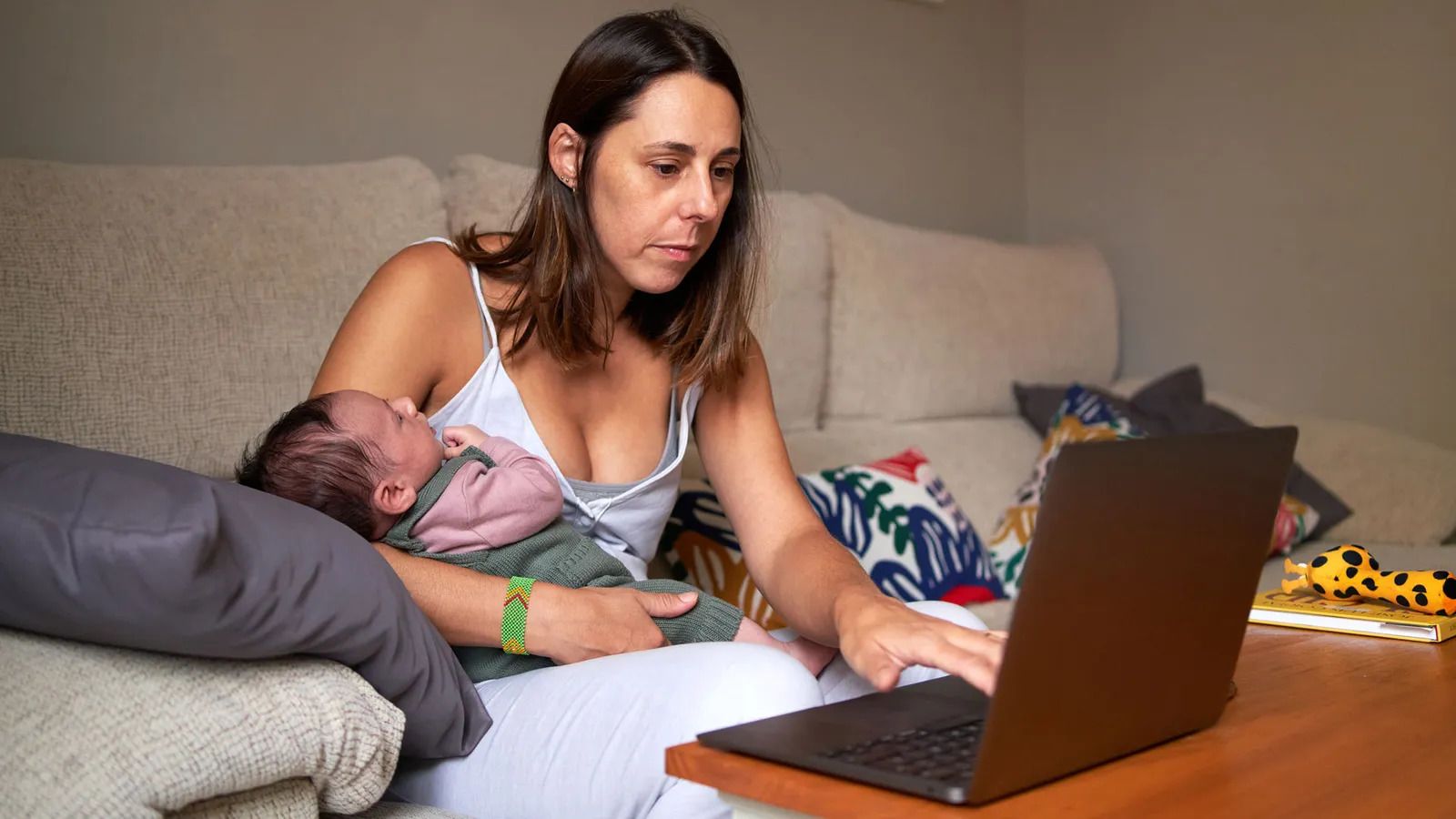 Many mums report struggling to balance professional obligations with childcare
In many ways, says Mona Zanhour, an associate professor of management at California State University, Long Beach, the remote work revolution has been good for mothers, allowing women who might otherwise have had to drop out of the labor force altogether to keep earning. But for some mums, she says, “it’s a double-edged sword. Technology is allowing us to work and parent and live our lives all at the same time in the same space. But it becomes its own monster when we add the childcare crisis”.
All this leads to some parents – usually mums – continuing to work from home while simultaneously caring for their children, says Zanhour. Many of these parents are forced to hide this fact from their bosses so as not to seem distracted or unprofessional, leaving them stressed and fearful. And, she says, a woman trying to be her work-self and parent-self at the same time, will often struggle with both and ultimately burn out.
Kristen Carpenter, a mum in Pennsylvania, US, who mostly does her job in healthcare from home, worries that her lack of childcare has had a deleterious effect on her five-year-old son. “He’s in Kindergarten for two-and-a-half hours, then comes home and is on a tablet for the afternoon, or watching a movie, or just doing things that aren’t productive because I have to get my work done," she says. “He’s super unmotivated to do anything else.”
Carpenter herself has experienced negative impacts, too. She doesn’t feel as focused at work as she once did, and struggles to be as productive as she’d like. “I definitely don’t get my ‘40 hours’,” she says. “I feel like when he’s here with me, I can’t fully concentrate. And when he’s at school, I only have two-and-a-half hours, and then I have to get him off the bus. What can I get done in that time? Especially when the whole time I’m just waiting for my alarm to go off to get him.”
Many of the 53 women Zanhour interviewed also reported feeling like they were constantly behind. “They end up really sacrificing sleep, sacrificing their personal health,” she says. “They wake up early before the kids to attend to their emails, spend their days going back and forth between the two roles, and after everybody sleeps, they’re trying to catch up.” And when, inevitably, they can’t, “they experience it as a personal failure”.
He’s in Kindergarten for two-and-a-half hours, then comes home and is on a tablet for the afternoon, or watching a movie, or just doing things that aren’t productive because I have to get my work done – Kristen Carpenter
Szerbin says she was constantly making minor errors at work, because her attention was divided. “It wasn’t something I would necessarily get in trouble for, but it made me feel so guilty and embarrassed because I know I was capable of doing it without those simple mistakes. And I can’t come out and say, ‘it’s happening because I’m taking care of my kid’, so then there’s the added concern and worry of, ‘are they going to bring this up? And I going to get in trouble? Am I going to lose my job?’”
Another issue compounding the situation is that some parents feel forgotten now that so much has otherwise returned to ‘normal’ in the working world. At the start of the pandemic, when schools closed and work went abruptly remote, there was a lot of understanding and empathy for working parents, explains Zanhour, who co-authored a study of working mothers’ experiences during and post-pandemic. “What we saw from our data is the empathy ran out pretty quickly.”
Along with stress, anxiety and burnout, all these factors have forced some mums to change their career paths entirely. Szerbin took a full-time, in-person job, while her own mum cares for her daughter. It’s not a perfect solution, she says. “My guilt has just progressed to different guilt. Now I feel guilty that I’m working and not taking care of my kid.”
Others, like Carpenter, remain stuck without any solution. She is counting the days until her son starts first grade and is in school all day. In the meantime, she’s muddling through. “I get angry,” she says. “I’m completely overwhelmed.”
In the meantime, some working parents may find themselves stalling out. There’s no simple solution, says Zanhour. Solving the problem will require “redesigning workplace culture so that motherhood does not have to be at odds with professionalism”, she says. It may be a long road. For now, a little more empathy might go a long way.