Budapest Post

Cum Deo pro Patria et Libertate
Budapest, Europe and world news

Scotland to lift most remaining Covid restrictions

Scotland to lift most remaining Covid restrictions

Scotland's Covid-19 restrictions are to be eased, with nightclubs reopening, large indoor events resuming and social distancing rules dropped.

The changes will take effect from Monday 24 January after a "significant fall" in new case numbers.

However people are still being asked to work from home and to take lateral flow tests before meeting with others.

First Minister Nicola Sturgeon told MSPs that Scotland had "turned the corner on the Omicron wave".

Guidance advising adults against meeting up with more than three households at a time will also be scrapped, along with curbs on indoor contact sports.

And ministers have decided against extending the vaccine passport scheme to more hospitality settings "at this stage".

Ms Sturgeon said that while Omicron is still infecting "large numbers of people", there had been a significant fall in the number of new infections over the past two weeks.

A total of 20,268 positive cases have been reported over the past three days, compared to 36,526 over the same three days last week.

The percentage of tests coming back positive has dropped from almost 30% in early January to under 20% now.

It is now thought that the Omicron wave peaked in the first week of January, and the number of people being admitted to hospital with the virus is also falling.
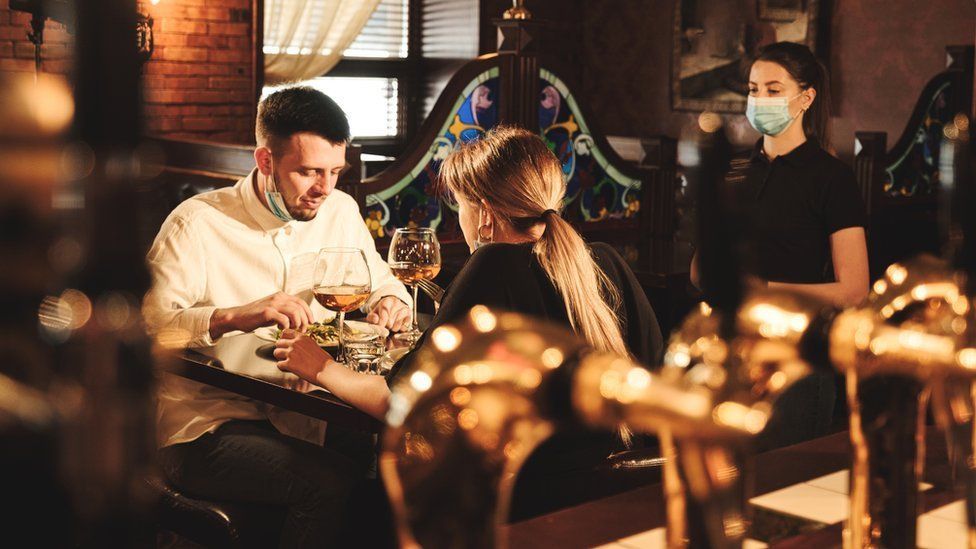
Hospitality venues such as pubs and restaurants will no longer need to operate on a table service only basis


Restrictions introduced over the festive period are being phased out, with limits on crowds at outdoor events such as football matches having been lifted on Monday of this week.

From next Monday, the limits on attendance at indoor public events, the requirement for 1m physical distancing and table service in hospitality venues, and the requirement for nightclubs to close will also be removed.

However longer-running measures such as the use of face coverings on public transport and indoor public places will continue, while Ms Sturgeon said people were advised to continue to keep gatherings "small" to reduce the risk of infection.

People should also continue to work from home wherever possible for now, but Ms Sturgeon said talks would be held with businesses about "a return to a more hybrid approach from the start of February".

The first minister said that Scotland was "once again entering a calmer phase of the pandemic", but warned there was still "significant pressure" on health services.

She said: "Although we can be increasingly optimistic at this stage, we must all still play our part in helping further slow the spread of the virus."


Whisper it but this really should be the beginning of the end of lockdown-style Covid restrictions in Scotland.

As the current Omicron measures are eased, the Scottish government certainly has no intention of bringing any of them back.

In fact, they are working on a new strategy for living with Covid without major restrictions in future.

That does not mean pretending coronavirus has gone away or abandoning all attempts to limit its spread.

For instance, the first minister has already said that some continued mask wearing in public is likely.

But the hope is that the continued use of vaccination and the exercise of personal responsibility can take more of the strain in future.

Opposition parties are anxious for more details of this revised approach which, of course, depends on Covid not mutating into a more dangerous strain.

The changes were broadly welcomed by business groups, with CBI Scotland saying the easing of rules for hospitality was "a huge relief to firms desperate to start trading their way to recovery after a difficult festive period".

The Scottish Chambers of Commerce echoed this, and welcomed the decision not to extend vaccine passports to more venues - while calling on ministers to "remove the shackles from offices as urgently as possible".

And the Federation of Small Businesses said withdrawing restrictions "doesn't mean that local economies will necessarily bounce back", calling for the government to "work hard to build business and consumer confidence".

'Trust the public'


The Scottish Conservatives also welcomed the easing of Covid measures, with health spokesman Dr Sandesh Gulhane saying there had been a "sea change" in government policy "towards trusting the Scottish public".

However the party called for the vaccine passport scheme to be scrapped altogether, and for a "credible plan" to tackle waiting times in the NHS.

Ms Sturgeon said the decision on vaccine passports was "finely balanced", but that if case numbers were to rise again then extending the scheme to all licensed hospitality venues "may well be a more proportionate alternative to other, more restrictive measures".

Scottish Labour leader Anas Sarwar said the changes would "offer hope to a lot of people who can once again look forward to getting some more normality back in their lives".

However he said businesses were "teetering on the brink", and called on the government to go further in getting promised financial support to firms.

AI Disclaimer: An advanced artificial intelligence (AI) system generated the content of this page on its own. This innovative technology conducts extensive research from a variety of reliable sources, performs rigorous fact-checking and verification, cleans up and balances biased or manipulated content, and presents a minimal factual summary that is just enough yet essential for you to function as an informed and educated citizen. Please keep in mind, however, that this system is an evolving technology, and as a result, the article may contain accidental inaccuracies or errors. We urge you to help us improve our site by reporting any inaccuracies you find using the "Contact Us" link at the bottom of this page. Your helpful feedback helps us improve our system and deliver more precise content. When you find an article of interest here, please look for the full and extensive coverage of this topic in traditional news sources, as they are written by professional journalists that we try to support, not replace. We appreciate your understanding and assistance.
Newsletter

Related Articles

0:00
0:00
Close
Spain and Morocco Trade Blame After 72,000 Migrants Enter Ceuta
AI Is Remaking the US Economy, From GDP Growth to iPhone Prices
Europe’s Heat and Drought Are Now Disrupting Power, Shipping and Tourism
Europe’s Drying Rivers Trigger Power Cuts, Factory Shutdowns and Wildfire Emergencies
Record-Low Danube Forces Nuclear Cuts and Emergency Power Curbs
Danube Drought Forces Hungary’s Paks Nuclear Plant Into Full Shutdown
Ceuta Death Toll Rises as Spain and Europe Clash Over Border Response
Valued at $109 Million: F-35B Fighter Jet Crashes in Southern California
Record-Low Danube Exposes Probable Mammoth Remains in Bulgaria
US Says It Has Carried Out Heavy Strikes on Iran After Attempted Attacks on Its Forces
The AI User Nightmare: Private Claude Conversations Leaked to the Internet
Over 24 Hours in the Air: Qantas Airbus Completes Record-Breaking Test Flight
Massive Wildfires Ravage Southern Europe: Fatalities in Greece and Evacuations Across France, Spain, and Turkey
Nvidia Reportedly Takes Vast Texas Data-Centre Lease to Underwrite AI Expansion
FIFA’s Private-Investment Plan for World Cup Rights Draws European Revolt
Apple Briefly Crosses Five Trillion Dollar Valuation as Investors Retreat From AI Bets
Fresh Heatwave Threatens to Rekindle France’s Historic Wildfire Crisis
Following OpenAI's Cyberattack: 'Most Companies Still Do Not Understand What Is Coming'
OpenAI Sued After ChatGPT Allegedly Discouraged Emergency Care Before Near-Fatal Embolism
Miliband Sets Climate and International Law at Centre of UK Diplomacy
Czech Central Bank Governor Rejects Early Euro Entry and Rate-Cut Pressure
Trump Readies New Tariffs as Temporary Global Levy Nears Expiry
Vivienne Westwood Casts Cicciolina, 74, in Its New Autumn Campaign
Dejavu: Germany’s Military Expansion Reshapes Europe’s Strategic Balance With France
Morgan Stanley Builds a Wall Street Lead in AI Infrastructure Finance
High Prices Push Coffee Drinkers Toward Whole Beans and Home Brewing
Trump Draws Boos and Podium Scrutiny at Spain’s World Cup Triumph
Brilliant move: Péter Magyar Moves to Nominate Chess Grandmaster Judit Polgár as Hungary’s President
Spain Defeats Argentina in Extra Time to Win Second World Cup
Current AI Seeks to Build an Open Global AI Infrastructure Outside Big Tech Control
Germany’s Economic Malaise Reopens the Sunday Shopping Debate
Proposed U.S.-Saudi Nuclear Pact Could Permit Limited Uranium Enrichment Under International Safeguards
Netherlands Declares Water Shortage Emergency After Drought Pushes Rivers to Historic Lows
Why Kentucky Fried Chicken Became KFC—and Why the False Explanations Persist
Ukrainian Drones Strike Wildberries Warehouses Deep Inside Russia
Reported CIA Mission Helped Clear the UAE’s Path to Advanced US AI Chips
Artificial Intelligence Capital Fuels Markets While Governments and Regulators Face Mounting Strategic Tests
China’s Moonshot’s Kimi K3 Narrows the Gap With Anthropic Through Scale, Openness and Lower Cost
The Ledger Will Not Trust on Faith
Trump Administration Pressures Banks to Restrict Financial Access for Undocumented Immigrants
Passenger Bound for Germany Refused to Sit Beside a Woman on a Plane — Then Slapped a Flight Attendant
Ukraine’s Leadership Rift Spills Into the Streets as Protesters Target Army Chief
Ukrainian Drone Barrage Kills Eight and Strikes Russian Logistics Network
The Ten World Cup Finals That Defined Football History
Smartphones Are Getting More Expensive, Sales Are Collapsing, and Even Apple Admits: "Prices Will Rise"
The Monaco Bombing Has Become a Test of Ukraine’s Intelligence Accountability
Leadership Change and Strategic Rivalry Redraw the Political Map
The AI Race Enters Its Infrastructure Era
Britain Nationalises British Steel to Protect Scunthorpe Production and Strategic Supply
French National Assembly Overrides Senate to Pass Historic Assisted-Dying Legislation
×