

Russian TV says nuclear strike 'more probable' than losing in Ukraine
Vladimir Putin will launch an all-out nuclear war on the West rather than accept defeat in Ukraine, Russia's chief propagandists have declared, in just the latest chilling threat coming from Moscow.
Margarita Simonyan, editor of state broadcaster RT and one of the Kremlin's highest-profile mouthpieces, declared on TV last night that the idea of Putin pressing the red button is 'more probable' than the idea that he will allow Russia to lose the war.
'Either we lose in Ukraine,' she said, 'or the Third World War starts. I think World War Three is more realistic, knowing us, knowing our leader.
'The most incredible outcome, that all this will end with a nuclear strike, seems more probable to me than the other course of events.
'This is to my horror on one hand,' she told a panel of experts shifting nervously in their seats, 'but on the other hand, it is what it is. We will go to heaven, while they will simply croak... We're all going to die someday.'
Simonyan's calm imagining of nuclear holocaust is just the latest threat issued from the top levels of the Russian state, after fellow propagandist Vladimir Solovyov, foreign minister Sergei Lavrov, and Putin himself issued threats in the last 48 hours.
The US and UK have dismissed such rhetoric as bluster but the increasing frequency of the threats coupled with the failures of Russia's military will raise fears that a Cold War-style standoff is now a realistic possibility before the war in Ukraine ends.
It comes after Russia successfully test-launched its latest nuclear missile - Sarmat 2 - last week, with Putin boasting it can strike targets anywhere on earth and cannot be stopped by any current missile defences.
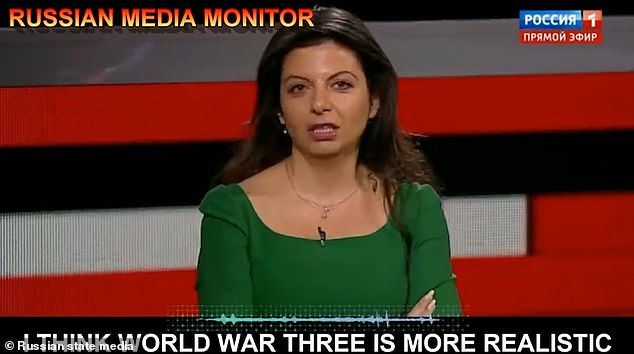 Margarita Simonyan told Russian state TV last
night that the idea of nuclear war is 'more probable' than the idea that
Putin will allow Russia to be defeated in Ukraine
Margarita Simonyan told Russian state TV last
night that the idea of nuclear war is 'more probable' than the idea that
Putin will allow Russia to be defeated in Ukraine
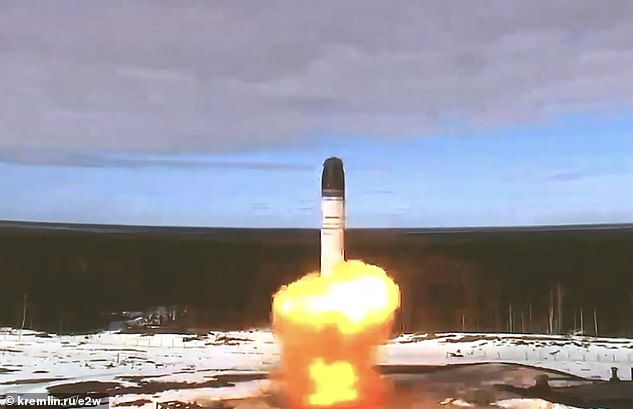 Russia has steppe up its nuclear threats to the
West ever since testing its new Sarmat 2 missile last week (pictured),
which Putin boasted is unstoppable by any current defences
Russia has steppe up its nuclear threats to the
West ever since testing its new Sarmat 2 missile last week (pictured),
which Putin boasted is unstoppable by any current defences
Lavrov was the first to raise the nuclear threat in an interview on Russian state TV late Tuesday, when he was asked whether the current standoff between east and west could be compared to the Cuban missile crisis at the height of the Cold War.
The foreign minister responded that the current situation is more dangerous, because the weapons involved are more powerful, the controls on them more lax, and communication between the two sides is non-existent.
'During the Cuban Missile Crisis there were not many "written" rules. But the rules of conduct were clear enough.
'Moscow understood how Washington was behaving. Washington understood how Moscow was behaving. Now there are few rules left,' he said.
Asked directly about the threat of nuclear war, he added: 'The risks are very significant. I do not want the danger to be artificially inflated [but] it is serious, real. It cannot be underestimated.'
That was followed by off-the-cuff remarks from Solovyev while discussing the deployment of Sarmat 2 with the head of the Roscosmos space agency, who said the missile will go into service later this year.
'As it turned out, one Sarmat means minus one Great Britain,' Solovyov boasted, suggesting the UK deserves to wiped off the map because it has become 'totally boorish' - in what appeared to be a reference for this country's support for Ukraine.
Dmitry Rogozin, head of the Roscosmos space agency, told Solovyov that 46 of the missiles will be constructed with the first deployed to units in Krasnoyarsk, Siberia, later this year.
'Everything is according to plan with us,' he said. 'It is all according to plan.'
That was then followed by a threat from Putin himself, who vowed a 'lightning-fast' response to any country who directly intervenes in the Ukraine conflict.
'If someone intends to interfere in what is going on from the outside they must know that constitutes an unacceptable strategic threat to Russia,' he said during a meeting with lawmakers in St Petersburg.
'They must know that our response to counter strikes will be lightning fast. Fast.
'We have all the weapons we need for this. No one else can brag about these weapons, and we won’t brag about them. But we will use them.'
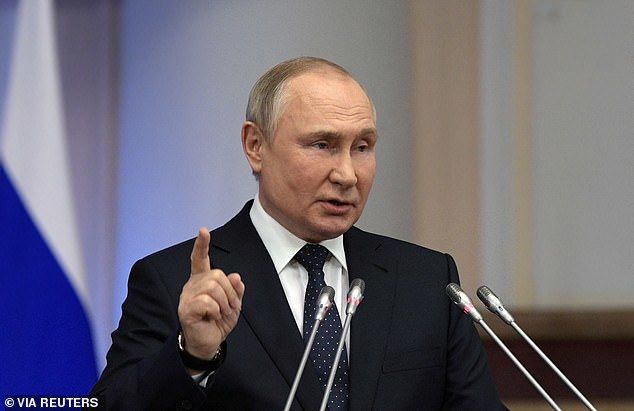 Vladimir Putin yesterday repeated a threat to
use nuclear weapons against any nation that directly interferes in
Ukraine, saying Russia's response would be 'lightning-fast'
Vladimir Putin yesterday repeated a threat to
use nuclear weapons against any nation that directly interferes in
Ukraine, saying Russia's response would be 'lightning-fast'
Putin did not directly mention nukes, but his phrasing appears to be a clear reference to the new Sarmat missile which he boasted is unlike any other weapon in the world as it was tested last week.
It also echoes a threat that Putin made as he declared the start of his 'special military operation' back in February, which was that any country seeking to interfere would face consequences 'never seen before in their history'.
The nuclear threats from state media also echo a wider narrative emerging from the Kremlin's propaganda machine which is that Russia is now engaged in a full-scale conflict with NATO that pre-sages a Third World War.
Olga Skabeeva, another state TV host and Kremlin mouthpiece, declared on Tuesday that a summit of 40 defence ministers in Germany held to coordinate arms deliveries to Ukraine was effectively a declaration of war.
'They declared a war,' she told viewers. 'World War III, no longer just a special operation, with forty countries against us.'
Political scientist Mikhail Markelov agreed with her, declaring that those 40 countries are 'today's collective Hitler'.
Dmitry Kulikov, another state media personality, also repeated the line. 'This is a big war,' he said. 'The West declared it against us.
'Let’s be worthy of our predecessors, everyone who lived through that. What made us think that our lives should be better than those of our grandparents?
'Why should we be free of our historical mission?'
Russia is now more than two months into what was supposed to be a days-long 'special military operation' to topple the Ukrainian government and install a puppet regime loyal to Moscow.
Ahead of the war, most experts and observers predicted Ukraine's military would survive only a few days or weeks against the onslaught, but troops have defied the doubters and remain in control of most of the country 62 days later.
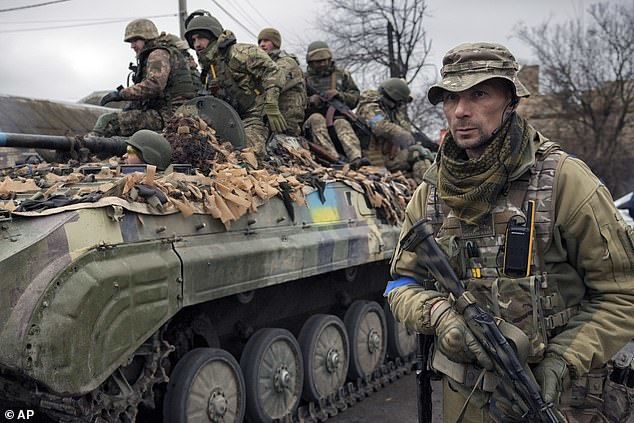 Ukraine has inflicted heavy losses on Russia
since the start of its invasion in late February, and there are fears
the Kremlin could resort to extreme measures if faced with defeat
Ukraine has inflicted heavy losses on Russia
since the start of its invasion in late February, and there are fears
the Kremlin could resort to extreme measures if faced with defeat
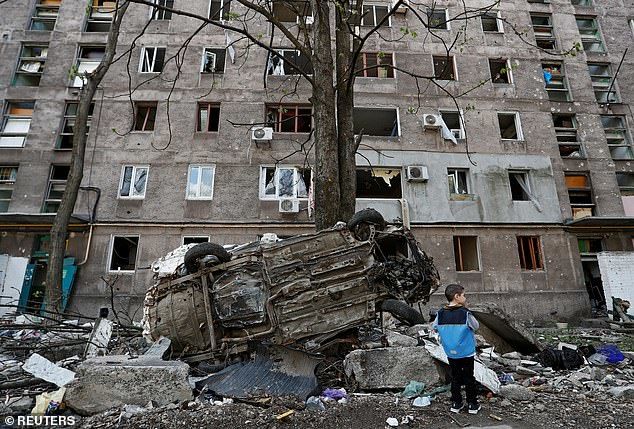 Russia has already resorted to indiscriminate
attacks on civilians, but has so-far avoided using nuclear or chemical
weapons which the West has said would provoke a response
Russia has already resorted to indiscriminate
attacks on civilians, but has so-far avoided using nuclear or chemical
weapons which the West has said would provoke a response
Having failed in its aim of taking Kyiv, Russia is now concentrating its forces in the east in the hopes of seizing control of the Donbas region and encircling a large part of Ukraine's ground forces.
Moscow's generals have also said their aim is to push out from Kherson - on the Black Sea coast and the only major city to fall to Putin's forces so far - and capture Mykolaiv and Odesa, cutting Ukraine off from the ocean.
But Western nations have rallied to support Kyiv, with US Defense Secretary Lloyd Austin declaring earlier this week that Ukraine will be given all the weapons it needs to 'win' the war and 'weaken' Russia to the point where it cannot attack again.
Liz Truss, British defence secretary, explicitly spelled out the victory condition in a speech last night - saying arms deliveries will 'keep going further and faster to push Russia out of the whole of Ukraine'.
That would mean not just re-taking the parts of Ukraine Russia has occupied since Putin ordered the invasion in February this year, but re-taking the parts attacked and annexed since 2014 - namely Crimea and rebel-held areas of Donetsk and Luhansk.
Ms Truss argued that the war could last for ten years, but that the West must be prepared 'for the long haul.'
If Putin succeeds in his war aims, she warned, then there will be 'untold further misery across Europe and terrible consequences across the globe'.
Some of those consequences took shape this week as Russia began cutting off gas supplies to Europe - something it has long-threatened to do but which was considered a remote possibility because of the damage it would do to the economy.
Poland and Bulgaria both had their gas supplies cut on Wednesday, sending the wholesale price soaring and threatening to inflict further financial pain on Europe as it recovers from Covid and deals with inflation.
Germany - which is highly dependent on Russian gas after years of foreign policy moves designed to forge ties with the Kremlin - now fears it will be next.
Experts have predicted that such a move is likely to plunge Germany's economy, the world's fourth-largest, into a recession. Italy an Austria could also be targeted.
Moscow is demanding that all countries must now buy its gas in rubles in an attempt to shore up its currency after it was hammered by Western sanctions over Ukraine.
One expert told the Times that most European Union importers were 'extraordinarily' likely to give way to Russia.
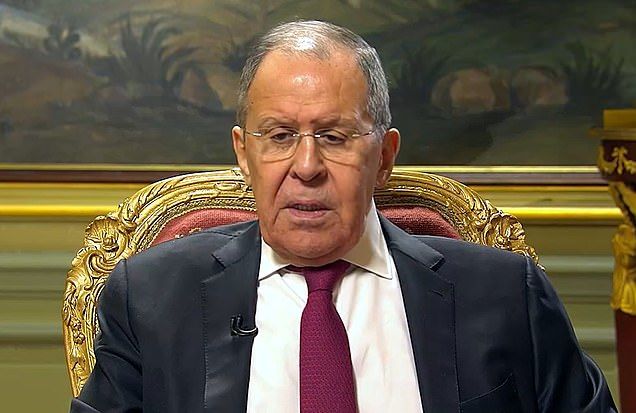 Sergei Lavrov, Russia's foreign minister, has
warned that NATO is now fighting a proxy-war against Moscow and there is
a 'very significant' risk the conflict will turn nuclear
Sergei Lavrov, Russia's foreign minister, has
warned that NATO is now fighting a proxy-war against Moscow and there is
a 'very significant' risk the conflict will turn nuclear
Hungary, whose president Viktor Orban has warm ties with Putin, is already thought to have found a work-around to the demand.
The Russian move is forcing governments across Europe to speed up a switch to alternative supplies. Western officials say that this represents a major strategic failure for Moscow.
One UK official said: 'This will be one of the major strategic developments from this campaign and it will be a failure for Russia because it will reduce its income and also compromise its offensive capability.
'This is one of the costs we are inflicting on Russia. Long-term sanctions will have the same effect. The Prime Minister has said Russia must be seen to have failed.'
Britain's Deputy Prime Minister Dominic Raab slammed Russia's decision, saying it will add to its status as an 'economic and political pariah'.
President of the European Commission Ursula von der Leyen said Russia's attempts at 'blackmail' were doomed to fail. She called it 'unjustified and unacceptable' and said it pointed to Russia being an unreliable gas supplier.
The EU was prepared for this scenario and contingency plans are in place to get gas from alternative sources and maintain maximum gas storage levels. Poland and Bulgaria are already receiving gas via their EU neighbours, including Greece.
Polish prime minister Mateusz Morawiecki was applauded by MPs in parliament when he said the 'blackmail' would have no effect.
Bulgarian prime minister Kiril Petkov said that it was a 'gross violation'. And despite Bulgaria taking nearly 80 per cent of its gas from Russia, he added: 'We won't give in to such racketeering.'
While there was a 20 per cent price hike in European wholesale gas prices in early trading, much of this fell away later in the day.
But despite many countries in Europe rallying together, four major gas trading companies have bowed to pressure to pay for Russian supplies in roubles through back channels, a report by Bloomberg claimed yesterday.
The names of the buyers and countries have not been revealed. However Slovakia, which is heavily reliant on Russian gas, previously suggested it may be forced to comply with demands.