

Roman’s empire: the rise and fall of Abramovich’s reign at Chelsea
So, for Roman Abramovich, after 19 years of being garlanded in Britain for the glittering success his money bought for Chelsea football club, the game is finally up.
A whole era in which the government, Premier League and crowds of London professionals were untroubled by the well-documented way the Russian oligarch had amassed his fortunes crashed when Vladimir Putin invaded Ukraine.
Now, with the immediate threat of sanctions, and speeches made in parliament linking him to corruption and Putin, he has put Chelsea up for sale. Just three weeks ago Chelsea won the Club World Cup in Abu Dhabi, and Abramovich went on to the pitch to lay hands on the trophy.
The universally familiar sight of his winning smile being broadcast around the world was abruptly switched for a different image when the Labour MP Chris Bryant got up in the Commons last Thursday.
Bryant called for sanctions on Abramovich and quoted a Home Office document written in 2019, after the novichok poisoning in Salisbury of the former Russian spy Sergei Skripal.
“As part of HMG’s [Her Majesty’s government’s] Russia strategy aimed at targeting illicit finance and malign activity, Abramovich remains of interest to HMG due to his links to the Russian state and his public association with corrupt activity and practices,” the document read. “An example of this is Abramovich admitting in court proceedings that he paid for political influence.”
Chelsea sources maintained the position that Abramovich was not involved in politics and had done nothing to merit being sanctioned, but within a week he was looking for an exit and selling the club.
 Abramovich admitted this week he was selling Chelsea FC, 19 years after the high-profile purchase.
Bryant’s statement in parliament should not have come as any kind of revelation. The challenge to the British establishment posed by the upending of Abramovich’s reputation is not why it took so long for these issues to be known, because they have been known for years.
Bryant confirmed to the Guardian that the case referred to in that Home Office document was the landmark high court claim Abramovich successfully defended in 2012, brought by his erstwhile oligarch mentor Boris Berezovsky.
The trial took place in public in the heart of London, with some of the English legal system’s most prestigious people involved. Abramovich was represented by Jonathan Sumption QC, who was afterwards appointed a supreme court judge.
The judgment in the case, delivered by Mrs Justice Gloster, setout in detail how Abramovich’s fortune had been forged in the “wild east” of post-communist Russia.
The document Bryant read out in parliament did not expose unknown facts; it only revealed that somebody in the Home Office had actually read the judgment and, seven years later in 2019, had given the case some attention.
Berezovsky’s claim was that he and Abramovich had a partnership agreement to share the enormous fortunes generated by the formation of the Russian oil company Sibneft, and the cut-price, mostly rigged auctions that delivered it to Abramovich’s ownership.
Abramovich’s defence, led by Sumption, was that there was no formal agreement and that Abramovich had paid Berezovsky approximately $2bn (£1.49bn) for political protection and influence, principally with Russia’s then president Boris Yeltsin.
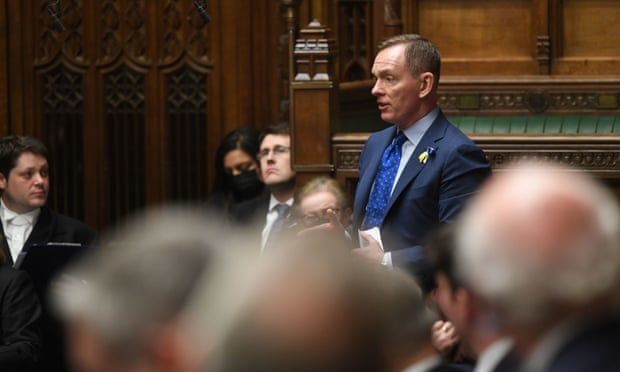 The Labour MP Chris Bryant, who called for sanctions against Abramovich in the House of Commons.
The details that emerged in the hearings were a shocking reminder of how Russia’s industries, all state-owned under communism, appear to have been transferred to a handful of individuals, who became oligarchs while most of the population was impoverished.
The judgment, and both Abramovich and Berezovsky in their own evidence, were clear that Yeltsin created Sibneft by decree after Berezovsky promised he would use income from the resulting oil giant to fund a TV company that would give Yeltsin favourable coverage.
Gloster, ultimately finding in favour of Abramovich on the basis that there was no formal agreement with Berezovksy and he had been paying for political influence, noted that Russia in the 1990s was “not governed by the rule of law”. Ambitious people needed “krysha,” a Russian word that originally meant paying violent criminals for physical protection, and was extended to protection provided by politicians and bureaucrats.
“It was Mr Abramovich’s case that the relationship between Mr Berezovsky and himself was founded principally on political krysha, or protection,” the judgment stated. “He claimed that the relationship with Mr Berezovsky included … an element of physical, as well as political, protection.”
The physical protection was provided by Berezovsky’s associate, a “hard man” from Georgia, Badri Patarkatsishvili. In a crucial passage, Gloster then noted:
It was also Mr Abramovich’s case that the lobbying activities of Mr Berezovsky, as a protector providing political krysha for Mr Abramovich, were inherently corrupt; and that, likewise, the deal between the two men, whereby Mr Abramovich agreed to pay Mr Berezovsky for his krysha services, was also corrupt. Mr Sumption accepted that Mr Abramovich was privy to that corruption but submitted that the reality was that that was how business was done in Russia in those times.
The narrative runs into the arrival of Putin, who is famously reported to have warned the oligarchs against encroaching on his power. Berezovsky misjudged the seriousness of this shift, his TV station did criticise Putin, and, in fear of his life, he fled Russia for Britain.
Abramovich made no such missteps. “Mr Abramovich enjoyed very good relations with President Putin and others in power at the Kremlin,” the judgment recorded. “It was also clear that Mr Abramovich had privileged access to President Putin, in the sense that he could arrange meetings and discuss matters with him.”
This ruling in his favour saved Abramovich approximately $5bn claimed by Berezovsky, but in the decade since his representatives have sought to play down the elements cited by Bryant’s Home Office document. They have said Gloster’s note about Abramovich’s case was due to Sumption’s opening speech having perhaps been mistakenly recorded, and that Abramovich did not in fact acknowledge that the means by which he acquired Sibneft were corrupt.
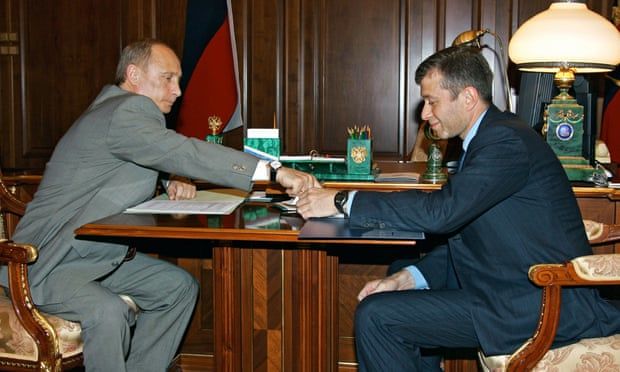 Vladimir Putin and Roman Abramovich during a meeting in the Kremlin in May 2005.
On Putin, they downplay the extent of the relationship, pointing to observations such as this in the judgment: “Mr Abramovich himself accepted that he was regarded by Mr Berezovsky and Mr Patarkatsishvili as ‘close to people in power in Moscow’. But, as [the senior Kremlin administrator Aleksandr] Voloshin explained, at the time, he was not a member of President Putin’s ‘inner circle’.”
Thomas Tuchel, Chelsea’s manager, lost patience with the persistent questions this week and said he did not know enough about the club’s owner to answer them. Nor, clearly, did many people who have played and worked for Chelsea, and supported Abramovich, through nearly 20 years of celebrated ownership.
But all of them could and arguably should have known, because the information is public and has been there throughout. Before the court case, even in 2003 when Abramovich bought Chelsea, there were already books on Russia’s post-communist tragedy. The Sibneft auction was covered in Sale of the Century, by the then FT journalist, now Canada’s finance minister, Chrystia Freeland. Yet as the money rolled in and football’s allure cast its magical spell, too few people seemed to care.
Until Putin attacked Ukraine, that is, and reality finally bit.