Budapest Post

Cum Deo pro Patria et Libertate
Budapest, Europe and world news

NATO treads fine line on Ukraine membership

NATO treads fine line on Ukraine membership

Even some of Kyiv’s closest partners in the alliance are hesitant.

An awkward dynamic was on full display as NATO foreign ministers met with their Ukrainian counterpart on Tuesday.

Arriving at NATO headquarters in Brussels on the day Finland formally became a member of the alliance, Ukrainian Foreign Minister Dmytro Kuleba offered congratulations and declared that “Ukraine is aiming at reaching the same goal, becoming a full member of NATO.”

“It will be one of the topics of our conversations here in Brussels, of how can we move forward,” he said.

Despite vast amounts of Western military assistance to Ukraine amid the war with Russia, NATO’s direct support has been limited to nonlethal aid. And while Kyiv formally requested “accelerated accession” to join NATO in September last year, the alliance is divided on how to tackle that demand.

As Finland’s flag was raised in front of its HQ, across the street a group of pro-Ukrainian protesters chanted: “Ukraine in NATO!”

And while Kuleba was more diplomatic, he conveyed a similar message.

“While we appreciate the practical support we receive from the alliance,” the Ukrainian foreign minister said, “there is no better strategic solution to ensuring strategic security in the Euro-Atlantic region than the membership of Ukraine in the alliance.”

The delicate issue has fueled debate. While there is consensus within the alliance that Ukraine cannot join NATO immediately, the discussion is ongoing over which political signals and concrete steps the alliance could offer Kyiv in the meantime.

“There are those who would say: Maybe nothing can happen because we need to concentrate just on the fight itself,” said Lithuanian Foreign Minister Gabrielius Landsbergis, referring to the grinding artillery battles playing out largely along Ukraine’s eastern front.

“But I think that Ukrainian people deserve to hear what we think,” he told POLITICO in an interview at NATO headquarters. “And we have to have an answer for them.”


Assistance instead of membership


Ukraine’s NATO aspirations are among the thorniest issues facing NATO allies.

On Tuesday, ministers formally convened in a NATO-Ukraine Commission format — a symbolic move acknowledging Kyiv’s aspirations for a closer relationship. Hungary, which has long blocked the body from meeting, grudgingly attended the session but vowed to continue opposing Ukrainian integration.
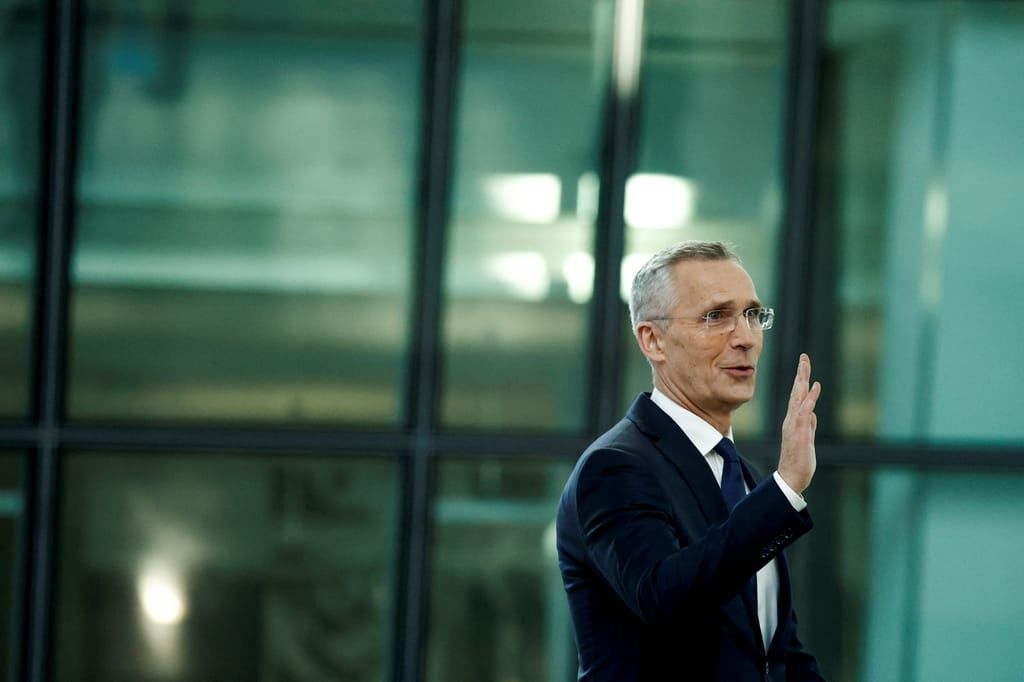
NATO Secretary-General Jens Stoltenberg has advocated for greater NATO support to Ukraine


NATO pledged in 2008 that Ukraine would eventually join the alliance, but the process stalled. Fast forward to 2022, when Russia infamously launched a full-scale invasion of Ukraine.

In the current situation, numerous Western capitals argue that the priority now is helping Ukraine win the war — and that discussion of NATO’s political relationship with Kyiv should wait.

A senior U.S. official, who spoke on condition of anonymity in order to discuss internal alliance dynamics, said that America stands by the alliance’s 2008 decision: “But the focus at this point has to be on practical support, and how do we best sustain the security assistance.”

Any broader post-conflict political relationship between NATO and Ukraine “is somewhat moot if we don’t absolutely guarantee that we’re able to sustain the security assistance,” the official added.

But some allies — particularly along NATO’s eastern flank — say the alliance needs to give Ukraine a credible gesture on moving closer now.

NATO Secretary-General Jens Stoltenberg has been advocating for boosting the alliance’s longer-term investment in Ukraine — supporting reforms in the defense sector and helping the country’s military transition to Western standards — while avoiding a concrete path or membership timeline for the time being.

Speaking after the ministers’ session with Kuleba, the NATO chief told reporters that allies have stepped up their contributions to NATO’s nonlethal fund for Ukraine.

“Building on this, we will develop a multi-year support initiative for Ukraine, to help ensure Ukraine’s deterrence and defense, make the transition from Soviet-era equipment and doctrines to NATO standards, and increase interoperability with NATO,” he said.

But Lithuania’s Landsbergis said that only expanding NATO’s nonlethal aid to Ukraine is “not sufficient.”

“We need to show to Ukraine that their application is being taken seriously and they are making steps towards NATO, which at the end will end up with their full membership,” he said.

“I don’t,” Landsbergis added, “see the future where Ukraine is not part of NATO.”

The senior U.S. official acknowledged that there is a “spectrum of opinion” within the alliance on the issue — with some advocating “to give Ukraine a specific date,” while others want to “evaluate as the situation evolves.”

But, the official said, “I would always want it to be clear that it’s within the construct of the framework of all allies having incredible levels of support for Ukraine.”

AI Disclaimer: An advanced artificial intelligence (AI) system generated the content of this page on its own. This innovative technology conducts extensive research from a variety of reliable sources, performs rigorous fact-checking and verification, cleans up and balances biased or manipulated content, and presents a minimal factual summary that is just enough yet essential for you to function as an informed and educated citizen. Please keep in mind, however, that this system is an evolving technology, and as a result, the article may contain accidental inaccuracies or errors. We urge you to help us improve our site by reporting any inaccuracies you find using the "Contact Us" link at the bottom of this page. Your helpful feedback helps us improve our system and deliver more precise content. When you find an article of interest here, please look for the full and extensive coverage of this topic in traditional news sources, as they are written by professional journalists that we try to support, not replace. We appreciate your understanding and assistance.
Newsletter

Related Articles

0:00
0:00
Close
US and Iran Exchange Direct Military Strikes Amid Fragile Gulf Ceasefire
World Health Organization Warns of Catastrophic Ebola Outbreak in DR Congo
Russia Threatens New Wave of Strikes on Ukrainian Infrastructure and Embassies
Scientists Warn Atlantic Ocean Currents Could Collapse Faster Than Projected
Anthropic Reaches $900 Billion Valuation in Historic AI Funding Round
Washington Imposes Crippling Sanctions on Iranian Maritime Authority
Japan and the Philippines Initiate Strategic Intelligence-Sharing Pact
Microsoft Deploys Autonomous Computer-Using AI Agents to Global Markets
Anthropic Secures $45 Billion Compute Infrastructure Agreement With SpaceX
U.S. Director of National Intelligence Resigns Amid Administration Shakeup
Micron Technology Crosses Trillion-Dollar Valuation Amid Unprecedented Hardware Demand
Canada and Germany Finalize Historic Long-Term LNG Export Agreement
China Expands International Travel Restrictions on Domestic AI Researchers
Japan Approves Sweeping Overhaul of National Intelligence Apparatus
Global Airlines Scramble Logistics as Middle East Airspace Remains Fractured
Japan's Naphtha Imports Plunge 47 Percent Amid Strait of Hormuz Closure
Global Crude Prices Retreat Below $96 as Gulf Tensions Momentarily Ease
Generative AI Outperforms Human Baselines in Landmark Global Creativity Study
NASA Partners With Private Aerospace to Unveil Permanent Lunar Base Architecture
South Korean Equity Markets Surge on Next-Generation Memory Chip Frenzy
U.S. Treasury Yields Slip as Energy-Driven Inflation Anxiety Cools
Extreme Spring Heatwave Blankets Europe Raising Summer Climate Alarms
European Union Faces Widespread Local Backlash Over Mega Data Centers
Washington Prepares Cuba Contingency Plans Amid Escalating Havana Pressure
U.S. Maintains Strategic Trade Tariffs Despite Advancing International Pacts
Canada Defies U.S. Defense Contractors With Swedish Arctic Surveillance Fleet Purchase
Wall Street Hovers Near Record Highs as Retail Sector Defies Inflation Constraints
Caesars Entertainment Agrees to $17.6 Billion Acquisition by Fertitta
White House Accelerates Infrastructure Security Following Violent Incidents
Prediction Market Legal Battles Escalate as Kalshi Sues Minnesota
World Health Organization Issues High Alert on Mutating Avian Influenza
EU Digital ID Claims Misstate What Brussels Can Legally Force on Member States
The Great Western Exit: Why Best Citizens Are Fleeing the Rich World [PODCAST]
The New Robber Barons of Intelligence: Are AI Bosses More Powerful Than Rockefeller?
The End of the Old Order [Podcast]
The AI Gold Rush Is Coming for America’s Last Open Spaces [Podcast]
The Pentagon’s AI Squeeze: Eight Tech Giants Get In, Anthropic Gets Shut Out [Podcast]
AI Isn’t Stealing Your Job. It’s Dismantling It Piece by Piece.
Lawyers vs Engineers: Why China Builds While America Litigates [Podcast]
Kennedy’s Quiet War on Antidepressants Sparks Alarm Across America’s Medical Establishment
French Police Probe Suspected Weather-Data Tampering After Unusual Polymarket Bets on Paris Temperatures
CATL Unveils Revolutionary EV Battery Tech: 1000 km Range and 7-Minute Charging Ahead of Beijing Auto Show
Changi Airport: How Singapore Engineered the World’s Most Efficient Travel Experience
Power Dynamics: Apple’s Leadership Shakeup, Geopolitical Risks in the Strait of Hormuz, and Europe's Energy Strategy Amidst Global Challenges
Apple's Leadership Transition: Can New CEO John Ternus Navigate AI Challenges and Geopolitical Pressures?
Italy’s €100K Tax Gambit: Europe’s Soft Power Tax Haven
Budapest latest News Roundup
Travel on all public transport in the Australian state of Victoria will be free in May and then half price for the remainder of this year as the government ramps up help for consumers battling high fuel costs
News Roundup
Microsoft lost 2.5 millions users (French government) to Linux
×