Kazakhstan unrest: 'If you protest again, we'll kill you'
Asel, who had been shot in the violence and was being treated in the hospital in Kazakhstan's biggest city Almaty, recalled the chilling encounter.
"One of them shouted, 'if you go out to protest again, we will kill you'."
She believes the men with guns were from the special police forces or security services and were rounding up anyone who had taken part in anti-government protests.
They tried to take Asel with them but she was too badly wounded to walk. Her name has been changed to protect her identity.
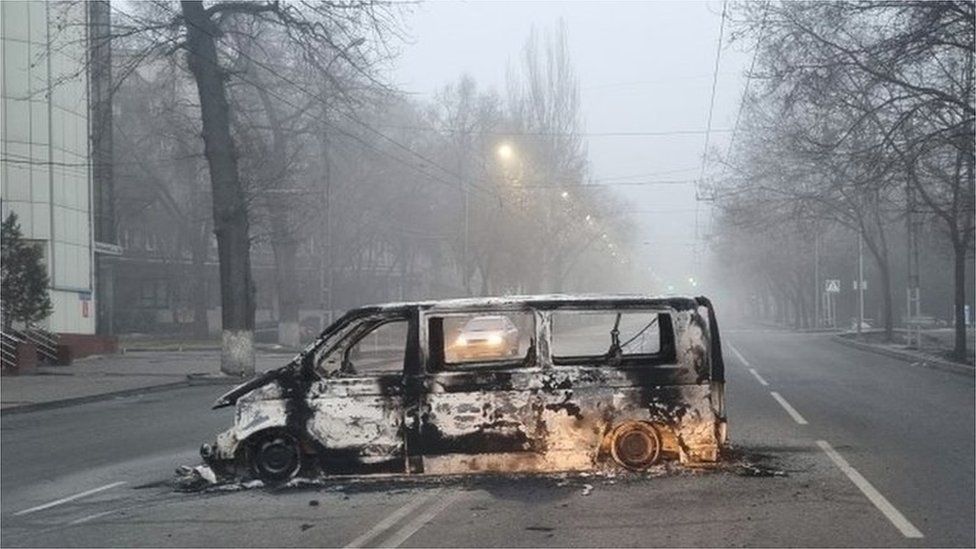 Violence and looting on this scale had not been seen before in Kazakhstan
Like many others, she joined what started as peaceful protests against fuel price rises in early January. Kazakhstan has some of the world's largest oil reserves but most of the population doesn't share in the wealth.
The demonstrations quickly spiralled into mass disturbances and looting that led to the worst bloodshed in the former Soviet state's 30 years of independence.
The authorities are accused of using excessive force to restore order. Officially, 225 people were killed and many more were injured. Some 10,000 people have been detained in the wake of the disturbances, the authorities say.
Like many others, Asel, who is 57, is now worried that she could be arrested and accused of participating in the unrest.
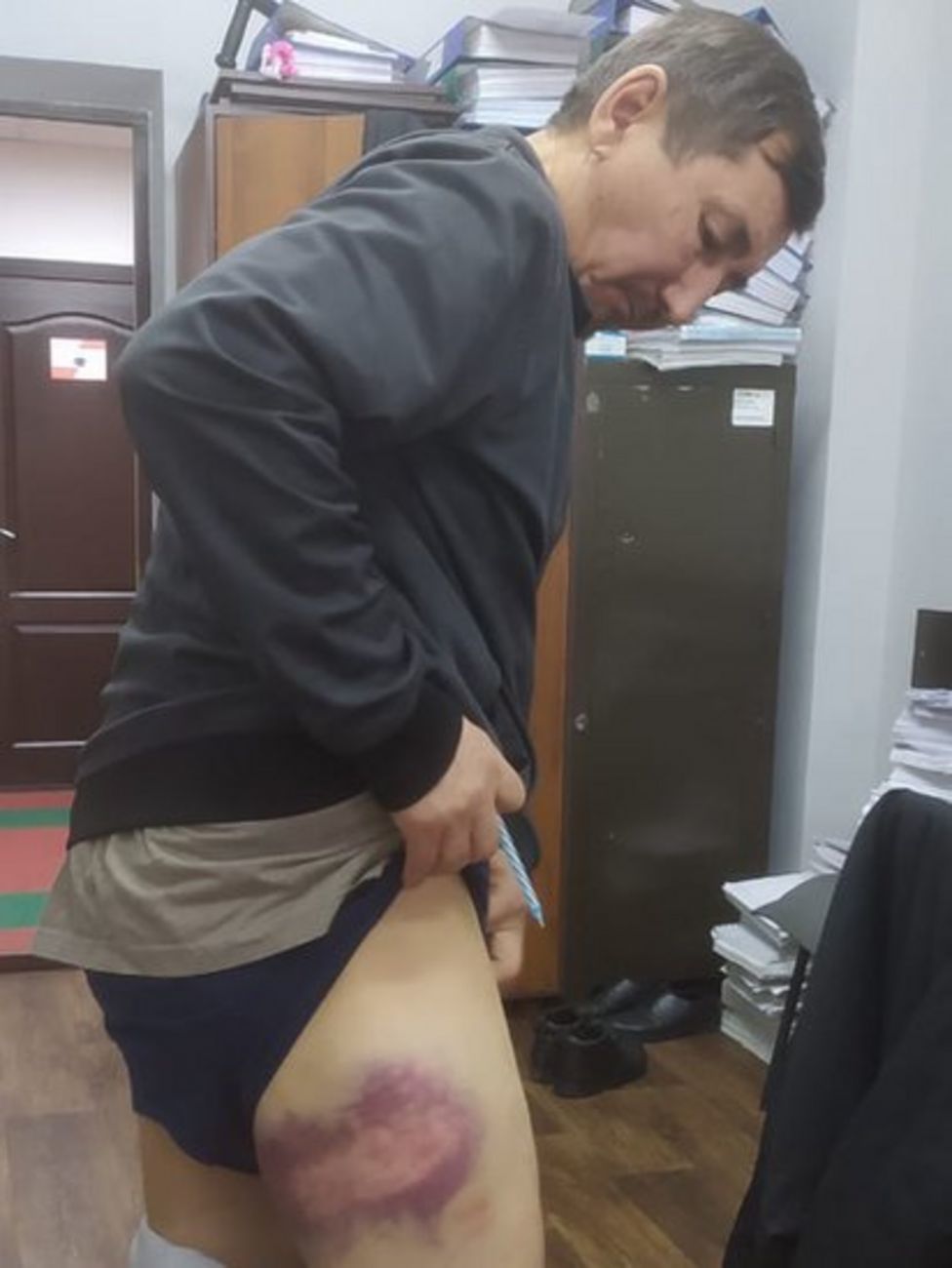 Muratbek Yesengazy's lawyer says he was beaten in detention
Kazakhstan's prosecutor-general's office has opened nearly 700 criminal cases. Some of those accused are charged with terrorism, murder and seeking to overthrow the government.
However, human rights groups say the authorities are cracking down on everyone who took part in the protests, including peaceful demonstrators.
Even those who simply posted on Facebook in support of the protests are being detained. They face beatings and torture, activists say.
"There is no presumption of innocence," said Bakhytzhan Toregozhina, a human rights activist in Almaty. "They are all potential terrorists for the authorities and they try to force confessions out of them."
One activist Muratbek Yesengazy who took part in the protest on Almaty's main square is accused of participating in the violence. His lawyer told the BBC that he had been beaten in detention - photos show his leg covered in bruises.
The authorities flatly deny any detainees have been beaten or tortured.
Those who didn't participate in the violence "should not worry", Saltanat Azirbek of the Almaty Police Department told the BBC, adding they would be released once the facts had been established.
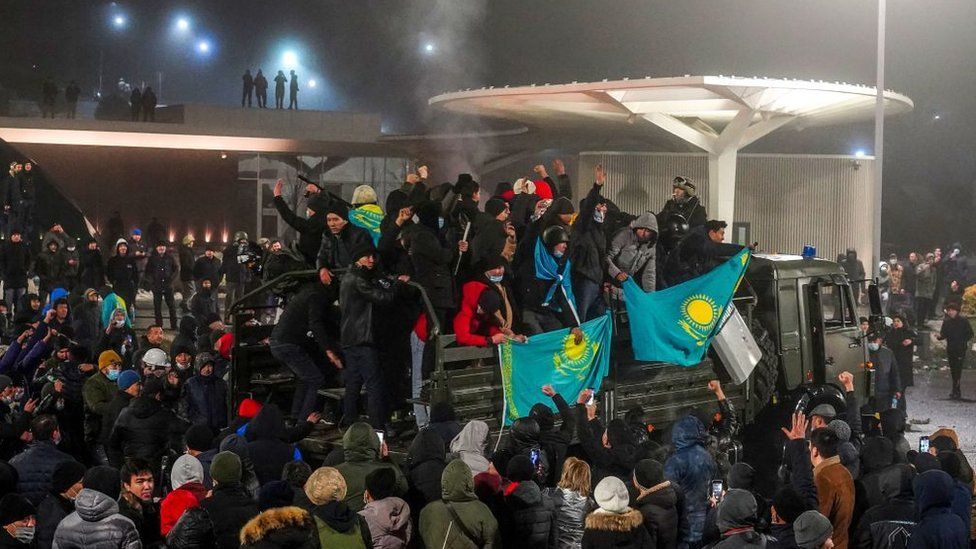 The protests began as peaceful demonstrations against fuel price rises
It is still not clear how peaceful protests turned so violent. Initially, the mood of the crowd was festive when people rallied on 4 January. They sang the anthem of Kazakhstan and chanted political demands.
"The crowd was very diverse," recalls Timur Nusimbekov, a local journalist who watched events unfold in Almaty. "There were people from the suburbs, people from the city centre. There were hipsters and young working people."
The atmosphere started to change when the authorities threw stun grenades and fired tear gas to disperse the crowd, leading to clashes between police and protesters.
The next day, on 5 January, tensions grew. Some people on the square in Almaty were armed with knives and hunting rifles, says Mr Nusimbekov.
It's still not clear who these people were.
Ms Azirbek of the Almaty police said "well trained men versed in combat tactics" attacked police with the aim of seizing their weapons.
Protesters who were there blame unidentified provocateurs. "We protested peacefully," one activist, Konay Abdiyev, told the BBC.
"But then a group of young men arrived and ran straight towards the city hall. We couldn't stop them. They destroyed cars and smashed windows.
"They were wearing masks that hid their faces. We were afraid even to look into their eyes out of fear that they would assault us."
'They shot at peaceful protesters'
Events soon spiralled out of control. Some in the crowd seized the city hall and set it on fire. The sounds of gunfire and stun grenades rocked the square.
One of those hit by the bullets was Asel.
"I could feel blood gushing from my leg. I had a blackout and then regained consciousness when two men were dragging me, covering me with their shields. They shouted to lay low as bullets whizzed by."
She was put into a truck and driven to hospital. "I remember there were a lot of people inside the truck. I moaned from pain. Several people were on top of my wounded leg. Some of them were not breathing."
Those who remained on the square on 6 January tried to hold a peaceful rally, among them many elderly men and women who were seeking an end to the shooting.
Protesters held a banner saying: "We are not terrorists, we are peaceful people."
But that evening soldiers arrived in armoured vehicles and blocked the square from both sides.
"We were near the independence monument," recalls Saltanat Khamzina, another protester. "People carried the flag of Kazakhstan. They lined up and waved with their hands [to show they were unarmed]."
At around 7pm, the military opened fire.
"It sounded as if they were firing into the air but people behind us were dropping dead. Not those in the front row - they were not hit. So probably there were snipers who shot under the noise of gunfire," said Saltanat.
Another protester, Meirkhan Abdumanapov, took cover near the independence monument where he saw a man of about 50 who had been hurt.
"He was moaning and couldn't move. Two young girls of about 17 or 18, and another young man, were lying on top of each other. They showed no signs of life.
"I was so furious that I promised myself I would tell everyone that they shot at peaceful protesters."
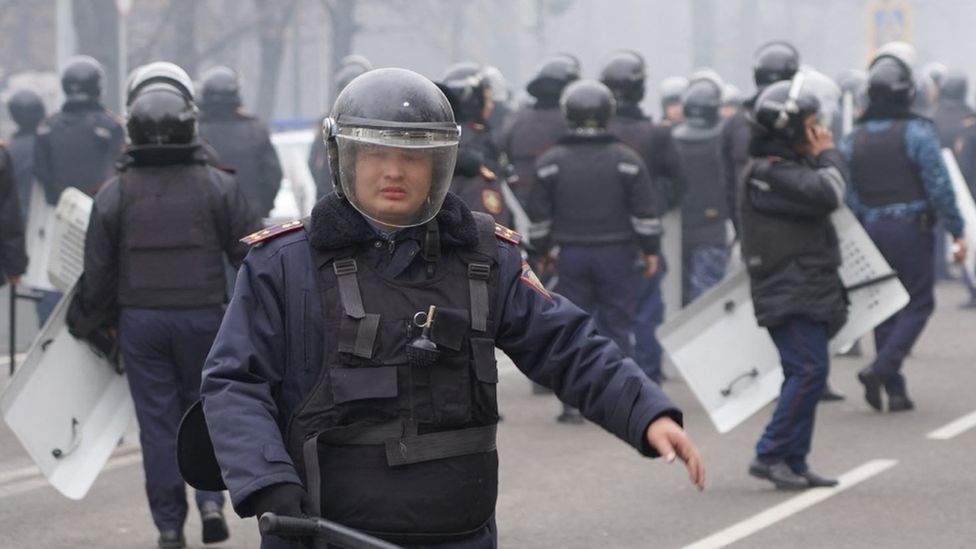 The authorities are accused of using excessive force to restore order
Ms Azirbek of Almaty police insisted the security forces used lethal force only in self-defence.
The Kazakh government, meanwhile, has blamed the violence on "terrorists" with international links, for which it has provided no evidence. There have also been reports of an internal power struggle linked to the former President Nursultan Nazarbayev.
Whatever caused the bloodshed, local journalist Timur Nusimbekov warns that "peaceful protesters, activists and journalists must not be confused with looters and bandits".
The authorities, he says, are trying to cover up "massive mistakes they made and which led to the worst humanitarian catastrophe in the history of Kazakhstan".
Kazakhstan: The basics
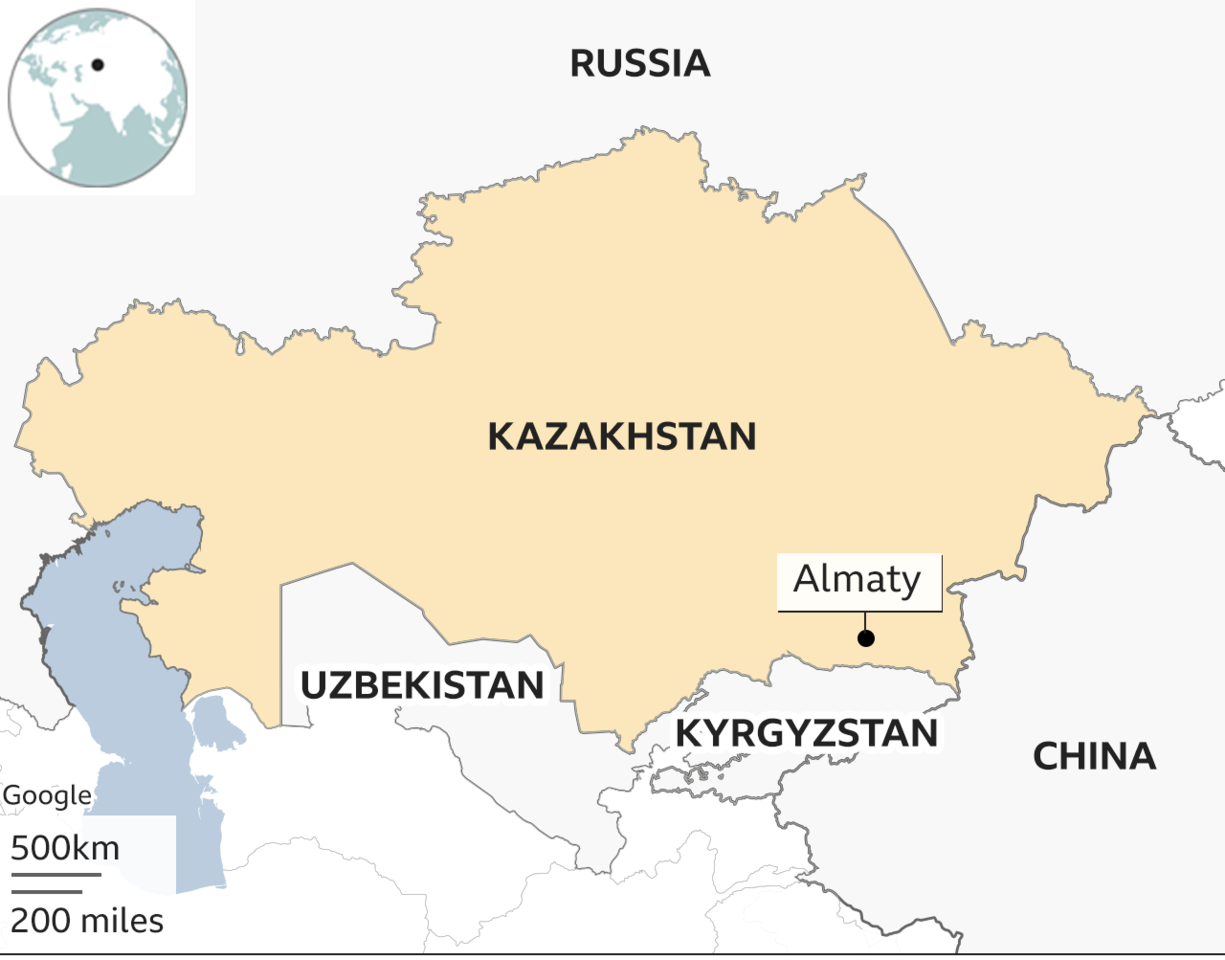
Where is it? Kazakhstan shares borders with Russia to the north and China to the east. It is a huge country the size of Western Europe.
Why does it matter? A former Soviet republic which is mainly Muslim with a large Russian minority, it has vast mineral resources, with 3% of global oil reserves and important coal and gas sectors.
Why is it making the news? Fuel riots, which have escalated to become broader protests against the government, have resulted in resignations at the top and a bloody crackdown on protesters.