

France thrown into limbo after humiliating setback for Macron
A very strange French parliamentary election has ended in humiliation for President Emmanuel Macron and it may well turn into a slow-motion calamity for France.
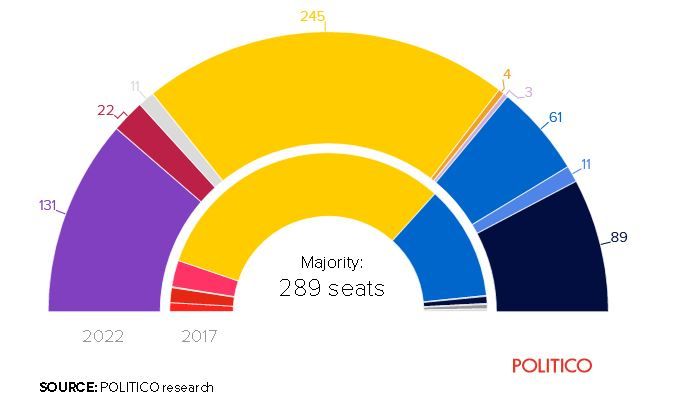
Macron’s centrist alliance Ensemble is marooned 44 seats short of a working majority in the National Assembly after the second round of the parliamentary election on Sunday. The results mark the first time since the present French governing system began 64 years ago that a recently elected president is this far short of an outright majority.
President François Mitterrand and three prime ministers managed to govern for five years without a majority in 1988-93 but they were only 14 seats short. The rules then allowed a government to steamroller legislation through parliament without a line-by-line vote. Those rules have since been tightened considerably.
The center-right Les Républicains (LR) have enough seats (64) to give Macron a majority when the new assembly is asked to vote on its confidence in the government — on, or soon after, July 5. The weakened LR is, however, very unlikely to enter any kind of permanent coalition with a newly elected but already unpopular president.
Such a close association with Macron would, they fear, destroy the party’s chance of rebuilding a strong, conservative identity and running successfully for the presidency in 2027. The party is, in any case, poisonously divided between moderate, Macron-compatible and hard-line, Macron-detesting wings.
FRENCH ELECTION RESULTS
In June 2022, voters elect the 577 members of the National Assembly following the two-round election of Emmanuel Macron. The French president is set to face a potentially tumultuous five years of deadlock after his centrist alliance fell short of an absolute majority.
To avoid an immediate crisis, the LR deputies may agree at least to abstain and allow the confidence motion to pass early next month.
Beyond that, how France will be governed, and by whom, for the next five years is anyone’s guess. Sources close to Macron suggested to the French media that he may be tempted to call another election. On one reading of the French constitution, he must wait 12 months. Another interpretation suggests he could do so whenever he chooses.
An already perilous situation for the president is complicated by the fact that he lost two of his most experienced parliamentary operators Sunday. Both the outgoing National Assembly President (speaker) Richard Ferrand and Macron’s Renaissance party parliamentary leader, Christopher Castaner, lost their seats.
The crushing blow of these losses comes against the background of a war on the European continent and a gathering threat of global recession. One of the curiosities of this parliamentary election was that the dark context — the Ukraine war and worldwide economic slowdown — were scarcely mentioned.
It was like watching a family paddle a canoe toward a giant waterfall while arguing about whether they should paddle to the left or to the right or a little of both. That canoe has now collided with the bank. And the giant waterfall isn’t far away.
Macron carries much of the blame for the electoral failure of his alliance. He, and they, conducted a non-campaign, apparently hoping to preserve the momentum from Macron’s election victory in April by doing as little as possible, a miscalculation for which they paid dearly at the voting booth this weekend. They sent some of their own voters to sleep — but not the virulently anti-Macron voters of hard left and extreme right.
Macron came to power five years ago promising to dissolve the political extremes in France. He now confronts a National Assembly in which the opposition benches will be occupied, inter alia, by 73 members of the anti-NATO, anti-EU, anti-capitalist France Unbowed and 89 members of Marine Le Pen’s National Rally. That is the biggest foothold of the far-right in national government in France since the fall of the Vichy regime in 1944.
Several options are now open to Macron — none of them very promising. His people are confident that around 20 to 30 of the new LR deputies would be ready to join a formal coalition or, at least, support the government on key business and legislation. Unfortunately, 20 to 30 extra votes are not enough.
Some voices in the LR, such as former President Nicolas Sarkozy and the former party leader Jean-François Copé are calling for a permanent governing “pact” with Macron. The present LR leader, Christian Jacob, says that his party will “remain in opposition” but hints that they may be prepared to support Macron from time to time.
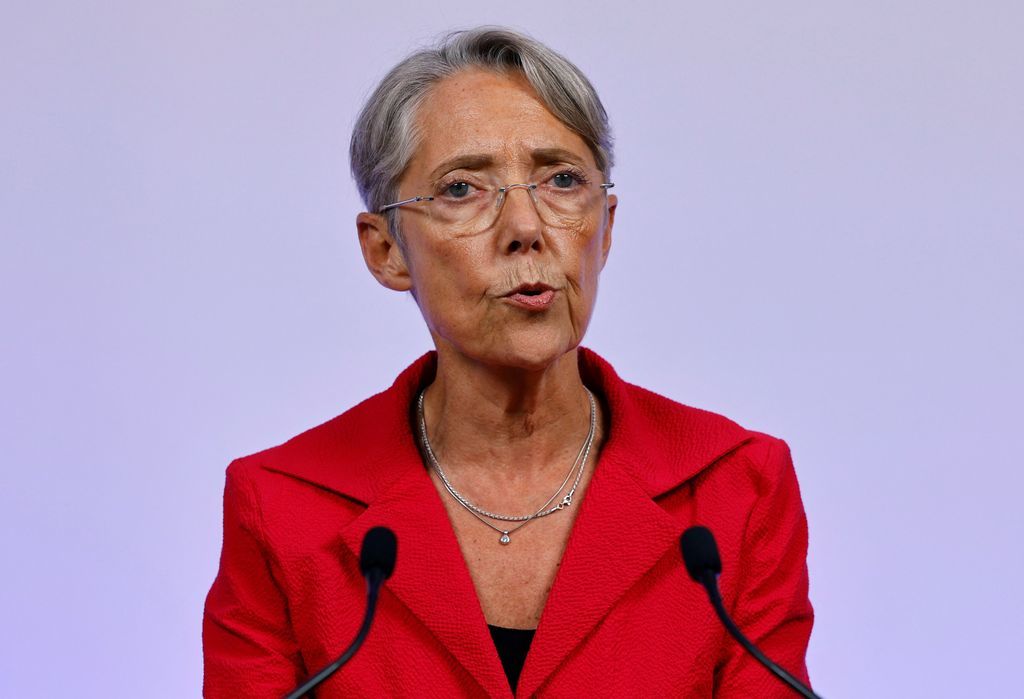 Emmanuel Macron and his Prime Minister Elisabeth Borne could also stumble on until an early election sometime next year
Jacob is, however, about to stand down as LR leader. He could well be replaced by someone from the hard-line, anti-Macron wing, such as the president of the Auvergne-Rhône-Alpes region, Laurent Wauquiez.
Another option for Macron would be what Mitterrand’s prime minister in 1988-92, Michel Rocard, called a “stereo majority” — attracting votes on different issues from different blocs in the Assembly. Would some of the more moderate left-wing deputies back Macron on some issues? Maybe, but it would be a ramshackle and fragile arrangement.
Alternatively, Macron and his Prime Minister Elisabeth Borne could stumble on until an early election sometime next year. There would be no certainty that would produce a better result but Macron might be tempted, all the same. Without a fresh popular mandate, Macron’s hopes of a reform-driven and successful second and final term are dead. To be a lame duck at 44 years old is not an attractive prospect.
Even if he does attract ad hoc votes in the Assembly for, say, pension reform, he will face even more ferocious than usual opposition on the street.
Macron’s best hope, paradoxically, might be a steep decline in the global economy which would allow him to call a crisis election early next year. By then, perhaps, the French electorate and political classes may have heard the sound of the waterfall.